Showing posts with label Australia. Show all posts

Friday, August 1, 2025

Pushing governments beyond words to real action to end Israel's crimes against Palestinians

Photo by Afitab:


Lisbeth Latham

On July 21 Senator Penny Wong, issued a joint statement with 27 other foreign ministers, which stated that “the suffering of civilians in Gaza has reached new depths. The Israeli government's aid delivery model is dangerous, fuels instability and deprives Gazans of human dignity.” This release has been followed by a series of statements by ALP ministers condemning the current actions of the State of Israel in Gaza. Given the extent to which these states have defended and facilitated the crimes of the State of Israel 20 October 2023, these statements have been met with significant public cynicism and anger. While this response is understandable, it misses the political moment that the joint statement represents, a moment where it may be possible to force action to end the crimes currently being committed against Palestinians in Gaza. To understand this moment, we must know why it has occurred, which has to do with shifts in international politics combined with broad popular opinion, rather than the pressure from the Palestinian solidarity movement.

The July 21 Statement is a response to two developments. The most important is the shift in global popular opinion against the State of Israel. This shift has been demonstrated repeatedly in opinion polls around the world, and is a core driver, along with the indefensible character of the IDF's actions in Gaza, of the increasingly desperate efforts to equate any criticism, or honest reporting, of the State of Israel’s actions as antisemitism. 

Adding to this pressure is that the Hague Group of countries, which was formed in January 2025, is calling for more concrete international action in solidarity with Palestine. Most notably, the Emergency Conference of States in Columbia in mid-July. This meeting, which 30 governments attended, resulted in a July 16 statement calling for states to:
  • Prevent the provision or transfer of arms, munitions, military fuel, related military equipment, and dual-use items to Israel;
  • Prevent the transit, docking, and servicing of vessels at any port in all cases where there is a clear risk of the vessel being used to carry arms, munitions, military fuel, related military equipment, and dual-use items to Israel;
  • Prevent the carriage of arms, munitions, military fuel, related military equipment, and dual-use items to Israel on vessels bearing our flag and ensure full accountability, including de-flagging, for non-compliance with this prohibition;
  • Commence an urgent review of all public contracts, to prevent public institutions and funds from supporting Israel’s illegal occupation of the Palestinian Territory and entrenching its unlawful presence;
  • Comply with obligations to ensure accountability for the most serious crimes under international law, through robust, impartial and independent investigations and prosecutions at national or international levels, to ensure justice for all victims and the prevention of future crimes;
  • Support universal jurisdiction mandates, as and where applicable in national legal frameworks and judiciaries, to ensure justice for victims of international crimes committed in the Occupied Palestinian Territory.
With 12 nations, Bolivia, Colombia, Cuba, Indonesia, Iraq, Libya, Malaysia, Namibia, Nicaragua, Oman, Saint Vincent and the Grenadines, and South Africa — committed to implementing the six measures immediately through their domestic legal and administrative systems to break the ties of complicity with Israel’s campaign of devastation in Palestine — and set a date of 20th September, to coincide with the 80th UN General Assembly, for additional states to join them.

These practical steps have created pressure for states such as Australia to follow suit, and so the purpose of the 21 July statement, which is devoid of commitments to concrete actions, should be seen primarily as a mechanism to distract from and reduce pressure to take concrete steps. As such, our response to the statement in general, or hand wringing statements by ministers that “the situation in Gaza has gone beyond the world’s worst fears.The position of the Australian Government is clear: every innocent life matters. Every Israeli. Every Palestinian”, should not be to complain that the statements weren’t made earlier, that they don’t go far enough, or that they empty words. Instead, we have to demand that those making the statements work to ensure that Israel is no longer able to starve, kill, or collectively punish Palestinians in any way. 

Adopting the actions called for July 16 would be an important start, however, while they bring pressure and will reduce the IDF’s ongoing capacity to terrorise the Palestinian population, they are not sufficient to address the pressing issue of concrete steps for the delivery and distribution of aid. Aid which is needed to halt the mass famine that has been created as a consequence of the Israel’s blocking and restricting of aid. This requires an ending of the limitations on the movement of aid, whether this interference is by the IDF, Israeli settlers, or other armed non-state actors. The last 22-months have definitely demonstrate that this cannot rely on the State of Israel to do the “right-thing”, but must be enforced by an UN-mandated protective force in Gaza. 

Such a force would require a mandate from the UN Security Council. As the US holds a veto on the Security Council that it has repeatedly used to stop or inhibit real action to support the Palestinians. Australia must pressure the US to not veto any action in support of Palestinians.

Action of this type will attract screams of outrage from numerous apologists for the crimes of the State of Israel - aimed at pressuring a return to normal acquiescence to these crimes. As such it is necessary at every step, while pointing out that more action is needed, for the movement to support each step in the right direction towards ending crimes against Palestinians.

This is an important opportunity to end the State of Israel’s genocidal actions in Gaza. If the solidarity movement does not find ways to bring sufficient pressure to bear to achieve this, then we will have failed the Palestinian people in their most desperate hour of need.

------------------------------------------------------------------------------- 


This article is posted under copyleft, verbatim copying and distribution of the entire article is permitted in any medium without royalty provided this notice is preserved. If you reprint this article please email me at revitalisinglabour@gmail.com to let me know.

Read more...

Monday, April 28, 2025

With an ALP victory likely: How can progressive forces fight for change?

Lisbeth Latham

In the wake of Trump’s victory, there was a strong sense that a similar victory for the Liberal/National coalition was in the offing. Over the past months, this fear has dissipated, not primarily due to the strong performance of the Albanese government, but due to the absolute failure of the Dutton-led opposition to posit a vision for a new government other than a cheap knock-off of Trumpism. While this outcome of an outright ALP majority government, or a minority government reliant on support of the Greens, Teals, and other independents, there are lessons that the left needs to learn to build pressure on any future ALP government, to deliver for working people.

The 2022 election of the Albanese government gave hope for change in Australia, particularly after the long years of Coalition government were made worse by the strain of the early years of the COVID-19 pandemic. Many of these hopes were likely misguided. Especially given that it is a social democratic government, but the ALP, along with the French Socialist Party, was one of the first social democratic parties to push and implement neo-liberalism. As such, it is unlikely that the Albanese government was going take the initiative to implement the broad social reforms, that had not been part of its platform, which forces to its left were calling for. Reforms such as raising social security payments or caps on rents. It also meant that it would be limited in its willingness to respond effectively, of its own accord, to the cost-of-living pressures that emerged, as capital took advantage of supply chain issues caused by restrictions of the early pandemic period, and other dislocations in the global economy, to justify massive price-gauging.


Despite this, the government has had a reform agenda, and while this agenda has been uneven, and internally contradictory, it has progressed on some of it. The government has been able to point to greater wage growth, albeit mostly at below inflation levels for much of its term, some of which is the consequence of amendments included in the Fair Work (Better Jobs Better Pay) Amendment Act (2022) and the Closing the Loophole Acts. The coalition has repeatedly promised to repeal these changes, particularly in relation to changes in the definition of casual employment, the right to disconnect, and the same job, same pay provisions that requires that labour hire workers to be paid at the same pay rates as the directly employed workers working on a project. At the tail end of the campaign, the coalition has walked back some of these threats, along with a range of other commitments.   

In other areas, such as the government’s failure to seriously raise opposition to Israel’s genocidal attacks on Palestinians, like the vast majority of Western imperialist governments. Along with its continued support for fossil fuels and erosion of environmental protections, it has alienated many in its own base and those to its left

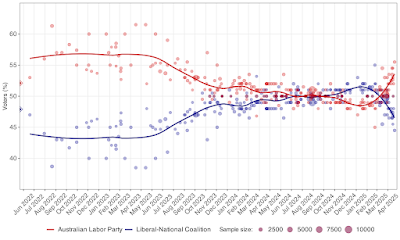
In the wake of Trump’s victory, this alienation led to an assessment within sections of Australian progressive forces that the ALP government was making the same errors Biden and Harris had made in the US. As such, a Dutton victory was inevitable. However, since the election was called, the ALP has built and strengthened a lead in the two-party preferred polls


Source: Wikipedia
While this has come as a shock to some commentators, it reflects a continuation of the problem the coalition faced going into the 2022 election in orienting to far-right discourse, made worse by their promise to bring Trump-style politics to Australia. 

This demonstrates a fundamental misunderstanding of how Australian and US politics differ. 

A key factor is the impact of compulsory voting. In the US, the largest voting block in the November elections, where people who didn’t vote, leaving aside the millions of US citizens who the Republicans have actively sought to prevent from registering to vote. In Australia, abstentionism and informal voting is not nearly that high, at around 15%. This means that in general, although not always, to win, a party needs to build a two-party preferred vote of more than 50% of the electorate. Historically, the coalition parties have done this by having a broad electoral base and then appealing to undecided voters in the centre.   

As I pointed out in 2022, the Liberal Party, following the US Republicans, has sought to energise the party’s right wing. For decades, while that has caused discomfort and alienation within the Liberal party’s voting bloc, within what has been described as the wets or social liberal-fiscally conservative, it rarely caused a split. However, there was a glimpse of a split with Howard losing the “doctors’ wives’” vote in 2007. However, with the emergence of the Teal independents before the 2022 elections, it has opened up a division in the Liberal Party’s historic voting base, with a permission pathway to preferencing the ALP over the Liberals. The Liberals lost six seats to Teal independents. To win government, they not only need to pick up seats from the ALP, but need to rewin those Teal seats. The promise to intensify cultural wars is unlikely to appeal to this constituency, which could also put additional Liberal seats at risk. 

Moreover, Dutton and Liberal strategists have interpreted the results of the Voice referendum as demonstrating an opportunity to use cultural wars to expand the coalition’s electoral support. However, while the outcome clearly demonstrated the ongoing deep vein of racism in the Australian politics, the referendum outcome was a consequence of additional factors in the campaign, such as confusion around what the Voice would mean, the relationship between Voice, Sovereignty, and Treaty, and the simple decision pathway “if you don’t know, vote no”. These are factors that don’t apply in a general election. 

In addition, the promise of gaining electoral support by modelling the coalition’s policies on Trump has proved a significant miscalculation. This miscalculation is not just that Australian society and electoral system are fundamentally different from the US, which will always mean a direct transplant of framing and rhetoric is unlikely to gain the same traction. It also fundamentally misread how Trump’s policies, once unleashed, would play out and be received in the US, globally, and most importantly within Australia. In all of these places they have been deeply upopular, most notably Tariffs that pose a threat to economies, promoting and endorsing Trump, means endorsing those attacks, in Canada, where Trump’s rhetoric also includes discussion of annexation, it has created a clear division of those who will stand up for national interests and those who will grovel at Trump’s feet. While the Albanese government has not been as resolute as the Canadian Liberal Party in opposing Trump, in both countries contrast on the question of Trump has been a key in turning election fortunes. 

Given the ALP’s likely victory, in a context where that victory will be primarily based on a rejection of the coalition and its regressive vision, rather than a sharp reorientation of the Albanese government’s policy position, poses a question of how can progressive forces within Australia, move the ALP towards more progressive positions? Whether on housing, social security, climate action, or a position of pressuring, rather than enabling, Israel’s ongoing genocide in Gaza?

In the wake of the emergence of social media, the answer to that question has often been to post hot-takes about the failures and inadequacies of the ALP, and while they generate likes and reshares in our bubbles, it won’t move the ALP. What has worked, and will always work is the clear articulation of demands that set out how things should be different and how that can be achieved, then seeking to organise and mobilise around those demands-based purely around support for the demands, not on an agreed assessment of the world and its ills, or even assessment of the ALP. This approach is starting to articulate in the US with the increasingly regular nationwide anti-Trump rallies. Building ongoing, escalating actions around clearly defined demands will not only strengthen and build the confidence of the movement, but also it will shake the government's and its supporters' confidence, irrespective of how much they claim the actions are irrelevant, opening up divisions and making a shift in government policy possible. How sharp this shift will be depends entirely on the level of ongoing pressure that the movement can generate and build.

If the unthinkable happens and the coalition wins on May 3, this strategic approach will be even more vital.  

------------------------------------------------------------------------------- 

This article is posted under copyleft, verbatim copying and distribution of the entire article is permitted in any medium without royalty provided this notice is preserved. If you reprint this article please email me at revitalisinglabour@gmail.com to let me know.

Read more...

Wednesday, July 5, 2023

Why Australian unionists should build solidarity with Ukrainian workers and their Unions

Members of the Independent Miners' Union of Ukraine (NGPU) in Novovolynsk district with representatives of the Ukraine Solidarity Campaign who were delivering donations to Ukrainian workers. Source: Ukraine Solidarity Campaign.


Lisbeth Latham

Sixteen months ago the Russian Federation launched a brutal invasion of Ukraine. Aimed at a quick lightning invasion, it was stifled, against all expectations, by the heroic resistance of the Ukrainian armed forces. This resistance not only blunted the attack but has been able to launch counter-offensives and liberate some Ukrainian territory - largely due to the much-delayed delivery of military equipment from Western imperialist governments. The ongoing conflict has sparked widespread debates globally about what attitude the left, particularly unions, should take to the conflict and how to achieve peace. I believe the only principled position for the left is to take solidarity with Ukrainian workers and their unions to defeat the Russian invasion. In doing so we not only have a position to build a better Ukraine post-Russia’s invasion but also our own ability to build a better world.

Picking sides
In the sections of the left and labour movement internationally and within Australia there has been determined resistance against supporting solidarity with Ukraine. Arguing variously:
  • That the Russian Federation’s invasion of Ukraine was provoked by the actions of the US and NATO; 
  • That Ukraine is acting as a proxy for NATO and as such denied military aid; 
  • That Ukraine receiving military aid is extending the war, and as such aid should end;
These arguments, apart from reflecting the position of the Russian Federation and its supporters in the global far-right, operate on the basis that global politics operate within a frame of a contest between two camps, US imperialism and its allies amongst Western imperialist states on the one hand, and an opposing camp of “anti-imperialist” countries in opposition to US interests and that it is necessary to pick sides in this conflict, with a view that the left must side with the opponents of US interests.

There are a number of problems with this. As has been argued by a number of writers it constitutes the “anti-imperialism of idiots” that simplifies politics to simply taking an opposing position to whatever one's own ruling class takes. It also, as Indian communist and feminist, Kavita Krishnan has argued results in the left uncritically supporting the actions of authoritarian regimes not only internationally but also against their own popular movements in the name of defending and supporting “multi-polarity”.

More importantly, it entirely ignores the agency of not just Ukraine as a sovereign country, but more importantly what the Ukrainian working class and their organisations believe is necessary. This has primarily been justified based on both the counter-posing of both US interests but also Russia’s right to a zone of influence - essentially accepting its right to a zone of influence where it can determine the domestic and foreign policy of its neighbours, similar to the US actions globally, particularly within Latin America under the Monroe Doctrine.

Central to the denial of Ukraine’s right to self-determination has been the maligning of Ukrainian society and culture as inherently fascist and far-right. This in part echoes some of Russian government’s justification of war in painting the idea of Ukrainian identity as inherently fascist but relies on the presence within Ukrainian society, and particularly the armed forces, which are “riddled with far-right forces that venerate anti-Semitic Nazi collaborators”. The Ukrainian left openly acknowledges that there has been, and continues to be, a significant influence in Ukrainian society by far-right forces. However, Ukraine is hardly alone in this problem, many societies have problems of far-right forces within society - indeed the Putin government is seen as a significant sponsor and inspiration for many of them. Also, many countries, including Australia, popularly venerate, at least within at least a section of society, thoroughly reactionary if not openly genocidal figures, it seems a strange threshold for a just war, particularly given that the most recent mass global anti-war movement against US imperialist action was in defence of Iraq, which at the time was lead by the Baarthist government with a long record of crimes against both its own population, particularly minorities, and its neighbours.

So what do Ukrainian workers and marginalised communities see as necessary in the face of the invasion? Ukrainian progressive organisations such as Sotsialnyi rukh (Social Movement), are very clear in their assessment that the defeat of the invasion is necessary for the broader liberation struggles in Ukraine to be successful. The Confederation of Free Trade Unions of Ukraine in a statement marking one year of the invasion said:

“This unprovoked war was started not only against Ukraine. It undermines everything that we, trade unions, represent – peaceful labor, democratic values, sustainable development, and justice. The unjustified invasion of the Russian army into Ukraine endangers not only our freedom and independence but also peace and stability in Europe and the world.
“We call on all people of goodwill to help Ukraine and its citizens protect the right to life! Stand with Ukraine! Help Ukraine to win this 9-year war, to restore Ukraine’s territorial integrity and to return peace to Ukraine!"

For these reasons thousands of workers, members of the LGBTIQA+, Tatar, Roma, Jewish, and feminist communities are participating disproportionately within the Armed Forces of Ukraine, the Ukrainian Territorial Defence Forces, and partisan units in Russian-occupied Ukraine. As such, they have made it clear that they support the provision of military aid to Ukraine to enable it to defeat and roll back the Russian invasion.

However, these forces also recognise that their struggle will not end with the defeat of the invasion. During the current invasion, the Valensky government has sought to carry roll back the rights of workers and their unions. It is also clear that both Ukrainian and global capital will seek to use any post-war rebuilding process in Ukraine to further liberalise the Ukrainian economy and increase the poverty and marginalisation of Ukrainian workers.

In the face of both the current invasion and the looming struggle in a liberated Ukraine, Social Movement and the Ukrainian unions are calling for material support from the global labour movement to maximise the capacity of Ukrainian workers to organise. The ability of organisations such as the Confederation of Free Ukrainian Unions, to support its members, both as they continue to keep Ukrainian society functioning and as they participate in the armed struggle, not only to speed the turning back of the invasion but build the authority of the union movement in seeking to build a more democratic and equal Ukrainian society in the future.

It is essential that Australian unions join global efforts to build material and political solidarity with Ukrainian workers. The simplest way to build material support is to make donations to the solidarity convoys being organised by those sections of the European labour movement that are supporting Ukrainian workers. Equally important is the building of direct links with Ukrainian unions and awareness amongst Australian workers of the current struggles in Ukraine. This is not just in keeping with our movement’s long history of struggle and solidarity with international struggles against imperialist oppression, but to maximise our ability to place pressure on the Australian government and its imperialist allies against their efforts to transform Ukraine into a neoliberal “paradise”.

-------------------------------------------------------------------------------

Lisbeth Latham is a long-term union activist and organiser. She is a trade union solidarity representative in Australia for the European Network in Solidarity with Ukraine. She tweets @grumpenprol and would like to hear from Australian unionists interested in building solidarity with Ukrainian workers.


This article is posted under copyleft, verbatim copying and distribution of the entire article is permitted in any medium without royalty provided this notice is preserved. If you reprint this article please email me at revitalisinglabour@gmail.com to let me know.

Read more...
Saturday, November 5, 2022

Ukraine: A "just peace" is only possible if Ukrainian people can defend themselves

Ukrainian anarchists within Ukrainian Territorial Defence Force source: libcom.org

Lisbeth Latham

In their recent opinion piece in Green Left Weekly Peter Boyle and Alex Bainbridge argue that anti-war activists in Australia should be calling for negotiations in Ukraine and oppose any effort to expand the war. This is in response to Fred Fuentes’s call for support for the ability of Ukraine to defend itself. Boyle and Bainbridge make a number of arguments, similar to other sections of the Western left, which Ukrainian radical forces have rejected as being based on a fundamental misunderstanding of the geopolitical situation in Eastern Europe, particularly the role of Putin’s Russia as the regional imperialist power.

Boyle and Bainbridge express concern at the costs of Russia’s invasion of Ukraine has had on human life and the potential for this to escalate as winter approaches. Flowing from this Boyle and Bainbridge conclude that the West’s provision of military support, in the form of weapons, equipment, intelligence, and training, to Ukraine risks unnecessarily prolonging the war and thus human suffering. Instead of supporting, or even demanding military support, as Fuentes, and the Ukrainian left, do, Boyle and Bainbridge argue that anti-war activists should instead be calling for negotiations.

This logic is fundamentally flawed. First, it ignores that the primary cause of suffering and death in Ukraine is the Putin government’s decision to invade. The risk of further loss of life and injury could be immediately avoided if Russian forces were to withdraw from Ukrainian territory unconditionally. For anti-war activists to demand negotiations or a return to diplomacy accepts that Russia has a right to intervene in Ukraine. Such a position echoes the debates in the movement against the Vietnam War. As Doug Lorimer wrote in his history of ‘The movement against the Vietnam War’, in reference to the Communist Party of Australia’s call for the US to “Stop the bombing, negotiate”:

“Almost alone, Resistance continued to support the "Out Now!" demand. We argued that "Stop the bombing, negotiate!" failed to recognise the Vietnamese people's right to national self-determination, the central issue underlying the war”.

Moreover, should negotiations occur between Ukraine and Russia, these negotiations would be informed by the balance of forces between Russia and Ukraine that exist at the time of those negotiations. The arming of Ukraine has allowed the Ukrainian people to initially blunt Russia’s invasion and subsequently launch counterattacks on a number of fronts. It is precisely this shift, in both the balance of forces and the momentum of the conflict, which has prompted some of Putin’s allies internationally, such as Trump, to call for negotiations to occur. However, as Volodymyr Artiukh and Taras Fedirko have pointed out, the Putin government has acted in bad faith around negotiations, primarily using them as “a smokescreen” for its aggression in Ukraine.

An important question that anyone calling on Ukraine to negotiate regarding its national sovereignty should answer is, what would the basis of negotiations be, when Putin and his allies deny the right of Ukraine to exist as a state? Calling for negotiations while Russian forces are on the backfoot but still holding significant amounts of Ukrainian territory would also place Putin in a position to demand ceding of Ukrainian territory as a basis for peace. Such an outcome could hardly be called a “Just Peace”, but more accurately the rewarding of criminal action.

Central to Boyle and Bainbridge’s argument is the imperial ambitions of the US and its allies to seek to maintain the US’s global imperialist hegemony. It is undoubtedly true that the US is seeking to use the conflict in Ukraine to undermine Russia’s attempts to re-establish itself as the dominant power in the territories which formerly made up the Soviet Union and the Russian Empire. In doing this they also hope to isolate China as it emerges as an alternative pole of economic and military power able to challenge US dominance.

Having said this, our assessment of US intentions should not be a primary determining factor in our attitude towards conflicts or popular movements. The orientation of revolutionary and progressive forces should be predicated on the needs and interests of popular movements, and not how imperialist powers might seek to maneuver in relation to those movements to protect their own interests. While many left forces have criticised the Syrian Democratic Forces (SDF) for accepting military support from the US, the Socialist Alliance (SA), which both Boyle and Bainbridge are in the leadership of, has historically defended the right of the SDF to receive weapons necessary to defend themselves. Indeed, SA and Green Left Weekly have taken a position calling for the enforcement of a no-fly zone in Northern and Eastern Syria - which is to be enforced by the US and Russia.

This begs the question, how the sending of arms to the SDF can be not just permissible but something that would be demanded, but we should oppose the Ukrainian people receiving arms to defend themselves? While our positions on different situations do not need to be, and shouldn’t be, identical, we should be able to explain why they are different, and I personally struggle to see how there is such a fundamental difference.

I believe that progressive forces should defend the right of both Rojava and Ukraine to defend themselves and that this means being able to obtain military equipment from whoever will provide it. Indeed, as has been made clear by the Ukrainian left, particularly the militants of Sotsialnyi Rukh, the defeat of Russia’s military aggression is a prerequisite for the democratic and social development of Ukraine and we should support their efforts to achieve that outcome.

------------------------------------------------------------------------------- 

This article is posted under copyleft, verbatim copying and distribution of the entire article is permitted in any medium without royalty provided this notice is preserved. If you reprint this article please email me at revitalisinglabour@gmail.com to let me know.

Read more...

Sunday, February 6, 2022

Action to address climate change requires a break with the profit and growth drive

Photo by Geoffrey Whiteway

Lisbeth Latham

As the Morrison government continues its determined defence of fossil fuel industries, there has been a range of attempts to justify a shift away from Australia’s reliance on fossil fuels- not just for its domestic energy production, but also as a significant source of export revenue. While many of the arguments focus on the environmental impact of Australia’s current policy settings and their potential flow-on effects on both life and the economy, some stakeholders have sought to shift the government’s position and build broader support for action by instead focusing on the missed economic opportunities of not moving to quickly build and expand production capacity and technology in the renewable energy sector. I believe this orientation, which seeks to win support for climate action on the basis of the opportunity for growth and economic expansion, is deeply flawed and actually undermines attempts to build serious and determined responses to the climate crisis.

Urgent need for action
Repeated reports on the state of the earth’s climate have made it clear that warming, ice sheet melting, and extreme weather events are all going to be worse than what had been projected in earlier modelling. According to the projections of the recent Intergovernmental Panel on Climate Change Sixth Assessment Report “6% of insects, 8% of plants and 4% of vertebrates are set to lose over half of their climatically determined geographic range for global warming of 1.5°C, compared with 18% of insects, 16% of plants and 8% of vertebrates for global warming of 2°C”. In addition, “impacts associated with other biodiversity-related risks such as forest fires and the spread of invasive species are lower at 1.5°C compared to 2°C of global warming (high confidence)”. In order to avoid a 1.5-degree-celsius increase in average global temperatures compared to 1850-1900, “we need to see a reduction in emissions of “CO2 emissions decline by about 45% from 2010 levels by 2030 (40–60% interquartile range), reaching net zero around 2050 (2045–2055 interquartile range). Even if this reduction in emissions is achieved, the report’s modelling suggests that the risk of exceeding the 1.5-degree target would remain. Furthermore, large-scale singular events like the disintegration of the Greenland and Antarctic ice sheets would continue to occur, reflecting the “relatively large, abrupt and sometimes irreversible changes in systems that are caused by global warming”.

As Australia continues to feel the disastrous effects of global warming, the Morrison government has become increasingly vocal and intransigent in its denial of human-induced climate change. Although some inner metropolitan ministers have indicated support for net-zero emissions in the distant future, the LNP, and, to a lesser extent, the ALP, are wedded to the extractive industries. These industries, which notably include extractive fossil fuel, comprise one of the dominant sectors of Australian monopoly capital. For this reason, we see MPs in both the LNP and ALP who actively talk up the continued necessity of fossil fuels, albeit at times conceding the need for “clean” fossil fuels, in Australia’s energy mix. However, most of these arguments rely on talking points regarding both fossil fuels and renewables that were at best only factually correct decades ago - most notably with regards to the cost of power and the reliability of renewables but are now just flat-out lies.

The government’s resistance to climate action has inspired some sections of the climate movement to build the narrative that Australia is missing an opportunity to shift its economic base and become a “renewable energy powerhouse” or to argue for changes that simply shift the source of energy, without reducing power requirements, such with the push to move towards electric vehicles replacing fossil fuel-powered cars. Notable examples include the World Wide Fund for Nature and the Climate Council.

Undoubtedly, it is possible for Australia to play an important role in shifting the world’s energy production base to beyond net-zero, where we are releasing less carbon than the planet's capacity to remove it from the atmosphere. However, there are a number of problems with tying the need for climate action to drive up profits for capital.

We know that in order to sufficiently reduce emissions we need a global reduction in emissions. However, the Global North, which includes Australia, disproportionately produces greenhouse gases so it is these economies that must drive emissions reduction. We also know that the Global South is understandably trying to increase its energy production capacity to boost living standards and productive capacity in order to better meet the needs of their populations. Whilst this growth will need to priortise social goods over boosting individual consumer consumption, it is of central importance that the lead on this shift be taken by the Global North. The Global South should be supported in achieving this through a mass increase in renewable energy capacity by imperialist economies such as Australia. However, unlike with what we have seen with limited availability of vaccines in the Global South due to protecting the IP of pharmaceutical companies, this exchange needs to be based on genuine solidarity, not boomerang aid plans aimed at stripping the Global South of its wealth - a process that has continued unabated for more than 500 years.

The climate crisis is not just about emission levels but is a reflection of capitalist social relations. These relations are based on a constant drive to build profitability and result in massive wastage. This is not only in the form of overproduction but in mechanisms that drive consumption above what is necessary to sustain life, pushing the planet’s resources to their limits - such as built-in obsolescence which ensures shorter than necessary life to goods. For this reason, responses to the challenge of climate change can’t be premised on continuing with a profit-first approach to the economy, which is a primary driver of push around the use of cryptocurrencies and non-fungible tokens, even if these investments are really speculative Ponzi schemes, which require massive power consumption and have caused power crises in country after country. Either we seek to expand profits and continue on our express train to totally exhaust the planet’s resources, or make the changes necessary to have a sustainable economy that meets human needs. If we opt for the first approach we make it harder to make the argument for the need to move away from growth, which is just as essential to the planet’s survival as addressing climate change. We need to be clear about the measures that are necessary, and this includes seeking to achieve climate action based on degrowth, which has been defined as “voluntary transition towards a just, participatory and ecologically sustainable society

Finally, advocating for action based on its economic potential accepts the fundamental capitalist logic for determining action. That is the reason that capitalists and their governments have delayed action has been based on an economic judgement that it is better for the economy to not take action. Arguing that there is money to be made from climate action, simply takes this logic and flips it. In doing so advocates of this position help to undermine their own position should the promise of jobs and profits fall short.

We need to reject the premise that action should be driven by what is profitable and instead argue for a position that prioritises effective action to limit climate damage and envisions a society that ensures a decent quality of life for everyone, whatever the cost.

In saying this, I recognise that actors such as the Climate Centre and the WWF operate within the framework of the capitalist growth drive. So my argument is not primarily aimed at them. Instead, it is aimed at those in the movement who are open to the reality that we are pushing towards the planet’s limits and calling on them to embrace and argue for a climate strategy based on degrowth. The louder this voice is the greater the chance we have of building a climate movement that meets the challenges we face and to of lesser importance pull the more conservative voices of the existing movement into having to address and listen to our arguments and join us in saving the planet.

------------------------------------------------------------------------------- 

This article is posted under copyleft, verbatim copying and distribution of the entire article is permitted in any medium without royalty provided this notice is preserved. If you reprint this article please email me at revitalisinglabour@gmail.com to let me know.

Read more...

Sunday, January 2, 2022

Everything is f***ed - So what do we do now?

Image by Martin Sanchez on Unsplash
Lisbeth Latham

Over the last weeks of December, the COVID situation in Australia has deteriorated, every day we see new records in the number of infections, as the health systems strain under the pressure of both infections and exposures. In response governments at both the national and state level have responded with both blame-shifting and with attempts to redefine our way out of the crisis, most notably with a change in the definition of close contact. In context, after two long years of the pandemic, it is easy to feel exhausted, demoralised, and it is easy to want to blame someone - there is plenty of blame to go around - but we can’t afford to feel any of those things for too long - as it is up to us to get ourselves out of this mess - because we can if we work together.

Many people have looked on in horror as Australian states, most notably NSW and Victoria, have loosened public health restrictions whilst COVID case numbers began to climb and the world faced the potential problem of the new Omicron strain of COVID which was widely feared as being more infectious. The decision to open up, despite these concerns, was justified on two levels, the first were claims by some public health figures that while more infectious Omicron could potentially be less serious and thus help as a way out of the pandemic - it should be noted that at the time these claims were first made there was very limited evidence to support this view. Secondly, concerns of exploding case numbers were dismissed as fear-mongering. Finally, the repeated statements that it was necessary to “live with COVID” have carried both a sense of inevitability of widespread infection but that those who remain concerned about the danger of pandemic as somehow detached from reality. While this may appear new, it is important to understand that if the like of Morrison and Perrottet had had their way, the current response to COVID would have been the response in March 2020. The reason it wasn’t is they knew that people wouldn’t stand for it, but now twenty months into the pandemic people’s energy and resilience has been eroded and many more people are open to neoliberal selfishness that prioritises individual interests over collective good.

It is extremely important to reject any idea that it was inevitable we would get to this point, whether due to the need to “live with COVID” or because of how infectious Omicron is. The current situation was anticipatable, and it would have been possible to take actions that would have limited and prevented the current explosion in case numbers. However, the necessary steps would have meant asking people to make sacrifices - an ask that is increasingly difficult both because the sacrifices that people have been asked to make have been so uneven and because of the almost constant media commentary decrying public health measures which have eaten away at people’s resilience, particularly after months and months of sacrifice and hardship. A significant factor that has warn down Victoria has been the ongoing mobilisation of anti-vaxx forces, urged on an encouraged by the Liberals and sections of the media, that clearly cowed the Andrews government into seeing efforts at stronger health measures as being untenable.

So, what do we do? Well our starting point has to be accepting reality. First, this pandemic is going to be with us for some time, it can’t be wished away. Secondly, the pandemic is being exacerbated by inequality, both on a local, national and international stage. Finally, the globes productive capacity in many areas is at their limits, while this is exacerbated by dynamics of the capitalist drive there are real shortages and these won’t be overcome easily, our responses need to take this into account.

At present, we can’t immediately shift government decisions. However, there are many health measures that individuals can take to help contribute to minimising the spread of COVID. The most obvious are things like maintaining our mask-wearing, irrespective of government direction, socially distancing, minimising our socialising, limiting our movement to what is necessary. Obviously, some people will be in a position where there this is more possible than in others. In workplaces, where contact is necessary, then we need to collectively be seeking to win and enforce measures that seek to eliminate and minimise the risk of exposure of workers to COVID. However, the problem is that, with the current close contact definition, many workers who are exposed to COVID, and who should isolate, won’t qualify for PCR test let alone state financial support exacerbating the extent that during this pandemic that public health will come down to the individual decisions of workers and their own financial decisions.

For this reason, we must be looking to demand a change of course by the state and federal governments:
  • Immediate reversal of the close contact definition adopted at National Cabinet 
  • Immediate action to make Rapid Antigen Testing free and readily available 
  • Creation of a genuine job subsidy system to support all workers and sole-traders unable to work due to COVID exposure or closure of workplaces 
  • Reinstatement of the COVID pandemic subsidy for all recipients commonwealth payments
  • Immediate action to increase funding to public healthcare system to enable these systems to initially sustained through the pandemic and then expanded
  • Expanded support by Australia to ensure poorer nations have expanded access to vaccines as an urgent step to limit the emergence of new COVID strains

The Morrison government will not simply agree to any of these actions, for that reason we will need to look to work collectively to place social, industrial, and economic pressure on the government through whatever mechanisms are available to us in the context of a global pandemic. It will be hard work, but persistent and expanding pressure can shift their actions, not because they suddenly care about us, but because they understand that we won’t stop.

-------------------------------------------------------------------------------
This article is posted under copyleft, verbatim copying and distribution of the entire article is permitted in any medium without royalty provided this notice is preserved. If you reprint this article please email me at revitalisinglabour@gmail.com to let me know.

Read more...

Wednesday, October 6, 2021

How do we build support for COVID vaccinations?

Lisbeth Latham

As the drive to raise vaccination rates increases and concerns regarding the ability of many industries which have either been shut down or pushed remotely to be able to safely return to the workplaces, there has been increased discussion of whether and how vaccination should be made compulsory. While the events in late September on Melbourne construction sites and outside the offices of the Construction and General Division of the Construction, Forestry, Mining, Maritime, and Energy Union, has been the most visible articulation of this debate it has not and will not end there. As both governments and individual employers have moved to make vaccines mandatory. In my view, much of this discussion misses the point. At best it distracts from the broader discussions that need to be had about how, in the context of COVID, we can ensure that workplaces are safe for workers and the broader public. At worst the discussion gives succour and ammunition to the bad faith and anti-working class actor in the anti-lockdown/anti-vaccination camp.

What are Vaccine mandates?
Vaccine mandates are legal requirements for people to be vaccinated to do specific activities. They should be based on medical evidence to support the requirement for vaccination to make a space safe. However, any legal requirement to be vaccinated needs to contemplate the need and make exemptions for individuals who are medically unable to be vaccinated - this accommodation does not need to mean the individual will perform the same duties, indeed there may well be a need to adjust their duties to protect them from the risk of exposure. Such medical mandates are not new, they already exist in a number of work contexts where exposure to or potential risk of transmission of specific communicable diseases are considered high.

In response to both hypothetical and concrete discussions regarding the introduction of workplace mandates, there has been a growing argument that such mandates are “heavy-handed” and remove choice from working people. The majority of these statements have come from organisations and individuals who ostensibly support and promote vaccination - although some, such as the LNP aligned “Red Unions”, which are clearly bad faith actors, and are openly hostile to vaccination and seeking to build themselves on the most likely false promise of defeating mandatory vaccination. I have concerns about direct objections to mandates, particularly on the basis of “choice”.

First, by focusing on an objection to mandates, individuals and organisations get distracted from their ostensive objective, which is supposedly maximising the number of people who are vaccinated. In doing so they tend to inadvertently lend their arguments to those opposed to vaccinations, for whatever reason they may oppose it. It is vital that those who recognise the need for mass vaccinations to promote workplace and public safety, not get distracted from supporting and facilitating people being vaccinated.

Secondly, the use of language regarding “choice” is a misnomer. Mandates don’t remove choice, they do however change the potential consequences of that choice. It means that in those parts of life, where medical advice is that vaccines are necessary, the individual in choosing not to be vaccinated is choosing not to be able to be in that space. This is no different to if individuals refuse to wear personal, protection, equipment, that choice means they cannot perform certain work. While there are differences between a vaccine and PPE, there are two things to note. The first is that many of those who defend their right to refuse vaccination, also demand the right to refuse to wear masks or follow other health advice with regard to minimising COVID transmission. The second is that refusal to follow safety requirements does not simply have potential personal impacts, it can put others at risk, this is particularly the case with COVID where there is the strong risk of not only further transmission but also the strain that transmissions have on the health care system and the ability for that system to provide other care to the community.

Thirdly, in focussing on vaccine mandates, we risk allowing employers and governments to avoid the equally important discussion about what other OHS measures need to be put in place to ensure that employers meet their obligations to provide safe workplaces. To counter this, workers and their unions need to be demanding consultation by employers not just about vaccinations, but other elimination and mitigation steps that are necessary in the workplace - these measures should not be just about direct risks of the virus, but also processes for ensuring that if there are requirements for members of the public to be vaccinated in order to interact with the workplace that the mechanisms for ensuring this is safe for workers.

Finally, many of the anti-vaccination forces are deeply cynical and willing to coopt and misrepresent arguments in order to buttress and built their position. The most obvious example of this is the cooption of the language of the reproductive rights movement as slogans of the movement. As such, it is important that we take every measure possible to ensure that any argument that we make cannot be used to argue against our objective, the vaccination of the maximum number of people possible in order to maximise public safety and health.

Instead of raising concerns regarding the potential of compulsion with regard to accessing vaccines what the movement needs to be focusing on is how we help to build public support for getting vaccinated. This is not new. Unions have a long history of build public support for health and safety campaigns - to normalise and make natural the steps necessary to keep people safe. This should be our focus. How do we, as a movement, expand the support for and the understanding of the need to be vaccinated and to continue to follow all public health measures to help reduce the transmission of COVID. In doing so we will not only make mandates irrelevant, but we will strengthen our ability to enforce safe workplaces that put health and safety before profits, and also constrain and limit the space that reactionary forces have to use the anxiety around COVID to build a movement against the interests of working people.

-------------------------------------------------------------------------------

This article is posted under copyleft, verbatim copying and distribution of the entire article is permitted in any medium without royalty provided this notice is preserved. If you reprint this article please email me at revitalisinglabour@gmail.com to let me know.

Read more...

Monday, September 20, 2021

The sobering reality of opening up


Lisbeth Latham

In recent weeks, political and media commentary about the COVID-19 pandemic in Australia has focused on the question of when, in the context of growing vaccination rates, the country should consider ‘opening up’ (in this context a permanent and total break from lockdowns).

This discussion conveniently ignores the reality that the situation in Australia -particularly in NSW and Victoria - is increasingly out of control and, consequently, neglects the more urgent questions of what should be done now. Despite the situation in NSW, the state government is pushing ahead with its plans to lift restrictions for the vaccinated leaving many of the poorest and most culturally and linguistically diverse local government areas in lockdown[1].

Are Lockdowns sustainable?
This is not a simple question. Nonetheless, it is the case that there is a limit to how long the current lockdowns can be sustained. This is due to the insufficient support being provided to those in the most economically precarious circumstances. This lack of support, which has only worsened as the pandemic has progressed, only serves to punish workers whose work has enabled communities to lockdown in the first place. If this was addressed, the capacity to maintain lockdowns would be expanded, yet at a certain point key sectors of the economy - those necessary for sustaining lives - would also be disrupted. Luckily, no one has ever suggested permanent lockdowns. Instead, governments have advocated for lockdowns of sufficient length to suppress the virus to levels that enable us to protect lives and health.

Mental Health
A major argument against lockdowns has been that they contribute to community mental health concerns. There is no doubt that lockdowns are tough; loneliness and isolation are significant predictors of mental health problems and lockdowns are often very lonely experiences. In addition to these commonly shared impacts, many people are experiencing additional stressors. These include the constant threat of infection; concerns around income loss and the cost of living; relationship stress arising from home confinement; and supporting and caring for children with little to no understanding of the restrictions’ purpose or necessity

However, much of the media discourse around mental health feels disingenuous, many commentators seem to believe that lockdown is the only cause of the current strain on the mental health system and that it’s lifting the only solution. Such commentators conveniently ignore the range of support mechanisms that could be further deployed to support community mental health. Furthermore, their constant depictions of lockdowns as wrong and corrosive are demoralising and may negatively impact people’s ability to cope and persevere. Lifting the lockdowns in the context of widespread community transmission is a recipe for mass infections and large scale death - both of which would devastate communities, particularly when the people dying are your loved ones. Too often media discourse around the psychological impact of lockdowns is nothing more than a cynical exercise aimed at building pressure for opening up, with little or no consideration for people’s actual mental health.

Debate in epidemiology
From the beginning of the pandemic, there have been notable discrepancies in the advice being given by epidemiologists regarding the preventative measures that should be applied to minimise the spread of COVID-19. To an extent, these differences should come as no surprise; COVID is a novel virus and it took time for the mechanisms via which it spreads to be fully understood. Furthermore, with professional reputations at stake, it is unsurprising that many experts have doubled down on their own position or attacked the conflicting opinions of their colleagues. The additional seduction of building a media profile by publicly endorsing or criticising government position(s) has not helped matters either. Nonetheless, a much bigger debate has unfolded within epidemiology throughout the crisis. This debate centres on how and when to make judgements about the adoption of various preventative public health mechanisms. On the one hand, epidemiologists from the “medical-based evidence” camp have resisted adopting measures without conclusive evidence that supports their value or efficacy. These experts argue that the potential cost of such mechanisms far outweigh any benefits - benefits which they say are at best unproven and at worst, nonexistent. On the other hand, were the epidemiologists who argued that, in the context of a major global public health crisis, it was neither possible nor prudent to simply wait for the evidence to come in. For these epidemiologists, adopting measures such as masks and social distancing was essential because their potential to curb infection risk far outweighed any potential costs, most of which were financial. This debate has occurred publicly, most noticeably in the Boston Review, but also in the exponential increase of opinion pieces and media interviews with epidemiologists regarding not only what actions work, but also what level of effectiveness is worth the social and economic cost. Early in the Pandemic, in response to statements by Bill Gates that “COVID was a once in a lifetime pandemic”, Stanford University epidemiologist John Ioannidis wondered if the coronavirus pandemic might rather be a “once-in-a-century evidence fiasco.”

I’m not in a position to judge the scientific merits of the modelling, but it is important to recognise that these judgements are not purely objective, but informed by subjective judgements regarding how we ought to weigh threats to life against the economic impacts of policy options. I personally stand by the idea that preserving human life and health is where we need to place our priorities - not only because saving lives is the whole point, but also because of the harmful impacts mass illness and death have on people’s livelihoods and the economy at large. Those who prioritise the economy at the expense of human life are not only lacking in empathy but have an unaccounted for, built-in error in their calculations.

Vaccinations: are they a magic bullet?
Since the emergence of viable vaccinations for COVID - public discourse has shifted towards the idea that the way to deal with the virus is to focus on mass vaccinations and that a vaccinated population would effectively eliminate the need for lockdowns. This argument has a number of flaws. First, reaching mass vaccination has been slow. This is understandable, since achieving mass production of vaccines takes time. In particular, the mNRA vaccines such as Pfizer and Moderna are essentially new technologies, meaning that whole new production and supply chains have had to be created from scratch.

Related shortages in production have contributed to and exacerbated the uneven distribution of vaccines globally. This is not just devastating for those populations left unvaccinated and who are left more vulnerable to infection and death; the mass transition also creates much better conditions for the mutation of the virus and is associated with the development of new strains, some of which may be more infectious, more deadly and/or more resistant to available vaccines. For this reason, it is essential that overcoming global inequalities in vaccine distribution becomes a priority for all rich countries, including Australia - not just as an act of solidarity (though this should be the primary driver) but also as an act of self-preservation.

In addition to the problem of vaccine inequality and the associated risk of new and increasingly deadly strains, much of the discourse around vaccination has overstated the effectiveness of vaccines in preventing infection, illness, and transmission between and among populations. While the effectiveness of vaccines is uneven, no vaccine for any illness delivers these outcomes. This disjuncture between promise and reality has thus lent undue credence to bad-faith actors, expanding and legitimising opposition to vaccinations and lockdown. Opponents, therefore, argue (or at the very least imply) that inaction is preferred to measures that cannot guarantee a 100 per cent success rate.

Still, the reality that mass vaccinations will not eliminate the virus has done little to impede the proliferation of media commentary linking mass vaccination to “opening up”. Instead, it has led to a growth in public discourse about the need to “live with the virus”. Such discourse initially relied on technically true statements that the vaccine would make it less likely for the vaccinated to get infected, to become seriously ill, and to die or infect others. Yet as concerning levels of infections continue to be recorded in countries with much higher vaccination rates, the rhetoric from a section of capital, political parties/leadership and the media have attempted to normalise infections and COVID-related deaths, arguing that these are acceptable price pay for ending “unsustainable lockdowns”. This push has, in many cases, been heavily reliant on modelling by researchers at the Doherty Institute whose research has informed the National Plan to transition Australia’s Covid response. What is clear is that this modelling is inadequate, but also that even the most optimistic projections include much higher levels of infection and death than Australia's previous strategy ever contemplated. Moreover, it is also clear that many of the assumptions which underlie this more optimistic projection, such as effective test, track and isolation mechanisms do not currently exist. Australians are thus being softened up for precisely the horrors seen in other countries - horrors which our collective sacrifice of lockdowns was aimed at avoiding.

This pressure is not new. It has been at play in Australia since the start of the pandemic. The idea that the economy should be prioritised over life - a position that was resisted not only by unions, but sections of capital, and most importantly some of the state and territory governments - most notably Victoria, WA, and Queensland - has drawn persistent attacks from large sections of capital, the media, and the LNP. This is despite the complete failure of their preferred model. Thus these ongoing attacks are not only bad in terms of their intent or potential outcome but are divisive and demoralising, sapping people’s reserve of endurance and tolerance. Lockdown is hard enough without constant reminders that it is too hard, unnecessary, or the supposed fever dream of a crazed dictator. While those who think lockdowns are horrible but necessary are unfairly denounced as mindless cultists, such discourse continues to create fertile ground for the conspiracy theories being actively spread by the far-right.

Human Rights
Questions surrounding the implications of lockdown measures for human rights, including the most appropriate means for convincing people to adhere to public health measures have also been a constant topic of debate. There is no doubt that the impact of lockdowns has been uneven, with race and class location significantly impacting certain populations' experience of not just lockdown but also some of the more repressive measures deployed by governments in the name of public health. For this reason, there need to be not only more and better resources allocated to support those in lockdown, but also increased accountability and scrutiny of the actions of the police. Having said this, focusing on the rights of individuals to not be impacted by the state ignores the intent and positive consequences that such health measures have on reducing infection rates. Protection from potentially life-threatening and debilitating illness is also a significant human right and in weighing these two rights we need to form a judgement about where to place our emphasis. In this respect, I am firmly in favour of preventing loss of life and promoting health. Public health orders play an important role in achieving this goal, and in order for them to be meaningful, there need to be consequences for breaching them - consequences which also must be appropriate, proportionate, and consistent in their application.

Pressure on public health
Part of the discussion regarding the response to’ COVID-19 has focused on pre-existing problems in public health systems, both in Australia and across the globe. These critiques point to the impact that decades of underfunding have had on public health systems as part of the neoliberal transformation of our societies. This transformation has effectively reduced both the available staffing in frontline and support roles and the number of available beds. It has also meant that, despite long-standing concerns regarding the risk of an emergent pandemic, little was done to prepare for it. These are important critiques. Nonetheless, it is important to recognise that even in the most ideal situation COVID, with its high level of infectiousness and increased risks of hospitalisation and long term complications, would have been a challenge. This can be seen that globally, despite the different capacities of health systems globally, as well as the different suites of policy responses have had varying degrees of horrific outcomes with a few notable exceptions.


Concerns about lifting lockdown restrictions prematurely
This concern is based on the fact that there is only a narrow margin for error and getting the timing and details wrong would put significant pressure on the country’s already strained health care systems. The reality is that while decisions about how hospital beds are used can be made quickly, simply designating additional beds for ICU or ventilation isn’t sufficient. In order to make these arrangements work, hospitals need additional qualified and trained staff - and those staff simply don’t exist. The Victorian health unions went further on September 17 released a joint statement which included: 
‘‘This has been a long, tough and incredibly stressful 18 months for healthcare workers. The impact on their mental and physical wellbeing has been huge. We need the Premier to hold the line and maintain strong public health measures to help keep the pressure on the hospitals and the healthcare workers as low as possible. We must stop counting bed capacity and start looking at healthcare worker capacity, both mental and physical. Healthcare workers are at breaking point. You have no health system without health professionals to run it”.
So, what are we to do? It is true the current lockdown will eventually need to end. However, the question of when and how must be contested. While rates of community transmission remain high you can’t substantially weaken the provisions without also substantially increasing the level of vaccination rates in the community. Even at this point, the measures need to account for and seek to protect those sections of the community that are unable to be vaccinated. This means that most of the social distancing and PPE measures that have been in place for the virus will need to be retained, at least at some level, for the foreseeable future. Finally, we should not accept the idea of a permanent end to lockdowns. In the event that infections rise again, we must continue to look to lockdowns as an option to protect people and to safeguard health care systems which, if overwhelmed, would exacerbate the possibility of further (and otherwise preventable) loss of life.

------------------------------------------------------------------------------- 
As a disclaimer, it is important to acknowledge that, like the vast majority of commentators in Australia, I am not an epidemiologist. As such I will not attempt to interpret models or do my own modelling, instead, I seek to simply explore issues that I feel are being overlooked in the current discussion.

This article is posted under copyleft, verbatim copying and distribution of the entire article is permitted in any medium without royalty provided this notice is preserved. If you reprint this article please email me at revitalisinglabour@gmail.com to let me know.

Read more...

Tuesday, August 24, 2021

Misplaced Sympathies: Anti-Lockdown Protests Undermine Social Solidarity

Lisbeth Latham

As more Australians enter lockdown in response to the spread of COVID-19 there has been an associated rise in protests against lockdowns and other public health measures designed to curb the spread of the virus. These protests are not a new phenomenon but have been occurring since the beginning of the pandemic. Although initially condemned, in Australia at least, there are now attempts to paint these protests in a sympathetic light or even as somehow progressive. According to these commentators, the protests, although misguided, are really a response to the state’s failure to deliver sufficient support to working people. Yet while financial hardship may be a motivating factor for some participants, remedying financial stress is by no means the objective of these rallies. Instead, the protests rely heavily on militant individualism and opposition to state limitations on behavior which are justified by appealing to a range of interlocking conspiracies that question the reality of the pandemic and the motivations for the various state responses to it.

In most countries, the early protests against lockdown and other public health measures aimed at limiting the spread of COVID. This was particularly aimed at the compulsory wearing of masks and the limiting of movement. The right-wing character was made clear not just by the groups pushing heavily within this framework - such as in the US militias, and other far-right currents such as the Proud Boys, and various Christian patriot groups, but the language that was used to justify and legitimise refusal to comply. These were heavily drawn from highly individualistic, right-wing libertarian sources, such as sovereign citizenship etc. which apart from denying the right of states to govern rely heavily on completely nonsensical quotes of non-existent legal arguments regarding the Magna Carta and other historical and totally irrelevant documents. These mobilisations were often also pushed by sections of capital who did not want to forfeit their right to make a profit at the cost of saving lives.

One of the numerous anti-lockdown advertisements published by Clive Palmer in major Australian newspapers.

In July of this year, the protests in Australia were bigger than earlier protests. This has lead to some on the left searching for a basis for this growth, the answer that a number have come to the conclusion that the driver is the shift in the level of financial support provided by the government to workers in lockdown and as such the protests are really, to paraphrase Marx, the sigh of the oppressed. While there is some appeal in being able to explain the growth in the protests as simply the growth in anger at financial difficulties brought on by the pandemic, you do need to be able to establish more than a correlation to demonstrate causation particularly if we are not descending into vulgar forms of materialism and accelerationism. However, the advocates for a position that this is a prime driver provide limited if any evidence. Tom Tanuki, in an article in the Independent Australian, whilst acknowledging that it is:
“a ’big tent’ conspiracist movement that houses discordant ideas and sometimes leaderless factions. It’s given direction by a ruling caste of portrait-video-filming figureheads who often scrap with each other for viral supremacy. The attention-seekers among them get a sugar rush of shares, the grifters get lots of money and the political careerists try to craft a future voting bloc.”
Despite this Tanuki plays down the significance of this reality and instead posits the movement, at least in Sydney, as “left” based on the participation of the working-class and sections of the Lebanese community from Sydney’s South West - however, no evidence is provided to support any of these claims. Christopher Knaus and Michael McGowan writing in the Guardian outline the global far-right network that has been seeking to build the anti-lockdown movement globally and notes that at least some of the organisers in Australia are embedded in these global far-right networks. However, Knaus and McGowan also cite Josh Roose, a senior research fellow specialising in extremism at Deakin University, as suggesting:
“While there were elements of far-right rhetoric among the protestors, what they actually shared was a level of marginalisation and distrust in authority.
“There are some similarities and commonalities to the far right in terms of content but these protests are not driven by the far-right per se,
“What immediately distinguishes these sorts of protest groups from the far right is that they’re highly multicultural and they’re made up not just of angry men at a patriot rally but also women.
“In both Melbourne and Sydney the people and areas being represented are the areas that have been hit particularly hard by the pandemic. There’s also issues here with the cultures and communities often have a deep-seated distrust of government, often for good reason.”
Again no evidence is provided to support either the observation or the conclusion. The idea that the presence of workers, people of colour, or women, may not fit with some people’s stereotypes of the far-right, but all of these identities are heterogeneous and historically they have all been sources of recruitment, particularly amongst more marginalised sections of communities, for the far-right even if our image of the far-right are young white men.

In questioning this argument I am not saying that financial hardship is not a factor. There would undoubtedly be people at the protest who have suffered financially - moreover, there are many people experiencing severe financial hardship due to the inadequacy of state and Commonwealth financial support. For some, this experience may have been a driver for their participation. Whether it is a driver of mobilisations, we should be raising demands not only to increase the level of financial support to workers, the self-employed, those reliant on welfare payments, and small business. Such financial support policies need to be consistent and locked in to provide greater certainty for people in the coming months. Our demands need to go beyond simply demanding the reinstating JobKeeper, and the COVID support supplement, but addressing the significant flaws in JobKeeper, many of which were entirely by the design of the Morrison government and for the COVID support supplement to be incorporated into all government pensions.

In saying this, I am also saying those advocating that financial hardship as the primary driver, or even a significant driver, need evidence that is the case. For me, a key basis for judging motivations of mobilisations are the public justifications for the mobilisations and the demands raised spontaneously within the participants. On this, the evidence does not suggest that seeking to address financial hardship is a key driver. It does not feature highly in the calls to action or with the homemade signs. Instead, we see calls for “freedom” and around the need for an end to lockdowns and other social distancing mechanisms, such as masks, and rejections of vaccines - which are core issues of this movement since its initial development.

Also, the growth and development of the movement internationally while not uniform, suggests it is growing irrespective of the financial and social distancing regulations which are actually in place in any given city or country. So rallies have occurred in cities without lockdown or provisions such as compulsory masking in place, although in these cities the protests tend to be smaller - which you would expect as the perceived threat is not present.

This does beg the question as to why there has been a growth in the anti-lockdown movement? Well, I don’t think it is for a singular reason. One factor is that there has been significant disinformation spread regarding both the virus and the various mitigation measures, including masks and vaccines. This is highlighted by the recent seven-day suspension of Sky News Australia from YouTube over the spreading of Covid misinformation. As the distress of lockdown and other limits on movement have built, it is understandable that some people who are experiencing extreme emotional distress would find the idea that that distress is both unnecessary but also can be ended simply by ending lockdowns. This is particularly the case in a country such as Australia where the health impact of COVID has been more limited - it is easier to imagine proceeding as normal without the fear that infections could explode to the levels experienced in other countries. This is contributed to discussions in both mainstream media and on social which talks about the Australian experience without contextualising it in the global context: at the same time the discussion also tends to discuss the Australian governmental response as far more repressive and restrictive than other states - this is particularly notable in discussions of Australia’s border policy as being unique in closing and limiting travel in and out of the country - which a review of sites such as the International Air Transport Association’s COVID-19 Travel Regulations Map - it is clear that Australia is not alone in having travel restrictions in place, nor does it currently have the harshest restrictions internationally.

Even in countries where infections and deaths have been much higher, most of the experience has been isolated to sections of the community particularly health care workers, and those who have experienced close family and friends become extremely sick and die. This is reflected in experiences in a number of countries of hospitals being targeted by anti-lockdown/COVID sceptical individuals as being part of a big lie to justify incursions on civil liberties.

The problem with identifying the drivers of protests is that they are not singular. However, it is clear that the process of the pandemic and associated public health measures have been extremely distressing for the vast majority of society. This is not a real shock, particularly when we consider the lack of certainty faced by many individuals, will they have work, will they be able to go see friends, will they be able to see family or travel. Uncertainty is highly stressful. It makes us feel anxious and that we have no power, or ability to control our own lives. It should be no surprise that psychological distress would help to create a fertile medium for conspiracy theories and anti-science denial to grow and take root. These ideas provide certainty, against a reality of a virus that might kill you and your loved ones - a counter reality where there is no virus and the restrictions are simply part of a conspiracy by the powerful to control us, can be appealing on many levels. That detachment from reality would not necessarily be a problem if it weren’t for the reality that rejecting the public measures increases the risk of exposure of everyone to a highly infectious virus that not only kills but causes long-term health problems in many of those who catch it.

These dynamics can only get worse as the emotional wear of the pandemic builds.

So what is the answer? While we must always come from a position of empathy, and understand that many participants in the protests are coming in situations of significant and understandable distress - I don’t think that empathy should let us fall into a position of accepting their arguments and motivations as being legitimate. These actions are aimed at undermining measures that protect public health - whilst people should not be treated with excessive or unreasonable force - the protests do need to be limited and prevented as they are aimed at disrupting the limits on social distancing needed to suppress the virus and save the lives and health of the broader community. Our efforts to maintain support for public health measures need to be premised on social solidarity and the idea that through some individual pain it is possible to reduce the severity of the impact on any individual - which means that the pain does need to be shared across the community - the idea of locking down working-class communities and communities of colour in order to enable rich suburbs to go on as if nothing is happening is unconscionable and reasonably erodes the idea that we are trying to protect everyone.

-------------------------------------------------------------------------------

This article is posted under copyleft, verbatim copying and distribution of the entire article is permitted in any medium without royalty provided this notice is preserved. If you reprint this article please email me at revitalisinglabour@gmail.com to let me know.

Read more...

About This Blog

Revitalising Labour attempts to reflect on efforts to rebuild the labour movement internationally, emphasising the role that left-wing political currents can play in this process. It welcomes contributions on union struggles, internal renewal processes within the labour movement and the struggle against capitalism and imperialism.

  © Blogger templates The Professional Template by Ourblogtemplates.com 2008

Back to TOP  

Creative Commons Licence
This work is licensed under a Creative Commons Attribution-NonCommercial-ShareAlike 3.0 Australia License.