Showing posts with label ALP. Show all posts

Monday, April 28, 2025

With an ALP victory likely: How can progressive forces fight for change?

Lisbeth Latham

In the wake of Trump’s victory, there was a strong sense that a similar victory for the Liberal/National coalition was in the offing. Over the past months, this fear has dissipated, not primarily due to the strong performance of the Albanese government, but due to the absolute failure of the Dutton-led opposition to posit a vision for a new government other than a cheap knock-off of Trumpism. While this outcome of an outright ALP majority government, or a minority government reliant on support of the Greens, Teals, and other independents, there are lessons that the left needs to learn to build pressure on any future ALP government, to deliver for working people.

The 2022 election of the Albanese government gave hope for change in Australia, particularly after the long years of Coalition government were made worse by the strain of the early years of the COVID-19 pandemic. Many of these hopes were likely misguided. Especially given that it is a social democratic government, but the ALP, along with the French Socialist Party, was one of the first social democratic parties to push and implement neo-liberalism. As such, it is unlikely that the Albanese government was going take the initiative to implement the broad social reforms, that had not been part of its platform, which forces to its left were calling for. Reforms such as raising social security payments or caps on rents. It also meant that it would be limited in its willingness to respond effectively, of its own accord, to the cost-of-living pressures that emerged, as capital took advantage of supply chain issues caused by restrictions of the early pandemic period, and other dislocations in the global economy, to justify massive price-gauging.


Despite this, the government has had a reform agenda, and while this agenda has been uneven, and internally contradictory, it has progressed on some of it. The government has been able to point to greater wage growth, albeit mostly at below inflation levels for much of its term, some of which is the consequence of amendments included in the Fair Work (Better Jobs Better Pay) Amendment Act (2022) and the Closing the Loophole Acts. The coalition has repeatedly promised to repeal these changes, particularly in relation to changes in the definition of casual employment, the right to disconnect, and the same job, same pay provisions that requires that labour hire workers to be paid at the same pay rates as the directly employed workers working on a project. At the tail end of the campaign, the coalition has walked back some of these threats, along with a range of other commitments.   

In other areas, such as the government’s failure to seriously raise opposition to Israel’s genocidal attacks on Palestinians, like the vast majority of Western imperialist governments. Along with its continued support for fossil fuels and erosion of environmental protections, it has alienated many in its own base and those to its left. 

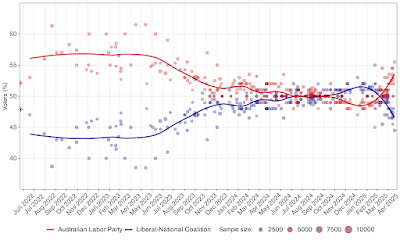
In the wake of Trump’s victory, this alienation led to an assessment within sections of Australian progressive forces that the ALP government was making the same errors Biden and Harris had made in the US. As such, a Dutton victory was inevitable. However, since the election was called, the ALP has built and strengthened a lead in the two-party preferred polls. 


Source: Wikipedia
While this has come as a shock to some commentators, it reflects a continuation of the problem the coalition faced going into the 2022 election in orienting to far-right discourse, made worse by their promise to bring Trump-style politics to Australia. 

This demonstrates a fundamental misunderstanding of how Australian and US politics differ. 

A key factor is the impact of compulsory voting. In the US, the largest voting block in the November elections, where people who didn’t vote, leaving aside the millions of US citizens who the Republicans have actively sought to prevent from registering to vote. In Australia, abstentionism and informal voting is not nearly that high, at around 15%. This means that in general, although not always, to win, a party needs to build a two-party preferred vote of more than 50% of the electorate. Historically, the coalition parties have done this by having a broad electoral base and then appealing to undecided voters in the centre.   

As I pointed out in 2022, the Liberal Party, following the US Republicans, has sought to energise the party’s right wing. For decades, while that has caused discomfort and alienation within the Liberal party’s voting bloc, within what has been described as the wets or social liberal-fiscally conservative, it rarely caused a split. However, there was a glimpse of a split with Howard losing the “doctors’ wives’” vote in 2007. However, with the emergence of the Teal independents before the 2022 elections, it has opened up a division in the Liberal Party’s historic voting base, with a permission pathway to preferencing the ALP over the Liberals. The Liberals lost six seats to Teal independents. To win government, they not only need to pick up seats from the ALP, but need to rewin those Teal seats. The promise to intensify cultural wars is unlikely to appeal to this constituency, which could also put additional Liberal seats at risk. 

Moreover, Dutton and Liberal strategists have interpreted the results of the Voice referendum as demonstrating an opportunity to use cultural wars to expand the coalition’s electoral support. However, while the outcome clearly demonstrated the ongoing deep vein of racism in the Australian politics, the referendum outcome was a consequence of additional factors in the campaign, such as confusion around what the Voice would mean, the relationship between Voice, Sovereignty, and Treaty, and the simple decision pathway “if you don’t know, vote no”. These are factors that don’t apply in a general election. 

In addition, the promise of gaining electoral support by modelling the coalition’s policies on Trump has proved a significant miscalculation. This miscalculation is not just that Australian society and electoral system are fundamentally different from the US, which will always mean a direct transplant of framing and rhetoric is unlikely to gain the same traction. It also fundamentally misread how Trump’s policies, once unleashed, would play out and be received in the US, globally, and most importantly within Australia. In all of these places they have been deeply upopular, most notably Tariffs that pose a threat to economies, promoting and endorsing Trump, means endorsing those attacks, in Canada, where Trump’s rhetoric also includes discussion of annexation, it has created a clear division of those who will stand up for national interests and those who will grovel at Trump’s feet. While the Albanese government has not been as resolute as the Canadian Liberal Party in opposing Trump, in both countries contrast on the question of Trump has been a key in turning election fortunes. 

Given the ALP’s likely victory, in a context where that victory will be primarily based on a rejection of the coalition and its regressive vision, rather than a sharp reorientation of the Albanese government’s policy position, poses a question of how can progressive forces within Australia, move the ALP towards more progressive positions? Whether on housing, social security, climate action, or a position of pressuring, rather than enabling, Israel’s ongoing genocide in Gaza?

In the wake of the emergence of social media, the answer to that question has often been to post hot-takes about the failures and inadequacies of the ALP, and while they generate likes and reshares in our bubbles, it won’t move the ALP. What has worked, and will always work is the clear articulation of demands that set out how things should be different and how that can be achieved, then seeking to organise and mobilise around those demands-based purely around support for the demands, not on an agreed assessment of the world and its ills, or even assessment of the ALP. This approach is starting to articulate in the US with the increasingly regular nationwide anti-Trump rallies. Building ongoing, escalating actions around clearly defined demands will not only strengthen and build the confidence of the movement, but also it will shake the government's and its supporters' confidence, irrespective of how much they claim the actions are irrelevant, opening up divisions and making a shift in government policy possible. How sharp this shift will be depends entirely on the level of ongoing pressure that the movement can generate and build.

If the unthinkable happens and the coalition wins on May 3, this strategic approach will be even more vital.  

------------------------------------------------------------------------------- 

This article is posted under copyleft, verbatim copying and distribution of the entire article is permitted in any medium without royalty provided this notice is preserved. If you reprint this article please email me at revitalisinglabour@gmail.com to let me know.

Read more...

Saturday, December 1, 2018

Against all religious exemptions

Lisbeth Latham

Religious exemptions to various anti-discrimination laws within Australian jurisdictions have come to the fore of public consciousness since the portions of the Phillip Rudock led the Expert Panel’s Review of Religious Freedom was leaked on October 9. Whilst much of the focus has been on the report’s recommendations regarding exemptions it has generated a broader discussion re religious freedom and how Australia’s anti-discrimination legislation works.

The Review of Religious Freedom has its origins in the 2017 Australian Marriage Law Postal Survey and in the subsequent process of legislating for marriage equality. At the time ultra-conservative sections of the Liberal Party pushed for dramatic expansion in the religious exemptions, which would have expanded religious exemptions to enable the denial of goods and services relating to marriage to any person holding a "religious belief" or "conscientious" belief not just about the nature of marriage, but about having children out of wedlock or the existence of trans or intersex people. At the time the LNP leadership rejected this legislative proposal but on November 22, 2017, offered a sop to the right (a section of which was in the party’s leadership) of establishing an enquiry into religious freedom.

A secret review
While any review of religious freedom established by the LNP would be a concern, per Yes Minister, you never commission unless you know the outcome beforehand, fears were escalated when it was revealed that the review would operate in secret with submissions, unlike normal enquiries, not to be made public. Which would mean that right would be able to make submissions that played up or simply fabricated without being subject to any public review or oversight. Following a public outcry, it was announced that all subsequent would be made public, but those who had already made secret submissions would be given the option of making their submission public. Following the closure of written submissions, a small number of closed hearings, where participants were promised that they would not be recorded.  The Review report was delivered to Cabinet on May 18, with no schedule for when it would be made public

Things could be worse, so its ok?
The leaked recommendations do not go as far in attacking the anti-discrimination as many feared it would, it fell far short of the objectives of in the alternative “Marriage Equality Bills” put forward by the ultra-conservative wing of the LNP. Indeed Liam Elphick, Amy MacGuire, and Anja Hilkemeijer argue that the report seeks to further constrains religious freedom in that it would require religious schools to have clearly articulated policies in order to have protection and must “act in the interest of students” when looking to discriminate against them – the fact that these religious schools would argue that acting against gay, lesbian, and trans students are in the interests of these students seeming to have escaped the authors. While at one level this is a reason for relief, the proposals are still toxic and reinforce the right of religious organisations to discriminate particularly in seeking to expand the right of religious schools to exclude students on the basis of the sexuality and gender identity, something that not all state anti-discrimination laws currently allow, and affirming the universal right of religious organisations to exclude staff based on their sexuality and gender identity.

Freedom to be bigots
Central to the logic of both the Review’s recommendations and the objectives of the religious right, is that religious beliefs give, as former attorney general George Brandis would say, a “right to be bigots” and that any impingement on this right is an impingement on religious freedom. However, as Anna Brown pointed out in response to the conservatives’ push to expand exemptions to the anti-discrimination acts in the Marriage Equality bill in 2017, whilst human rights laws internationally protect religious freedoms, these rights are not unfettered, and they do not extend to breaching the rights of others. However, for the religious right – religious freedom is not about freedom for religious minorities – indeed the religious right are happy for Australia’s Islamic community to be persecuted including mobilising polygamy as “dangerous consequence” of marriage equality which is a marriage practice which is permitted under a number religious and so they were happy to mobilise hostility to religious rights of marginalised groups as part of their campaign against the LGBTIQ+ community. Of course, our entire legal system is based on limits on the enforcement of religious doctrines

One of the ironic things about the recommendations of the Review report is that in asserting the importance of defending the right of religious organisations to discriminate on the grounds of gender and sexuality based on their doctrines, it at the same time rejects this right on other attributes, including race and intersex status, and thus accepts that it is appropriate for it to be curtailed in these circumstances. Which really begs the question how is being gay, or bisexual, trans or a woman, different from other attributes which the Review accepts that it is not ok to discriminate against? Importantly the Review, in seeking to defend and reinforce the right to discriminate creates a beachhead for an expansion in the right for religious organisations to expand their right to discriminate.

Dishonest
The argument that religious exemptions from sex discrimination acts are necessary to protect the religious convictions, are morally turgid but detached from reality that these exemptions do not prevent lesbian, gay, bisexual and trans workers from working for religious organisations, it just impacts on the circumstances in which they work. It means these workers will be deeply in the closet, they will have to hide significant aspects of their life from co-workers and live with anxiety when participating in activities within the LGBTIQA+ community for fear that someone with some connection to them at work seeing them. Research shows that being in the closet It means that a worker that no one has ever had any problem with regarding their performance or ability to meet the expectation associated with the organisations' doctrines could be lawfully dismissed on the grounds that their sexuality or gender if it is discovered.

In November 2017, Craig Campbell a relief teacher at a Baptist High School in Rockingham Western Australia (he had also previously studied at the school), having attended a family wedding with his partner but having to hide the relationship at the wedding because three students from the school were in attendance. Campbell told OUTInPerth “It got to this point where I was like, ‘I can’t hide this anymore.’” He also found it challenging to be a teacher who is supposed to instil values like honesty into students, while also being required to lie and cover up his own identity. In response, the school told him that he would no longer be given any work.

Roll back all religious based exemptions

The public response to the leaked report demonstrates that there is widespread opposition within Australia to discrimination on the grounds of sexuality and gender identity. This opposition has forced the Morrison government to make noises about removing exemptions which allow LGBTIQA+ students to be discriminated against by religious schools – however reports on negotiations over potential legislation to achieve this shows a desire on the part of the government not fully remove exemptions and to leave ambiguity as to what action schools will be able to take.

The public backlash has also resulted in the ALP, which had previously supported the existing religious exemptions, to join with the Greens, who have had a standing position against such exemptions, in moving a private members bill in the Senate on October 18. It remains unclear whether the opposition parties will have the numbers to pass the bill in both houses. It is important that all exemptions are removed in all Australian jurisdictions otherwise religious organisations, which employ more than 200, 000 workers across Australia, will remain free to discriminate on the grounds of gender and sexuality. This beachhead into anti-discrimination legislation would remain to be used to justify the further roll back protections should a future conservative government be willing to go against public opinions. For this reason, it is important all progressive forces commit to an ongoing campaign to rollback and overturn all religious exemptions in Australian jurisdictions.

------------------------------------------------------------------------------- 
This article is posted under copyleft, verbatim copying and distribution of the entire article are permitted in any medium without royalty provided this notice is preserved. If you republish this article please email me at revitalisinglabour@gmail.com to let me know.

Read more...

Friday, November 17, 2017

Still no easy pathway to marriage equality

Lisbeth Latham

Thousands of people gathered around Australia on November 15 to hear the results of the Australian Marriage Law Postal Survey.

While the survey delivered the result that was hoped for by these crowds, there has been a growing awareness that a majority Yes response in the survey does not necessarily deliver an easy pathway to the legislation that would deliver marriage equality. Instead, a new battle is looming, to win not just the legislation that a clear majority of Australians support, but to defend anti-discrimination protections for LGBTI people.

The past four months have been difficult for the LGBTI community. As expected, right-wing homophobic organisations have used every opportunity to mobilise every tangential homophobic, transphobic and misogynist argument they can think of to support their campaign against equal marriage. At the same time as they constructed an increasingly violent and hostile atmosphere, they sought, with the aid of the mainstream media, to paint themselves as the real victims in the debate.

Despite this effort by the right, participation in the survey at 79.5% was far higher than anyone expected and it helped to deliver a very strong Yes response in the survey, with 7,817,247 people, or 61.6% of respondents saying Yes. This has created an understandable desire for parliament to deliver quickly and pass an amendment to the Marriage Act so that it provides for marriage equality.

This was reflected in the thunderous cheer at the Melbourne Marriage Survey Announcement rally to Opposition Leader Bill Shorten's call: "Today we celebrate, tomorrow we legislate". Indeed, parliament has moved quickly, with the Senate agreeing on November 15 to begin the debate on WA Liberal Senator Dean Smith’s private members bill to amend the Marriage Act. Based on the current schedule, it could be passed before Christmas.

Dean Smith’s bill

The Smith bill is seen as the consensus cross-party bill. On October 16, Labor’s parliamentary caucus endorsed the bill, arguing it “strikes an acceptable compromise” between marriage equality and religious freedoms. The Greens, who have historically opposed the inclusion of religious exemptions in the Marriage Act, have also endorsed the Smith bill. Greens leader Richard Di Natale was reported by The Guardian as saying the Greens would push for cross party changes to the bill, but would “not do anything to jeopardise” the bill if those changes were not supported.

However, the Smith bill is flawed, as it maintains the existing exemptions for religious organisations from the Sex Discrimination Act. These allow religious ministers to refuse to marry two people of the same sex or gender, if that is consistent with the beliefs of their church, and allows religious organisations to refuse to hire their venues. Also, as Catholic Archbishop of Melbourne Denis Hart told Fairfax Media on August 20, it would allow the Catholic Church and any other religious organisation to sack any of their employees who marries a partner of the same gender.

It would also extend an exemption to civil marriage celebrants via the creation of a new category of "religious marriage celebrants". Celebrants would be able to register as religious marriage celebrants and be able to lawfully refuse to perform marriage ceremonies on the basis of people's sexuality.

The problem with these exemptions is that they elevate the right of churches and religious individuals to hold their views above the right of LGBTI people to live their lives openly and exercise rights that the rest of the community takes for granted.

As bad as this legislation is, it could get worse as a consequence of efforts to further amend it. It has been very clear that opponents of marriage equality were not going accept the results of the survey if it did not go their way. It was always a cynical manoeuvre. Throughout the survey, the Australian Christian Lobby and other right-wing groups have sought to paint themselves as the real victims in the campaign and as the people in need of protection. The religious exemptions in the Smith bill are not seen as going far enough by more conservative forces both inside and outside of parliament, who have been threatening to move more than 100 amendments to the bill.

James Paterson’s bill

A glimpse of the types of amendments that could be moved was provided by Victorian Liberal Senator and former deputy executive director of the Institute of Public Affairs James Paterson. On November 13, Paterson announced his own bill to amend the Marriage Act – a bill that was described by Anna Brown from the Human Rights Law Centre as "a Trojan Horse, which would allow unprecedented discrimination".

Paterson's bill went much further than the Smith bill in creating "religious exemptions". It also created two categories of marriage — "traditional marriage" between a "man and a woman" and "marriage" between "two people".

The protections proposed by Paterson would have extended the right to refuse goods and services relating to marriage to any person holding a "religious belief" or "conscientious" belief not just about the nature of marriage, but about having children out of wedlock or the existence of trans or intersex people.

The bill would also have provided wide protections against discrimination for people advocating and holding views regarding the character of "traditional marriage" and provided binding directives to schools regarding the delivery of the Safe Schools or similar programs.

While the Patterson bill was seen as having no prospect of success, it was designed, as Brown put it, as "a blatant attempt to punch holes in discrimination law and introduce special privileges for religious conservatives".

On November 15, Paterson announced he would be withdrawing his bill, saying: “It is clear the majority of Senators believe my colleague Senator Dean Smith's bill is where we should start. I will now work constructively with my parliamentary colleagues over the coming weeks on amendments to ensure that the strongest possible protections for the freedoms of all Australians are enshrined in the final legislation.”

Amendments

Attorney General George Brandis indicated on November 15 he would introduce an amendment to extend the right to conscientious objection to performing a marriage to all civil celebrants.

The Australian reported on November 16 that Treasurer Scott Morrison is leading efforts to incorporate into the Smith Bill Paterson's proposed protections for advocates of "traditional marriage" and for guaranteed "parental protections". These would require schools to inform parents of any discussions that might be expected to occur in class, "which parents might reasonably object to", about marriage, sexuality and gender, and enshrine the right for parents to withdraw their children from these classes.

While there are clearly the numbers in parliament to pass the Smith bill as it is, it seems odd, after a 13-year campaign to end discrimination in marriage and a survey that showed the majority of Australian voters support doing so, that the campaign would settle for legislation that not only accepts existing religious exemptions to anti-discrimination laws but goes further — without an attempt to push for a reduction in these exemptions.

More importantly, failing to maintain the pressure allows the most conservative forces inside and outside the Liberal Party to push for amendments that will dramatically expand the right of religious bigots to discriminate against the LGBTI community. They are using the threat of blowing up the party, a threat that contributed to the survey being held in the first place, to help build the numbers to pass these amendments.

Conservatives will also rely heavily on arguments that they are seeking to protect the rights of the 40% of the population who opposed any change to the Marriage Act. It is important that we continue to be in the streets to remind parliament that the overwhelming majority of Australians support real marriage equality.

-------------------------------------------------------------------------------
Lisbeth Latham is a member of the Socialist Alliance
[This article was originally published in Green Left Weekly #1162]

Read more...

Friday, November 10, 2017

Marriage equality: the fight is far from over

Lisbeth Latham

The results of the non-binding voluntary survey on same-sex marriage will be announced on November 15.

The Australian Bureau of Statistics estimated that by October 31, 12.3 million people (77% of the electorate) had returned their surveys – a much higher level of participation than initially expected.

This strong turnout has been viewed as favouring a Yes result in the survey. 

Irrespective of the outcome, we will need to continue to fight not only to achieve marriage equality but to combat the right's bigotry.

The survey was intended to eliminate marriage equality as a source of tension within the Coalition's party room and ensure that legislation was not put before parliament. The hope was that the survey would deliver a clear No vote.

The desire to avoid debating any legislation is reflected in the government's continued lack of clarity on what bill it will support in the event of a Yes majority.

The most likely bill – because it already has the support of Labor – is the private member's bill put forward by Western Australia Liberal senator Dean Smith in August.

The Smith bill expands significantly on existing religious exemptions in the Sex Discrimination Act. It would enable churches to refuse to marry gay and lesbian couples and civil marriage celebrants to register their objection to marrying same-sex couples.

It is objectionable that churches should be able to refuse to marry people on religious grounds. But to allow private citizens performing a secular marriage to do so sets a dangerous precedent in terms of legalising bigotry.

Smith has argued that his bill provides essential protection to "religious freedom". This refrain has been taken up by the Christian right in its campaign against marriage equality.

In late October, ultra-conservative Liberal MP Andrew Hastie called for the Smith bill to be dramatically modified. It is thought that Hastie will put forward more than 100 amendments to the proposed bill.

This is a cynical move, aimed at delaying the legislation and using marriage equality legislation to expand the ability of bigots to lawfully discriminate against LGBTI people.

 If successful, it would not only undermine marriage equality, but raise the level of discrimination and marginalisation experienced by LGBTI people.

The right's obsession with religious freedom is entirely cynical and divorced from the real historic struggles for religious freedom, which were about defending and protecting the rights of religious minorities from laws linked to state religions.

Organisations like the Australian Christian Lobby (ACL), together with various far-right groups, have been at the centre of the right's campaign against marriage equality.

They have actively mobilised fear of polygamy as a reason for opposing marriage equality, despite there being no current push to legalise polygamy from those religious communities, including within Islam, where it is practiced.

These arguments are not just about saying that it is OK to discriminate against some religious beliefs; they actively seek to promote homophobia based on Islamophobic dog-whistle politics.

The right’s push to protect "religious freedom" is part of a broader assault to impose its conservative social attitudes via the state. It is a campaign that is anti-secular while seeking to violate the religious and social freedoms of those whose lives do not fit within the right's view of morality.

There are supporters of marriage equality who view these concessions as acceptable to achieve marriage equality. They argue that the amendments are irrelevant or that, once passed, the bill could be subsequently amended.

The reality is that these amendments will be used by bigots to marginalise and discriminate against LGBTI people. Moreover, once legislation is passed, it will be much harder to mobilise popular support to amend it.

The Christian right will not just rely on right-wing MPs and senators to stop or amend any marriage bill – it will broaden its campaign of vilifying the LGBTIQ community.

The ACL is likely to follow the approach of the US Christian right, from whom it borrowed its campaign against marriage equality, to push for the right to discriminate same-sex couples and amplify the marginalisation and vilification of the transgender community.

In the face of the right’s determination to roll back our rights, it is vital that we continue to mobilise in support of the LGBTIQ community.

Mobilising helps to build solidarity and reassert our right to exist and live our authentic lives.

Mobilising will also help create pressure to ensure that legislation is introduced quickly to parliament and help prevent a situation where Labor and other parties that support marriage equality accept amendments that expand the right of bigots to lawfully discriminate against the LGBTI community.

-------------------------------------------------------------------------------

Lisbeth Latham is a member of the Socialist Alliance
[This article was originally published in Green Left Weekly #1161]

Read more...

Friday, September 1, 2017

Why a Yes response in the survey is not enough

Lisbeth Latham

Ever since it was announced, the federal government’s postal survey on marriage equality has been met with responses questioning both the legitimacy of the survey and demonstrating support for marriage equality — responses that have been vital for the confidence and morale of members of the LGBTIQ community.

Despite this, the right, particularly the Christian right, has demonstrated its determination to defeat the push for marriage equality through the mobilisation of homophobic and transphobic hatred and disinformation.

This opposition and the desire by significant sections of the Liberal and National parties to avoid legislating for marriage equality suggests that a clear and decisive response to the survey in support of marriage equality may be insufficient in itself to achieve that goal. We will need to build the strongest movement in the streets not just for marriage equality but in support of the broader rights of the LGBTIQ community.

The survey has been widely denounced by supporters of marriage equality. There are currently two High Court challenges to the constitutionality of the survey. These cases are scheduled for September 6, just six days before the surveys are due to be mailed out. Tasmanian independent MP Andrew Wilkie, who is one of the High Court litigants, has described the survey as a “sham” and argued that the government is “exceeding its powers and acting illegally”.

Despite this opposition to the idea of the survey, there is a widespread understanding that if it goes ahead, it is important that people engage in the survey in support of marriage equality.

Alex Greenwich from Australian Marriage Equality told ABC News on August 11: “Should we have to deal with a postal vote plebiscite being inflicted upon us, we have a duty of care and responsibility to make sure we campaign for marriage equality, to make sure we campaign Yes for marriage equality.”

This determination to engage with the survey is also reflected in changes in electoral enrolments since the survey was announced. Guardian Australia reported on August 24 that 90,000 young people had enrolled to vote for the first time, along with 675,000 people updating their details. At that time, a further 165,000 forms were still to be processed.

While some of these interactions with the Australian Electoral Commission would include opponents of marriage equality, the latest Newspoll on support for marriage equality indicates that 67% of those polled support marriage equality.

This support has also been reflected in and reinforced by the 20,000 people who rallied for marriage equality in Melbourne on August 26. Protests in support also occurred on August 26 in Perth and August 27 in Wollongong and further mobilisations are planned across Australia over the coming weeks.

The focus of the campaign has been on maximising both participation in the survey and the number of people who respond in support of marriage equality. Achieving a strong response in support of equality will put pressure on the government to introduce a bill to parliament and encourage its members to vote for that bill, but it may not be sufficient to secure marriage equality.

Despite this broad support, and to some extent because of it, the level of homophobic and transphobic rhetoric from opponents of marriage equality has increased.

Homophobia rising
The clearest example of this has been the appearance of homophobic posters distributed by neo-Nazi organisations in Melbourne and Sydney which have linked equal marriage with child abuse and paedophilia.

The posters drew widespread condemnation from across the community, including forcing sections of the religious right to seek to distance themselves from the posters. Lyle Sheldon, the head of the Australian Christian Lobby (ACL), did so by arguing the posters were part of a conspiracy by supporters of marriage equality to call into question the legitimacy of the survey. The ACL is seeking to paint the survey as a threat to marriage generally and an assault on religious freedom, with some of its more feverish supporters online suggesting that marriage equality would lead to the need to establish “underground churches”.

Prime Minister Malcolm Turnbull has sought to normalise this hatred by saying that it is part of democratic discussion around the survey and that people were likely to say things that are “hurtful, unfair and sometimes cruel” but, rather than stifle free speech, Australians should stand up for any friends and loved ones feeling distressed “at this challenging time”.

Turnbull also said: “You cannot ask for respect from the No case if you’re not prepared to give respect to the No case. The vast majority of people who do not agree with same-sex marriage are not homophobic and do not denigrate gay people.” This makes how the community has responded to homophobic attacks the problem, rather than the attacks themselves.

The reliance of the right on hatred and fear to mobilise its base is not just upsetting. It is potentially dangerous both in the lead up to the survey and in the wake of any legislation being passed.

In both the US and France, the final pushes towards marriage equality were responded to by the right escalating violence against the LGBTIQ community. This violence did not drop to the earlier lower, but still unacceptable, levels in the immediate wake of achieving formal marriage equality.

In both countries the right have continued to use marriage equality as a basis to mobilise their base to attempt to not only wind back marriage equality but also other rights that have been won by the LGBTIQ community and to block further gains. The clearest example of this push has been the growth, after the US Supreme Court’s decision in favour of marriage equality, of legislative efforts to block trans people from accessing the toilets of their affirmed gender.

The Christian Right and far-right are not as large or energetic here as those in the US and France. But we can see evidence of the right attempting to energise their base through hypocritical and hyperbolic attempts to convince themselves and their supporters that the survey and Safe Schools programs are existential threats to families and particularly children. These attempts have the potential to create a desperate desire not only to maintain the right’s rage against marriage equality but also to increase the physical threat towards visible members of the LGBTIQ community.

Need for mobilisations
This situation makes ongoing mobilisation during and after the announcement of the survey result central to maximising any result. It will also help maintain morale within the LGBTIQ community. Mobilisations will raise the pressure on the government — particularly those concerned that opposition to marriage equality is a vote loser — to push for marriage equality legislation to be passed.

Equally importantly, ongoing large mobilisations will help to create an atmosphere where homophobia and transphobia are not tolerated in our society. As part of our efforts to build mobilisations in support of marriage equality and against homophobia, it is important we build empathy and support for issues facing the broader LGBTIQ community.

We must support efforts to enable trans people to achieve gender recognition, combat broader discrimination against the community, particularly the religious exemptions from the anti-discrimination acts, and actively combat the Australian government’s ongoing racist policies targeting refugees, and Aboriginal and Torres Strait Islander communities.

[Lisbeth Latham is a trans woman and a member of the Socialist Alliance. This article was originally published in Green Left Weekly #1151

Read more...

Friday, July 31, 2009

Unionist faces jail for not answering ABCC questions — abolish anti-union secret police!

Lisbeth Latham

On August 11, Ark Tribe, a member of the South Australian Branch of the Construction Forestry Mining and Energy Union (CFMEU), will appear in court charged with refusing to answer questions from the Australian Building and Construction Commission (ABCC).

If he is found guilty he faces a maximum six months in jail.


Tribe is the second member of the CFMEU to face trial for refusing to cooperate with the ABCC. In November, the ABCC dropped a similar case against CFMEU Victorian branch assistant secretary Noel Washington.

Despite union opposition to the undemocratic powers of the ABCC, the ALP government, under PM Kevin Rudd, plans to keep most of the ABCC's powers under a new body — the Building Industry Inspectorate.

Unions, particularly blue-collar unions, have pushed for the total abolition of the ABCC since the election of the Rudd government in late 2007.

The ABCC discriminates against building union members by treating them as criminals and takes away many of their rights, including the right to silence.

The ABCC’s coercive powers are designed to intimidate building workers. It can order any person it deems to have information relevant to an investigation to face interrogation or face six months’ jail.

Ironically, the penalty for an individual failing to cooperate with the ABCC is far worse than the penalty for many of the “violations” the ABCC investigates.

Unions have also said the ALP has a mandate to remove all of the Howard government's anti-worker legislation. Most who voted for the ALP did so in the belief the ALP would abolish all of the anti-union legislation of former PM John Howard.

A ruling by the International Labour Organisation in March has increased the pressure on the government. The ILO said the ABCC and the associated Australian Building and Construction Industry Improvement Act breach Australia's commitments as a signatory to the ILO's conventions.

Yet the government is trying to justify keeping most of the ABCC's powers with the argument a “tough cop” has to deal with “lawlessness” in the building industry.

The Rudd government is employing the same false argument the Howard government used to justify the introduction of the union-busting ABCC.

Howard set up the ABCC in 2005 under the cover of recommendations made by a royal commission into the building industry led by former judge Terence Cole. The government launched the Cole commission, with $60 million in funding, to investigate “unlawful activity” in the construction industry. Unions condemned the commission as a blatantly anti-union exercise.

When the commission was launched in 2001, the ALP described it as a witch-hunt against the militant construction unions, in particular the CFMEU.

Ninety percent of the commission's time was devoted to allegations against building unions. Little or no time was devoted to investigating allegations against employers. Unions were denied the right to cross-examine witnesses who made allegations against them.

Despite the commission’s anti-union terms of reference, Cole was able to find only 392 cases of possible unlawful behaviour in the industry over a seven-year period. The vast majority of these “unlawful” acts were instances of unions holding on-site union meetings; union attempts to ensure all workers on sites were union members; and work stoppages over unsafe working conditions.

Although 30 of the incidents were associated with employer behaviour, these were largely instances of employers paying strike pay.

The commission failed to make any recommendations to stop employer breaches of occupational health and safety laws, despite the shocking one work-related death a week record of the industry.

The commission’s terms of reference did not include an examination of employer’s schemes to rob workers of their lawful entitlements.

The ABCC, with its power to initiate prosecutions, was created by the Howard government to crush the industrial muscle of the building unions and help drive down wages and conditions in the industry.

The Rudd government's commitment to transfer most of the ABCC's powers to the Building Industry Inspectorate reflects that the ALP, like the Liberals, is committed to attacking the rights of workers to organise in order to protect bosses’ profits.

Originally published in Green Left Weekly Issue #804

Read more...

Monday, May 11, 2009

Steel union protects bosses’ profits

Lisbeth Latham

Since the global economic crisis began, there has been a sharp fall in global demand for steel, resulting in more competition between steel makers.

This competition will place considerable pressure on Australian steel makers BlueScope and OneSteel. Australian steel producers are also facing the potential financial impact of attempts to cut CO2 emissions.

In response to these pressures, on April 17 the Australian Workers Union (AWU) launched New Steel Plan: Our Vision for Australian Steel in the 21st Century.

AWU national secretary Paul Howes, in promoting the plan, has said failure to support the steel industry could potentially cost 500,000 jobs.

Steel crisis

The current crisis in the steel industry has its roots in the global resources boom over the past decade. During this boom, there was a substantial rise in the productive capacity in the steel industry. New small producers entered the market — particularly in India and China.

Despite expansion, production peaked for US steel makers at 97% of capacity in June 2006, remaining as high as 94.6% in December 2007. By March, it was down to 35.11%.

In Australia, says the AWU, production has fallen from 85% of capacity in the 2006 June quarter to 75% of capacity in the 2008 December quarter. Expectations are that it will fall to 71% for the March quarter.

In response to the fall in production, steel makers — like other manufacturers — have begun to shift workers onto shorter shifts. Socialist Alliance member Garry Holiday, who is an AWU assistant delegate at BlueScope’s Western Port steel refinery at Hastings, said workers are on average working 60% of their previous hours.

In the medium term, steel producers will be looking to shed jobs. To offset this, the AWU proposes a 10-point plan. It aims, among other things, to:

  • increase domestic sales by creating a mechanism that gives preference to Australian-made steel;
  • have the Australian government take action against international steel makers “dumping” — ie selling steel at much lower prices — in Australia; and
  • support productivity growth, wage restraint and jobs by using new technology.

The AWU’s plan is modelled on the steel plan adopted by the Hawke Labor government in 1983, which the AWU says “secured our local industry for the past 25 years”.

However, this plan, which was implemented during a similar period of high excess capacity coming out of a resource boom, led to more than 10,000 job losses in the steel industry.

At the same time, Australian steel producers were making significant gains in labour productivity and lifting their international competitiveness.

It is clear that the AWU’s proposed new plan will have similar results. Holiday said: “The hoped for results are contradictory. They are supposedly aimed at protecting jobs. However if you look at the tables provided in the plan, the goal is increased labour productivity. So the goal is to work less to produce more. I’m not sure that is supposed to produce or protect jobs.

“I was talking to a delegate from a contractor at Western Port about the plan; he was not impressed at all. He said ’they want us on the dole queue’.”

Much of the AWU’s plan is about the broader impact on the Australian economy from maintaining a steel industry, rather than the direct impact on steelworkers themselves.

The plan suggests that for every 1000 tonne cut in steel production, there will be 60 jobs lost, and the government would lose $1.97 million in tax revenue.

However, if steel production is going to be maintained through growth in productivity, then it is likely that there will be poorer outcomes in terms of job generation from the steel industry.

The AWU’s plan gives first priority to steel producers’ profits.

“In producing the plan, the AWU leadership is attempting to demonstrate that it is a ‘responsible union’ to employers, not only in the steel industry but in other sectors, such as the aluminium and the civil construction industry”, Holiday said. The AWU wants to be the union that employers prefer to deal with.

Environmentally friendly steel?
The AWU portrays the steel industry as environmentally friendly. In a March 25 Australian article, Howes said steel was environmentally friendly as it 100% recyclable and, like aluminium, was used in the construction of solar panels and wind turbines.

The steel plan expands on this, outlining how the steel industry could potentially help to cut total greenhouse gas emissions through process and raw materials enhancement, energy and materials recycling and waste and emissions cuts.

The AWU leadership is correct to say the steel industry is under pressure, as a collapse in employment looms. It is also correct that these sectors can potentially contribute significantly to cutting greenhouse gas emissions.

However, in acting as an advocate for steel companies, the AWU puts the company’s profits before workers’ right to employment and decent wages as well as a liveable environment.

Originally published in Green Left Weekly issue # 794

Read more...

Friday, October 17, 2008

Australian Construction Workers Fight For Democratic Rights

Lisbeth Latham

Australian construction unions have launched a new campaign demanding that the Australian Labor Party (ALP) government of Kevin Rudd abolish the Australian Building and Construction Commission. Despite being elected on widespread working class anger against anti-union laws, the Rudd government have pledged to keep the ABCC in place at least until 2010, with the possibility it role be shifted to another government agency.


The ABCC was formed in 2005 following the passing of the Building and Construction Industry Improvement Act. Much of the legislation contained in the BCIIA had been recommendations of the 2001-2003 Royal Commission into the Building and Construction Industry (Royal Commissions are the highest level of public inquiry in Australia). It was established to investigate the “extent of unlawful activity in the construction industry”. Commissioner Terrance Cole found 392 incidents that might constitute of unlawful behavior in the industry over a seven year period. The vast majority of these were instances of unions holding on site union meetings, attempts to ensure all workers on sites were union members and work stoppages over unsafe working conditions. Thirty of the incidents were associated with employer behaviour, these were largely instances of employers paying strike pay. The terms of reference of the Royal Commission did not include examining unsafe work practices pursued by employers or the use of shelf companies which are closed down robbing workers of their entitlements.

REDUCING THE RIGHTS OF WORKERS
The BCIIA undermine the industrial effectiveness of Australia’s construction unions. In doing this it made illegal a wide range of previously legal industrial activity including:


  • Banning collective agreements from including retrospective pay rises;
  • Banning pattern bargaining, where unions seek common pay deals across hundreds of different employers;
  • Increasing penalties for industrial action occurring outside bargaining periods to $110,000 Aud for unions and up to $22,000 for individuals;
  • Requiring unions to hold secret ballots of their members before taking protected industrial action, including on urgent health and safety issues;
  • Introducing a mandatory 21-day cooling off period after two weeks of protected industrial action;

In order to enforce the BCIIA, the ABCC was given extra-ordinary powers to investigate and prosecute workers. If the ABCC believes on reasonable grounds that a person has information or documents relevant to an investigation, or is capable of giving evidence relevant to investigation it can require a person to give the information, or documents or attend an interview. At an interview the ABCC can require a person to:

  • Reveal all their phone and email records, whether of a business or personal nature;
  • Report not only on their own activities, but those of their fellow workers;
  • Reveal their membership of an organisation, such as a union;
  • Report on discussions in private union meetings or other meetings of workers;
  • The penalty for failing to hand over documents or answer all questions asked is six months imprisonment.

A TOUGH COP FOR A TOUGH INDUSTRY?
The Howard government, and now the Rudd government have justified the need for the ABCC, on the basis that the construction industry has a “culture of lawlessness”. However there is growing evidence that the ABCC focuses overwhelmingly on policing construction workers and their unions. Federal Court Justice Jeffrey Spender on October 8, said that the ABCC’s prosecution of the Queensland Plumbing Division of the Communication, Electrical and Plumbing Union and its state secretary Brad O’Carroll, was “misconceived and completely without merit”, and if the “Commission was even handed in discharging its tasks of ensuring industrial harmony and lawfulness in the building and construction industry proceedings” would have launched against the company that the CEPU had been in dispute with.

TARGETING ORDINARY WORKERS
These laws have been impacting on ordinary construction workers across Australia. The largest case was the charging of 107 members of the Construction, Forestry, Mining and Energy Union, following a strike by 400 CFMEU members of the in Western Australia following the sacking of the Health and Safety Officer on their work site. Of these workers, 87 of the workers were given fines of between $8,400 Aud and $10,000, Aud the ABCC had sort the maximum penalty of $22, 600 Aud.

A CFMEU vice president charged with coercing crane operators into negotiations faces six months jail time in December for refusing to appear before the commission.
The Australian trade union's say similar investigations have been little more than excuses for union-bashing politicians to seek publicity.


In September, police in Victoria state withdrew charges against a building worker after two years of investigation. The union member was fingered by the commission, which claimed he threatened to kill inspectors when they visited his worksite.


“They besmirched the name of an innocent man in a desperate attempt to portray construction unions as bullies and thugs,” said Dave Noonan, national secretary of the CFMEU. “It is a disgrace, an abuse of power and corruption of the political process.”

[For more information on the ABCC and the campaign against it visit http://www.rightsonsite.org.au/.]

This is an expanded version of an article that appeared in the November issue o f Labor Notes this version has been submitted to Union Syndicale Solidaires International the Journal of French Union Federation Union Syndicale Solidaires.


Read more...

Wednesday, February 11, 2004

WA Labor's new workers compensation laws

Lisbeth Latham

On January 29, John Kobelke, minister for Consumer and Employment Protection, released Restoring Fairness, Balance and Certainty: Workers' Compensation Reforms. The document's introduction states that it is the final stage of checking before the legislation is submitted to parliament.

The state Labor government has argued that the amendments will provide workers with improved access to benefits, injury management and greater legal protection. However, the legislation has made limited advances in protecting workers' rights.

The cap on weekly benefit payments will be increased to two-times average weekly earnings, from one-and-half. This payment will be reduced by 15% after eight weeks; it is presently reduced after four weeks.

Weekly benefit payments will still be limited. For workers with permanent total incapacity, the maximum prescribed amount can be extended up to $228,0000, up from $50,000.

The prescribed amount is the total amount available for any injury; if an injured worker dies then his or her dependents receive the prescribed amount, minus any weekly payments already received.

The amendments propose reintroducing lawyers into the whole system (rather than simply during final appeals) and the creation of a new Workers' Compensation Dispute Resolution Authority, which will oversee a process of conciliation conferences and arbitration.

Under the existing legislation, "injury management" — the process by which injured workers return to work — was voluntary, and only vocational rehabilitation was required. Labor's amendments would require large employers to develop their own policy and procedures for injury management and encourage insurers to provide resources for smaller companies to develop these as necessary.

Labor also proposes that injured workers be legally required to participate in injury management and rehabilitation activities. Failure to do so could result in the stoppage of payments.

While workers should have the option of returning to work, and employers be legally required to make arrangements to facilitate this process, Labor's amendments are not aimed at giving workers greater options. Instead, they are aimed at saving employers and insurers money by compelling injured workers to participate in attempts to return to work, and allowing an earlier reduction in weekly compensation payments.

Labor proposes to maintain the "two-gate" system for access to common law introduced by the state Coalition government in 1999. Under this system, injured workers assessed to have a "whole person impairment" (WPI) of greater than 25% (currently the threshold is 30%) are eligible to receive uncapped compensation payments.

For workers assessed to have a "serious impairment" of between 15% and 25% compensation is capped at a maximum of $275,000. Labor's updated amendments maintain its previous position to exclude workers' secondary and consequent impairment, including psychological impairment, in assessing WPI. This is aimed at reducing workers' access to civil damages.

The proposed amendments will extend the deadline for seeking common law damages to 12 months, extendable by an additional six months.

Workers with a serious impairment will also no longer lose their entire statutory benefit. Instead, all coverage of medical and other expenses will cease and weekly payments will be reduced to 70%, then to 50% after three months and cease after six months.

As common law damages are reduced by the amount of weekly benefits that the worker has already received, the phasing down of benefit payments and ending of coverage of medical expenses can only be interpreted as intended to dissuade injured workers from making common law claims.

From Green Left Weekly #570

Read more...

Wednesday, November 26, 2003

11,000 teachers strike in WA

Lisbeth Latham

PERTH — Despite heavy rain and a fierce campaign of misinformation by the state Labor government, 5000 teachers attended a rally on November 18 as part of their campaign for a new certified agreement.

The first full-day strike by Western Australian teachers in eight years involved half of WA's 20,000 public school teachers.

In the days leading up to the strike, state education minister Alan Carpenter, education director-general Paul Albert and WA Council of State Schools Organisations president Rob Fry all made statements in the West Australian condemning the strike as unnecessary and being against the interests of students. Carpenter has also claimed that as conciliation was beginning it was unnecessary for the teachers to strike.

However, as Dave Kelly, general secretary of WA branch of the Australian Education Union (AEU), told the rally, the government has been steadfastly refusing to enter negotiations with the AEU, although a framework for conciliation had been agreed to in August.

Under the pressure of the strike, the government approached the AEU and the Australian Industrial Relations Commission to initiate conciliation on November 17, with meetings to occur on November 24, 25 and 28 if necessary.

The key issues identified by the AEU have been pay levels for beginning teachers; primary school teachers receiving equal levels of duties other than teaching (DOTT) as other teachers, to allow for class preparation; and reduction in class sizes.

Following Kelly's address, the teachers marched to Parliament House. Contrary to the government's hopes, the marchers received a warm response from passers-by, with motorists tooting and construction workers on city building sites cheering the marching teachers.

From Green Left Weekly #563.

Read more...

Wednesday, November 19, 2003

WA teachers escalate industrial action

Lisbeth Latham

PERTH — On November 6, the Western Australian branch executive of the Australian Education Union (AEU) announced that a 24-hour strike would be held on November 18 to support the teachers union's campaign for a new certified agreement.

The strike will be the first full-day stoppage by WA teachers for eight years, and has been called in response to the state Labor government's attempt to take the AEU into arbitration following the union's rejection of the government's second offer.

The strike has also been called in response to the government's attempt to suspend the bargaining period for a new agreement. Premier Geoff Gallop's government claims that the industrial action that is being taken by teachers in support of their campaign is disrupting and adversely affecting the schooling and education of large numbers of students.

However, the industrial relations commission has postponed any decision until a hearing on December 1-3.

Teachers are not alone in seeing their campaign for better wages and conditions being frustrated by the WA Labor government. Since October 23, members of the Liquor, Hospitality and Miscellaneous Workers Union (LHMU) who work as cleaners, gardeners and education assistants in WA schools, have been conducting work bans in support of a claim for a wage rise of 15% over two and half years.

According to Sue Lines, acting LHMU state secretary, the government has refused to negotiate with the union, but instead has sought to have the Western Australia Industrial Commission lift the bans.

Members of the Civil Service Association (CSA) have imposed bans targeting government revenue-raising as part of their campaign for a new certified agreement.

On November 7, workers in the Registry of Births, Deaths and Marriages issued certificates for free. According to the CSA, the public response was so overwhelming that management decided to close the doors of the registry early. Workers at the registry told the union that by midday revenue losses exceeded the registry's maximum daily takings of $5000.

From Green Left Weekly #562.

Read more...

About This Blog

Revitalising Labour attempts to reflect on efforts to rebuild the labour movement internationally, emphasising the role that left-wing political currents can play in this process. It welcomes contributions on union struggles, internal renewal processes within the labour movement and the struggle against capitalism and imperialism.

  © Blogger templates The Professional Template by Ourblogtemplates.com 2008

Back to TOP  

Creative Commons Licence
This work is licensed under a Creative Commons Attribution-NonCommercial-ShareAlike 3.0 Australia License.