Showing posts with label neo-liberalism. Show all posts

Monday, April 28, 2025

With an ALP victory likely: How can progressive forces fight for change?

Lisbeth Latham

In the wake of Trump’s victory, there was a strong sense that a similar victory for the Liberal/National coalition was in the offing. Over the past months, this fear has dissipated, not primarily due to the strong performance of the Albanese government, but due to the absolute failure of the Dutton-led opposition to posit a vision for a new government other than a cheap knock-off of Trumpism. While this outcome of an outright ALP majority government, or a minority government reliant on support of the Greens, Teals, and other independents, there are lessons that the left needs to learn to build pressure on any future ALP government, to deliver for working people.

The 2022 election of the Albanese government gave hope for change in Australia, particularly after the long years of Coalition government were made worse by the strain of the early years of the COVID-19 pandemic. Many of these hopes were likely misguided. Especially given that it is a social democratic government, but the ALP, along with the French Socialist Party, was one of the first social democratic parties to push and implement neo-liberalism. As such, it is unlikely that the Albanese government was going take the initiative to implement the broad social reforms, that had not been part of its platform, which forces to its left were calling for. Reforms such as raising social security payments or caps on rents. It also meant that it would be limited in its willingness to respond effectively, of its own accord, to the cost-of-living pressures that emerged, as capital took advantage of supply chain issues caused by restrictions of the early pandemic period, and other dislocations in the global economy, to justify massive price-gauging.


Despite this, the government has had a reform agenda, and while this agenda has been uneven, and internally contradictory, it has progressed on some of it. The government has been able to point to greater wage growth, albeit mostly at below inflation levels for much of its term, some of which is the consequence of amendments included in the Fair Work (Better Jobs Better Pay) Amendment Act (2022) and the Closing the Loophole Acts. The coalition has repeatedly promised to repeal these changes, particularly in relation to changes in the definition of casual employment, the right to disconnect, and the same job, same pay provisions that requires that labour hire workers to be paid at the same pay rates as the directly employed workers working on a project. At the tail end of the campaign, the coalition has walked back some of these threats, along with a range of other commitments.   

In other areas, such as the government’s failure to seriously raise opposition to Israel’s genocidal attacks on Palestinians, like the vast majority of Western imperialist governments. Along with its continued support for fossil fuels and erosion of environmental protections, it has alienated many in its own base and those to its left

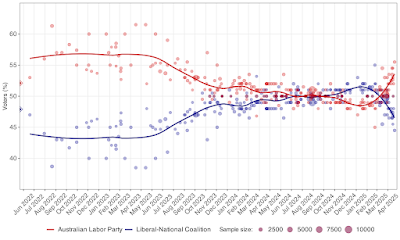
In the wake of Trump’s victory, this alienation led to an assessment within sections of Australian progressive forces that the ALP government was making the same errors Biden and Harris had made in the US. As such, a Dutton victory was inevitable. However, since the election was called, the ALP has built and strengthened a lead in the two-party preferred polls


Source: Wikipedia
While this has come as a shock to some commentators, it reflects a continuation of the problem the coalition faced going into the 2022 election in orienting to far-right discourse, made worse by their promise to bring Trump-style politics to Australia. 

This demonstrates a fundamental misunderstanding of how Australian and US politics differ. 

A key factor is the impact of compulsory voting. In the US, the largest voting block in the November elections, where people who didn’t vote, leaving aside the millions of US citizens who the Republicans have actively sought to prevent from registering to vote. In Australia, abstentionism and informal voting is not nearly that high, at around 15%. This means that in general, although not always, to win, a party needs to build a two-party preferred vote of more than 50% of the electorate. Historically, the coalition parties have done this by having a broad electoral base and then appealing to undecided voters in the centre.   

As I pointed out in 2022, the Liberal Party, following the US Republicans, has sought to energise the party’s right wing. For decades, while that has caused discomfort and alienation within the Liberal party’s voting bloc, within what has been described as the wets or social liberal-fiscally conservative, it rarely caused a split. However, there was a glimpse of a split with Howard losing the “doctors’ wives’” vote in 2007. However, with the emergence of the Teal independents before the 2022 elections, it has opened up a division in the Liberal Party’s historic voting base, with a permission pathway to preferencing the ALP over the Liberals. The Liberals lost six seats to Teal independents. To win government, they not only need to pick up seats from the ALP, but need to rewin those Teal seats. The promise to intensify cultural wars is unlikely to appeal to this constituency, which could also put additional Liberal seats at risk. 

Moreover, Dutton and Liberal strategists have interpreted the results of the Voice referendum as demonstrating an opportunity to use cultural wars to expand the coalition’s electoral support. However, while the outcome clearly demonstrated the ongoing deep vein of racism in the Australian politics, the referendum outcome was a consequence of additional factors in the campaign, such as confusion around what the Voice would mean, the relationship between Voice, Sovereignty, and Treaty, and the simple decision pathway “if you don’t know, vote no”. These are factors that don’t apply in a general election. 

In addition, the promise of gaining electoral support by modelling the coalition’s policies on Trump has proved a significant miscalculation. This miscalculation is not just that Australian society and electoral system are fundamentally different from the US, which will always mean a direct transplant of framing and rhetoric is unlikely to gain the same traction. It also fundamentally misread how Trump’s policies, once unleashed, would play out and be received in the US, globally, and most importantly within Australia. In all of these places they have been deeply upopular, most notably Tariffs that pose a threat to economies, promoting and endorsing Trump, means endorsing those attacks, in Canada, where Trump’s rhetoric also includes discussion of annexation, it has created a clear division of those who will stand up for national interests and those who will grovel at Trump’s feet. While the Albanese government has not been as resolute as the Canadian Liberal Party in opposing Trump, in both countries contrast on the question of Trump has been a key in turning election fortunes. 

Given the ALP’s likely victory, in a context where that victory will be primarily based on a rejection of the coalition and its regressive vision, rather than a sharp reorientation of the Albanese government’s policy position, poses a question of how can progressive forces within Australia, move the ALP towards more progressive positions? Whether on housing, social security, climate action, or a position of pressuring, rather than enabling, Israel’s ongoing genocide in Gaza?

In the wake of the emergence of social media, the answer to that question has often been to post hot-takes about the failures and inadequacies of the ALP, and while they generate likes and reshares in our bubbles, it won’t move the ALP. What has worked, and will always work is the clear articulation of demands that set out how things should be different and how that can be achieved, then seeking to organise and mobilise around those demands-based purely around support for the demands, not on an agreed assessment of the world and its ills, or even assessment of the ALP. This approach is starting to articulate in the US with the increasingly regular nationwide anti-Trump rallies. Building ongoing, escalating actions around clearly defined demands will not only strengthen and build the confidence of the movement, but also it will shake the government's and its supporters' confidence, irrespective of how much they claim the actions are irrelevant, opening up divisions and making a shift in government policy possible. How sharp this shift will be depends entirely on the level of ongoing pressure that the movement can generate and build.

If the unthinkable happens and the coalition wins on May 3, this strategic approach will be even more vital.  

------------------------------------------------------------------------------- 

This article is posted under copyleft, verbatim copying and distribution of the entire article is permitted in any medium without royalty provided this notice is preserved. If you reprint this article please email me at revitalisinglabour@gmail.com to let me know.

Read more...

Saturday, May 12, 2018

France: Call of the National Student Coordination

Original in French available here
6 May 2018
We mobilized from 20 universities, gathered on the 5th and 6th of May at the Faculties on Strike at the University of Nanterre, and reiterate our determination to achieve the withdrawal of the ORE law [which increases selection processes for entrance processes from the current guaranteed entrance for anyone with a 10/20 from the Baccalaureate (BAC) exams], abandonment of the student plan and the roll back the of the government's whole antisocial policy. From the rail reform to the Asylum-Immigration Act, to the increase in the CSG [General Social Contribution - a compulsory payment which helps to fund France's pension system]and the reform of the BAC, Macron, the proud representative of the interests of employers, attacks us on all fronts.


For two weeks, despite the holidays and the arrival of the mid-year exams, thousands of students, in the street and in general assembly, pursue with determination their strike movement. Everywhere, convergence is intensifying with employees, railway workers, hospital workers and high school students, with a view to ending the ongoing pro-employer project. This particularly scares the government because it is this strategy that will allow us to win against a government that seeks to break our social gains for the benefit of a minority.

Faced with the growth of the youth and employee movement, the government is trying to break the student movement by all means, as a stakeholder in interprofessional mobilization. As if the intervention of the CRS in Nancy, Censier or Clignancourt, was not enough, Minister Vidal plays on the anguish provoked by the exams to try to break the strike. Final exams are replaced by online mid-year exams, homework assignments, or relocated to stop mobilization and avoid blockages. The government and the university presidents argue that they standing in defence of the value of the diplomas and the future of the students to justify the holding of the mid-year-exams. But if the strike movement continues in the universities, it is precisely because of the desire of students to defend their conditions of study, save their future working conditions, and to ensure continued access to a degree for all.

In view of the national situation, we reaffirm our determination to continue our mobilization against the ORE law and will not allow the exams to interfere with our commitment. That's why we invite all the teaching-research academics, BIATSS (Librarians, Engineers, Administrators, Technicians, Service and Health staff) and students to take all the forms of action that seem most relevant to them. (10 améliorable (50% pass mark), partial boycott, automatic pass, etc.)

In the event that the examinations are held, we call for the holding of general assemblies at the beginning of the mid-year examinations, as done at Paris-1, to allow students to meet and decide collectively, regarding the holding or not of the examinations. These General Assemblies should thus decide on the score to be applied for all (resulting from the cancellation of the examination). They will also be a means for disrupted universities to maintain collective frameworks for discussion and decision-making as part of the strike.

We applaud and support the choice of the staff gathered in the CNU (National Council of Universities) to go on strike until the withdrawal of the law and to call for the retention of notes.

Anger at this government is expressed in many sectors: in hospitals, the SNCF, the private sector and the universities, among others. This is the response of our social camp against the all-out attacks of employers. The scale of demonstrations in early May has shown, one year after the election of Macron, that young people and employees are determined to inflict a defeat. Thus, we call to amplify the strike and the blockages underway in the universities and to descend massively in the street. We call on students to make May 9, a day of a railway strike, a national date for mobilization and local action coordinated nationally. Already, the trade unions of Education and the National Coordination of the Universities call to mobilize on May 16th, we call the students and high school students to make this date a day of strikes. We will also join the May 22 strike called by the public service, the day of publication of the first results of Parcoursup [the new website which will publish student admission into university].

In the coming weeks, many sectors will take to the streets, especially on May 14 and 15, respectively for the railway and hospital workers. We call on students, where possible, to support these strikes and join them. However, we deplore the scattering of sectoral mobilization dates that push the isolation of our respective struggles. In the face of a government that is attacking us all the time, we are stronger when we take to the streets together, at the same time. That is why we are calling on employees and high school students to join us on May 16 and 22, with the aim of spreading the renewable strike in as many sectors as possible. It is by the total blockage of the economy that this government can be bent.

In order to expand the movement, we seek to actively connect with other sectors in struggle. Thus, we will take part in the general assemblies of railway workers, the gatherings in support of the hospital workers and we will address the striking high school students who will meet for a new National School Coordination, May 26th and 27th in Paris.

We demand:
- the repeal of the ORE law, the abandonment of the Parcoursup system and the maintenance of compensation and catch-up system [a process for determining whether a student who failed to attain a passing average for a unit (due to missing a piece of assessment) can still have the unit count towards their degree].
- a massive investment by the State to meet the needs of the universities, in order to guarantee free, critical and open education for all.
- stop the prosecution of mobilized students, stop police interventions on universities.
-the CNE affirms its unwavering support to all the sectors in struggle and their demands against the anti-social measures of the Macron government: against the cuts to public services, the general precariousness of the world of work and all the racist and xenophobic laws

We warn about the rise of reactionary acts and ideologies and condemn the attacks of fascist militia in the universities, as well as the blocking of the migrants on the border by groups the of extreme right.

We are calling for a next National Student Coordination on May 19th and 20th at Toulouse 2 Le Mirail University. We are particularly interested in universities that have not yet participated in the CNE so that they send delegations to help develop the coordination of the student movement at the national level.

Read more...

Thursday, March 31, 2016

France: As mass protests and strikes loom, the challenges and potential of a movement to defeat the work law

Lisbeth Latham
Today (March 31) workers, students, unemployed and retirees will join the fourth mass mobilisation against the attemps of the Parti Socialiste lead government of Prime Minister Emmanual Valls to pass a new work law. This new legislation if passed will significantly reduce the rights of French workers The, legislation which is popularly referred to as El Khomri, in reference to labour minister Myriam El Khomri, will deepen the efforts of previous efforts by both the current PS government and earlier right-wing government’s to make workers and other popular sections of French society pay for capital’s crisis. Despite the mobilisations against the law, media commentary are seeking to portray these mobilisations as fruitless against the inevitable introduction of the "necessary" liberalisation of France’s labour laws. This dismissal has centred on the relatively small size of the current movement in comparison to previous French mass mobilisations around workers’ rights. This article will explore the proposed bill and the emerging movement against the new laws comparing this movement with previous mass French mobilisations within the world of work and examining the new challenges it faces within current political landscape in France.

The initial proposed bill contained significant attacks on both working conditions and unions, these included:

  • Increased number of consecutive weeks where workers can be required to work overtime – the French working week is 35 hours, however this can currently be increased to 44 hours (with paid overtime) for a period of 12 consecutive weeks. The bill would this to be extended 16 consecutive weeks – where an enterprise agreement had been reached this could be extended to 46 hours over a maximum of 16 weeks;
  • Capping of payments to workers who are unfairly dismissed at 15 months of salary;
  • Making It easier to for employers to force part-time employment – current provision requires that for part-time work to be implemented, the employer must give prior notification to the labor inspectorate in order to avoid abuse. The bill proposed that the employer be able implement part-time work unilaterally;
  • Removal of the legal entitlement to bereavement leave (presently set at two days) with local agreements determine whether workers have access to such leave and its duration;
  • Increase in the maximum duration of night work from 40 hours per week for three months to 40 hours a week for four months;
  • Increased use of "package-days" where work is expressed in days rather than hours – 50% of French managers already are employed on this basis – the change would extend the practice to more workers – with enterprises with less than 50 employees not needing an enterprise agreement to implement. The proposal would also remove responsibility for ensuring workers take minimum hours of rest between work days or days off;
  • Varying of work time over three years. Under France’s 35 hour week it is possible for hours to be averaged over a number of weeks (if the average over this time is not above 35 hours) then no overtime is paid. If there is no enterprise agreement then the maximum span of time that hours can be averaged over is four weeks – with an agreement the maximum is one year. The proposed change is that this be extended to three years. In companies with less than 50 employees were no agreement is in place the four weeks could be extended to sixteen weeks;
  • Increase in the work week for apprentices under the age of 18 – the current maximum working hours are 35 hours per week and eight hours a day – the new maximums would be 40 hours a week and ten hours – this increase would not need to be approved by the labour inspectorate;
  • Making it easier for employers to force through enterprise level agreements – current provisions requires that for an enterprise agreement to be valid it must be agreed to by one or more unions representing 30% of employees (based on votes France’s union representative elections) and that the agreement is not opposed by unions representing more than 50% of workers. The new law would allow a company referendum will validate an agreement even if the unions representing 70% of workers are opposed;
  • Companies would be able to reduce wages or increase working hours (with no increase in wages) even when company is not having financial difficulties. Currently can do this (for a maximum of two years) if they are facing financial difficulties if workers and unions agreed – the proposed change would allow companies to propose the change if they felt it would enable them to meet a business opportunity, to do so they would be able to bypass unions and put a vote to workers – if a majority approved the change any worker who refused to accept the change could be sacked without any redundancy payment;
  • Ending the right to  11 consecutive hours of rest between "package-days" – instead breaks would be able to be broken up with periods of work within these 11 hours. If a worker is on call then on call, the period that they on call and not  engaged in work would count as part of the rest period;
  • Change of mission of occupational physicians – occupational physicians are currently primarily responsible for prevention of workplace injury, and is in place with a focus on the health of workers. Their objective is to maintain of employees to perform their duties - by proposing adaptations to them if necessary. The new bill would give physicians a new mission: to certify "the ability of the employee to exercise any of the existing tasks in the company" and "to ensure the compatibility of the worker's health the position to which he is assigned" – which is an inversion of the current role and significant attack on workplace safety;
  • Leave during natural disaster no longer be legally guaranteed - currently the length of leave for natural disasters is 20 days guaranteed by law. With the bill, it is the branch or company agreement that will define its duration and the conditions for access;
  • The duration and terms of a sabbatical would no longer guaranteed by law - the minimum duration of the sabbatical leave is currently set at a minimum of six months  and a maximum of eleven months. With the bill, any access to a sabbatical, and its duration, would be defined in an enterprise or branch agreement;
  • Weakening of job training programs – currently young workers or older unemployed workers can enter into a "professional contract" which includes on the job training for a recognised qualification while receiving a subsidised wage – the bill would allow these contract to include more limited on the job training that would not result in a recognised qualification;
  • Increased use of three year wage deals – currently there are mandatory annual negotiations on wages. Since 2015, it is possible for an enterprise to hold its negotiations every three years if there is a majority agreement in place in that company. The bill will allow a branch agreement to be negotiated triennially based on 30% support in that branch of industry;
  • Allow for the state to finance private apprenticeship training providers;
  • Facilitate dismissals during the transfer of business - currently, when a company sells all or part of its business, jobs are maintained and work contracts are automatically transferred into the new structure. The bill will provide for a portion of employees to be transferred with the business, but will allow for the dismissal of others;
  • Allow for part-time worker to be paid less for additional hours – currently when part-time workers work hours in addition to their contract they get a differented payment of additional wages – for those hours that constitute upto 1/10 of the contracted hours they receive a loading of 10% on the additional hours worked and a loading of 25% for all hours in addition to this – only a branch agreement can change this arrangement to a flat additional payment of 10%. Under the bill all part-time workers would receive a 10% loading – this change will have a significant impact on gender equality as women workers make up 82% of all part-time workers in France;
  • Reduce notice period for changes in rosters – currently part-time employees must given seven days notice of a change in their work schedule – only a branch or enterprise can reduce this to a shorter period (with a minimum of three days). The bill provides for that the schedule change is possible for all part-time workers with three days notice;
  • Employers able to change paid leave arrangements at short notice - the law currently provides that employers should take into account workers’ family situations when determining dates for paid leave. Within a month scheduled beginning of a workers’ leave the employer has no right to change the start or finish dates of the leave. With the proposed bill, these mandatory measures were transformed into 'supplemental' provisions. They can be challenged by way of enterprise or branch agreement;
  • Under the bill enterprise agreements would have a maximum of 5 years – Current enterprise agreements last indefinitely, unless otherwise provided in the Agreement, or terminated by either party. The agreement can be unilaterally denounced by trade unions signatories or by the employer. In this case, the rights and entitlements within the agreement continue to apply until there is a new agreement. Once terminated there is a three-month notice period before renegotiation begins, allowing trade unions to prepare, inform and mobilize workers ... With the proposed bill, all enterprise agreements have a term of 5 years. The provisions of the agreement are immediately canceled and cease to apply, even if there is no new agreement. There is no notice period prior to the beginning of negotiations;
  • Overpayment: employment centre can draw directly on unemployment benefits - When an employment centre claims to have made a mistake in the payment of unemployment benefits and wishes to recover the overpayment it must get the approval of a judge. This ensures that the overpayment was actually made (sometimes it hasn’t been) and allows the unemployed person to arrange for repayments to be made in instalments. With the proposed bill the judge's approval is no longer mandatory. The employment centre will directly deduct the overpayment from following month’s benefits payment. If the employment centre made a mistake, it unemployed person to go to court to their money repaid. This risks unemployed workers suddenly facing having little or no money one month to another. The spreading of repayments, which has been previously easily accessed, will be much harder to obtain;
  • On call-time may be counted as rest time – in violation of the European Committee on Social Rights requirements that time when works are required to be on call not be counted as mandated rest-time between working time the proposed bill will allow this to occur;
  • Reduced protections for employees who invalidly made redundant - when a court declares a redundancy void the worker is entitled to reinstatement. When this is not possible the current law provides 12 months of salary compensation to a minimum. The new law will limit this to six months, and this will only be for works with at least two years of service with the company;
  • Lower allowances for dismissed sick and injured workers - when a worker is dismissed for incapacity following an industrial accident or an occupational disease and the employer took no steps to find alternative work or arangements – the dismissal is not valid. The current law provides for compensation of a minimum of 12 months of salary. The bill proposes that this be only 6 months salary;
  • Enterprise agreements will be able to reduce overtime payments – the Labour Code provides that the first eight hours of overtime attract a penalty rate of 25% with subsequent hours paid an additional 50%. Under the proposed bill management will be able through an enterprise agreement to reduce the overtime rate to a flat 10% rate.

  • The government has motivated these changes on the idea that France’s existing labour code deter investment in the French economy and discourage companies from taking advantage of business opportunities (for fear of a subsequent contraction in the business) – the reality is that much of the changes have a significant capacity to undermine job creation – this is particularly the case for the provisions for increasing the work week – even those that supposedly make investment "less risky" they don’t address the key cause of France’s economic woes (the ongoing effect of the GFC) nor do they address the reality that outside of a sharp decline in demand companies have the capacity to adjust employment numbers without recourse to redundancy through mechanisms of natural attrition.

    Blaming the growth on precarious employment in France on "rigid employment laws" is undermined by the reality that more liberalised labour markets, like Australia, have extremely high levels of insecure and precarious employment.

    The proposed bill has caused widespread anger across France – with opinion polls indicating 70% opposition. A change.org petition against the bill launched in February received 200, 000 signitures in the first four hours of being online, the petition has now been signed by more than 1.2 million people.

    March 9 strikes and mobilisations
    Strikes and mobilisations were called in 140 cities and towns across France for March 9. These protests were supported by the three most militant union confederations – the CGT (Confédération générale du travail – General Confederation of Labour), FO (Force Ouvri – Workers Force) and the trade union Solidaires – in addition the call for the mobilisation was supported the large education union the FSU (Fédération syndicale unitaire – United Union Federation)and the university and high school student unions UNEF (Union Nationale des Étudiants de France – National Union of Students of France), FIDL (Fédération indépendante et démocratique lycéenne Independent and Democratic Secondary Student Federation) and UNL (Union Nationale Lycéenne – National Union of Secondary Students). Between 250, 000 and 500, 000 people participated in the protests across France (both the unions and the interior ministry employ official protest counters to count the size of protests – these counters differ in their methodology as to who should be included as a participant in the protests – with police only including those who within the confines of the march on the street – whilst the union counters will tend to include those who are on the edges of protests along the footpaths – which particularly makes sense on big mobilisations).Think this is too long to be in brackets and needs some full stops and that. The largest of these was held in Paris with between 27, 000 and 100, 000 participating in three protests across the day. In addition to the protests a number largest of these was in the SNCF (France’s national rail system) where four main rail unions (including reformist unions such as the Confédération française démocratique du travail (French Democratic Confederation of Labour - CFDT) and the Union nationale des syndicats autonomes (National Union of Autonomous Trade Unions)) had issued a strike notice resulting in significant disruptions to rail services over a range of issues including the ongoing reduction in the SNCF workforce via natural attrition of some 25, 000 workers over the past decade.

    At the Paris union march from the MEDEF (Mouvement des entreprises de France – Movement of the Enterprises of France) to the ministry of labour, CGT general secretary Philippe Martinez told the crowd that in the CGT’s call (reformatting) that the government withdraw the bill that "The message is clear. Mr Hollande and Manuel Valls to stop incorporating the proposals of employers".

    Some of the student slogans at the March 17 and March 24 protests included:
    “On strike until retirement!”
    “Be young and shut up!”
    “Less valls, more tango” - a play on valse (waltz)
    “You do not let us dream, we will not let you sleep!”
    "The night is made for kissing, not for work”

    In the lead up to the March 9 mobilisation the government announced that the presentation of the bill to the council of state would be delayed from the scheduled date of March 9 until March 24 – this was to provide more time for the draft bill to be amended to take on criticisms from both within PS and concerns from the more moderate unions particularly the CFDT - with three aspects expected to be changed. In the wake of the protests El Khomri announced that she would take on board calls. Prime Minister Valls announced he would meet with student organisations to discuss their concerns.

    The bill presented to (and adopted by) the council of ministers on March 24 had undergone considerable changes including:
    • Return to a maximum of 12 consecutive weeks of overtime;
    • The proposal to extend the maximum number of consecutive weeks of overtime will be subject to a consultation period up until October;
    • Proposal to cap unfair dismissal payments has been removed however there has been an indicative scale in place since 2013 for during the conciliation stage of unfair dismissal cases – the government has indicated that it will change this scale by decree (avoiding the need to have the law passed) and extend the scale to apply to awards in cases that move to trial;
    • The provision to remove bereavement leave from the Labour Code has been withdrawn but other forms of leave such as carers leave will be determined in the enterprise agreement;
    • For a company to implement the spreading of overtime over three years an enterprise level agreement would not be sufficient, instead there would need to be branch agreement in place;
    • Increase in the hours for young apprentices was withdrawn (although companies will be able to apply to the labour inspectorate for an increase);
    • proposal to allow unilateral introduction of part-time work dropped;
    • Proposal to extend "package days" was modified to stop employers being able to unilaterally implementing "package days" – any shift would require agreement with union representatives in the enterprise;
    • In the revised bill, the referendum on adopting a contested enterprise agreement is called "consultation". Initially, these "consultations" will not be implemented for determining working hours, however the bill provides for referendum to eventually apply to all sections of the Labour Code including working hours;
    • Removal of the entitlement leave for caring for parent or close family with illness or disability (currently set at three months) and would have to be provided in an enterprise agreement.
    In addition a new change was included removing the minimum payment for wrongful dismissal – at present if a worker is unfairly dismissed they receive a minimum payment of six months if the company has more than ten employees and they have more than two years of experience – the new proposal is to strip this protection entirely meaning a worker who is wrongfully dismissed could receive nothing.

    While MEDEF and other employer groups have been critical of the government for buckling to the movement– the unions leading the mobilisations are clear that they want the bill withdrawn in its entirety.

    A limited Movement?
    Much of the mainstream English language media coverage of March 9 protests (the later student protests have barely rated a mention) have focused on the fact that this mobilisation was smaller than previous mass union mobilisations in France, (new sentence) most notably the 2010 movement against Francois Fillon’s assault on pensions – which featured seven days of mass strikes and protests between September 7 and October 28 of that year involving more than two million people and ongoing strikes in a number of sectors most notably the oil industry.

    While these observations are true, they fail to recognise either the different context in which the current movement is occurring. Much of these conditions act to undermines mobilising capacity of the unions; or that of the big union mobilisations across the last decade only one of these began with truly large union mobilisations, while the others grew into a larger movement from a more modest beginning.

    Looking at the experience of the previous campaigns there arethree distinct experiences for the movements of 2006, 2009 and 2010. In 2009 the movement against the austerity policies that sought to make working people pay for the capital’s crisis began with two mobilisations of more than two million people on January 29 and March 19. By May Day protest numbers were down to 1.2 million people, and the movement dissipated after the summer holidays. By comparison the unsuccessful campaign against pension reforms in 2011 began with mobilisations of around 800, 000 in March of that year (this mobilisation was supported by the entire labour movement). While the campaign against the first employment contract (CPE) in early 2006 initially attracted limited union participation in the protests. Instead the movement was driven by hundreds of thousands of university and high school students whose action during February helped to overcome the resistance of a number of union confederations to participating in the movement (largely to regain control of the movement from the insurgent student). Once the unions came on board the protests and strikes grew rapidly. With 1.5 million and 2.71 million on March 18 and 28 respectively and 3.1 million on April 4, resulting in the scrapping of the law on April 10 (another anti-worker law – the equal opportunity law – remained in place but the movement split and dissipated in the wake of the scrapping of the CPE).

    The last three big national labour movements in France all occurred under governments of the right. The defeat of the 2011 movement saw a shift away from street mobilisation into hopes that change could be achieved through the ballot box – demonstrated by through the PS victory in the 2012 presidential and national assembly elections and the rise of Front de Gauche’s (an alliance of left parties centred around the PCF and the Parti de Gauche) whose presidential candidate Jean Luc Melechon achieved a vote of 11.10% in the presidential election. Since the 2012 election the PS and its governmental allies have been a disappointment to much of its base and the social forces to its left– not only has the PS failed to reverse the pension changes but has also deepened the liberalisation of the labour market in the interests of capital. These actions have resulted in the electoral rise of the Marine Le Pen’s far-right Front Nationale – and electoral decline of the PS and more importantly the parties to its left.

    Unlike the previous mass worker and student mobilisations – the current mobilisations have not been united (with the "reformist" worker and student organisations not supporting the March 9 protest). This division makes it more difficult to build as large protests as in the previous movements. As to bring the members and supporters of the reformist unions (particularly the CFDT - , France’s largest union by membership) into motion, they have to be appealed to over the heads of the leaderships of their unions. However the absence of these forces means that there is a stronger basis for ongoing mobilisation as differences in objectives between the two wings of the union movement (demands for total withdrawal of the bill by the militant class struggle unions vs. calls for consultation and modification of the proposed text of the bill by the reformist forces) are not expressed within the movement itself. This presents a greater opportunity for mobilisations to continue if the legislation is passed, particularly compared to 2011, when the reformist unions who had sought greater consultation by the Fillon government withdrew completely from the movement once the legislation passed – resulting in the almost immediate collapse of the campaign.

    An additional factor impacting on the mobilisations against the El Khomri bill is the continuing state of emergency in France (the state of emergency was initiated in the wake of the terror attacks in Paris on November and has since been extended twice). From its inception the state of emergency has stifled the re-emergence of union mobilisations – with strikes cancelled in the week following November declaration of the state of emergency. The state of emergency has also provided a space in which the state has been able to exercise significant levels of repression particularly directed at students- both at student mobilisations and against student organising. The most notable case of repression was the assault by riot police and BAC undercover police on a 15-year-old high school student who had his jaw broken by police - the video of this violence was shared widely and forced the Minister of Education, Najat Vallaud-Belkacem tweet regret about "shocking violence violence against high school student" (the police officer is now facing criminal charges and is expected to go on trial in May). A number of universities have been closed administratively to stop them being used as organising spaces, whilst there have been reports of CRS riot police actively excluding union activists from university general assemblies to stop them from participating in the deliberation and votes on further actions in the campaign.

    Despite these difficulties and challenges there are important signs that movement that can challenge and potentially defeat the bill is developing. The most important aspect of this has been both ongoing organisation of students through the holding of general assemblies of students at universities and schools but also the development of joint actions between works and students between the mass days of mobilisations – which was so central to the 2006 campaign against CPE, albeit at lower level than in 2006. Since the lead up to the March 9 protests, student unions have holding general assemblies in which students come together to decide on the course of action at their institution – including whether the institution should be operating. These meetings, particularly at universities involve hundreds of students.

    Where to for the movement

    Today’s protests are an important test for the campaign. The growth in the size of the protests from March 9 will be important to maintaining momentum and in bringing pressure to bare on the government MPs, particularly those from the PS who are divided over the law - with its right-wing objecting to the concessions to the movement, center supporting the amended bill and left-wing opposing it.

    The early signs for a growth in the movement are good with more protests scheduled across both metropolitan France and the overseas territories than on March 9. Equally important a statement by the leadership of Solidaires indicates that their militants are reporting that at the local level at least, it appears likely that members, and possibly some branches, of the CFDT will participate in some of the actions despite that confederation’s leadership not supporting the strikes and protest. However, the experiences of 2006, 2009 and 2010 suggest that the growing may not be enough for the movement to force the defeat of the bill either in parliament or once if it is passed. For the movement to have a strong chance of success it will need to increase in intensity and again in both amongst students and workers there are signs this is possible. Amongst students the general assemblies of students, particularly at university continue to grow – with some meetings involving more than 1000 students on individual campuses. Moreover like in 2006, there are reports of students linking up with striking workers and helping to spread the movement. Amongst workers, in a number of sectors, most notably the SNCF, there are discussions of launching "renewable strikes" where workers meet in the local workplace each day to vote on whether to continue their strike action – with general assemblies of workers being organised for tomorrow (April 1). There has already been a further day of protest called by the "facs in the struggle" – the campuses whose general assemblies have voted to participate in the campaign – for April 5.

    -------------------------------------------------------------------------------
    This article is posted under copyleft, verbatim copying and distribution of the entire article is permitted in any medium without royalty provided this notice is preserved. If you reprint this article please email me at revitalisinglabour@gmail.com to let me know.

    Read more...

    Monday, September 17, 2012

    Chicago Teachers: As long as it takes to win a good contract

    Elizabeth Schulte and Alan Maass
    Socialist Worker
    14 September 2012

    UPDATE: On Friday afternoon, at a meeting of the Chicago Teachers Union (CTU) House of Delegates, CTU leaders said they had reached an agreement on what they called the "outlines" of a new contract. The details need to be finalized, they said, but they hope to have a proposal ready for delegates to vote on at a meeting on Sunday. If approved then, the contract would go to the entire membership for ratification, though classes could resume on Monday. The CTU House of Delegates voted on Sunday to not suspend the strike and to give delegates two days to hold discussions with the Union's 26,000 members about the draft agreement between the Union and the Chicago Board of Education.

    STRIKING TEACHERS in Chicago walked the picket line for a fourth day on Thursday with raised hopes after leaders of their union said they thought they were closer to an agreement on a new contract.

    But as Chicago teachers know full well, you can't trust Mayor Rahm Emanuel or his personally anointed millionaire school board to follow through on any promise unless they're forced to. Negotiations won't be over--or the strike either--until Chicago Teachers Union officials have an agreement in hand that they can share with the union's 26,000 members.

    Emanuel has been gunning for the CTU since before his election as mayor in 2011. He thought he could intimidate and abuse the teachers into submission, and then flaunt their concessions to prove he was the new boss in Chicago.

    But the teachers stood up to this bully. Last June, nearly 90 percent of all CTU members--and an incredible 98 percent of those who cast a ballot--voted to authorize a strike. When the time to walk came on September 10, teachers hit the picket line and haven't looked back. If union leaders are making headway at the negotiating table, it's because of this determined mobilization.

    The CTU's House of Delegates was due to meet for an update on negotiations at 2 p.m. on Friday, and as talks broke up after midnight, there was no news of a deal. So teachers and their supporters will continue with daily pickets--and prepare for a mass rally on Saturday that they hope will show the full scope of support for the union. The demonstration will begin at noon at Union Park, at Ashland and Lake, west of downtown--the site of the very first of the mega-marches for immigrant rights in 2006 that shook American politics.

    As one teacher said on a West Side picket line Thursday: "We've achieved more in four days of striking than in 10 months of negotiations. But it ain't over 'til it's over. We're standing strong until we see what's being offered--and not from the anti-union Chicago Tribune, but from our union. It's only by staying strong, continuing to mobilize support, and exposing the injustices in our educational system that we will win."

    - - - - - - - - - - - - - - - -

    THE STRIKE continued Thursday with energetic pickets lines in the morning at schools across the city--and then a demonstration of tens of thousands at a downtown Hyatt hotel.

    Protesters focused on the Hyatt because Penny Pritzker, heiress to the Hyatt family fortune, sits on Emanuel's appointed school board--and her company has taken millions in funds from the city's Tax Increment Financing (TIF) system, basically a slush fund for the mayor to funnel taxpayer dollars to his developer pals, rather than give them to schools and poor communities, where the money is desperately needed.

    All eyes are on this battle for Chicago's future--here in the city, and around the country--because it is so clearly about more than teachers' wages and benefits, as important as they are, but the future of public education.

    Speaking on behalf of big business and the political establishment, the Chicago Tribune published the latest in a series of editorial rants Thursday arguing that Emanuel's war on the teachers was of historic importance: "Chicago Teachers Union officials aren't merely fighting City Hall. They're fighting the inevitability of education reform. They are denying the arc of history."

    But teachers know a little something about history, too--and the high stakes in this struggle. On every picket line, they talk about the importance of their fight for themselves, their families and their students, but also for other educators. Donielle Lawson, who teaches special education at York Alternative High School, located inside Cook County Jail, told the Chicago Tribune: "Other schools and strikers around the country can realize we should no longer be bullied."

    Lawson said she was looking forward to discussing the lessons of the CTU's struggle with her students inside Cook County. "They're all too familiar with bullying and societal injustices, so it would be a very easy conversation with them," she said. "They're all fighting cases right now."

    The city has been cranking up its anti-teacher propaganda machine to full volume--and they have plenty of allies to call on among those connected to the Democratic Party political machine.

    For example, a group of religious leaders published an open letter in the Chicago Sun-Times urging teachers to go back to work. "We do not side with the Mayor, the Chicago Public Schools, or your organization," the letter claimed. "We side with the 350,000 students who will be placed in harm's way if you lead Chicago teachers into a strike."

    As the Chicago Reader's Ben Joravsky pointed out, "Of course, by writing this letter, they're very much siding with the mayor. Because if the union calls off the strike, they lose what little leverage they have to force the tough and powerful people who run this city to give them even a fraction of what they want."

    This is the new favorite mantra for Emanuel and his supporters on the City Council: The teachers should go back to the classroom while union leaders meet with CPS officials to work everything out.

    Only none of the 33 City Council alder-sheep who demanded a return to work in a letter to CTU President Karen Lewis have had anything to say about negotiations between teachers and the city since they began 10 months ago. Their first signs of interest date from the day the teachers went on strike.

    That's yet more evidence of the importance of this courageous strike by Chicago teachers. In the last few days, they've done much more to focus attention, not only their own cause, but on the struggle to defend public education in general--for people around Chicago and the country.

    - - - - - - - - - - - - - - - -

    THE SAME goes for the chorus of voices suddently talking about failing schools in Chicago, and expressing concern about the students who attend them. But only now--after the teachers have gone on strike.

    If these schools are failing, it's not because of the teachers, but because they've been starved of resources--right under the noses of city officials. As a direct result of supposed "reform" schemes, schools in poor neighborhoods have been underfunded until they are deemed "failing." Then, they are closed or "turned around"--or replaced by a charter or selective-enrollment school.

    Last winter, the Board of Education unanimously voted to close or turn around 17 neighborhood schools rather than devote greater resources to them. Six of the schools were slated for takeover by the politically connected charter operator Academy for Urban School Leadership. In other words, they were slated to make a profit.

    The schools left to die on the vine are in poor and disproportionately Black and Latino neighborhoods, of course. As thousands of protesters chanted at Wednesday's march at Marshall High School on the West Side, "Hey, Rahm, we're not fools--we won't let you ruin our schools!" Earlean Green, a member of the local school council at Marshall, described the twisted priorities of Emanuel and friends:

    Why are the public schools paying for private schools? When our students go to charter schools, and they don't come up to par, the first thing they do is put them out. They send them back to the public schools, but they don't send the money with them. They keep the money. When they come back to the public schools, and they don't come up to par...they put the teachers out.

    Rahm Emanuel and his friends aren't fighting for the schools our children deserve. They're fighting for an agenda of privatization, charter schools, high-stakes testing and busting teachers' unions, where the ultimate aim is to destroy public education.

    Working-class Chicago is showing what side they're on. The latest in a series of polls, conducted by a generally Republican pollster no less, shows the CTU with far greater support than Emanuel and CPS--55.5 percent of people said they generally supported the decision of the CTU to go on strike.

    Teachers--not politicians and for-profit schools pushers--are the best equipped to decide what public education needs to thrive. And in Chicago, teachers are taking a stand to make that a reality.

    They need all the support we can give them--on the picket lines for as long as the strike continues, at the Saturday mass rally in Union Park, and in the weeks and months to come.

    Read more...

    Thursday, June 30, 2011

    Massive outrage: Notes on the day of 19J in Barcelona

    by Josep María Antentas and Esther Vivas
    International Viewpoint
    June 2011

    The level of outrage has once again exceeded all expectations, taking to the streets en masse, and showing the gap that exists between those who are angry and political institutions. From the 19 May (15M) to the 19 June (19J), forces have come together and unity has been created, not just the local areas (protest camps and neighborhood groups), but broader segments of society who identify with our fierce condemnation of the political class and the financial and banking system which are responsible for this crisis. The slogan "we are not commodities in the hands of politicians and bankers" summarizes both demands.


    The indignad@s (indignants) have unambiguously pointed the finger at those who have buckeld under the pressure of the "markets" and who in demanding that others tighten their belts, have not done so themselves. "We want to see politicians earning pitiful salaries of 1,000 euros a month" was one of the enthusiastically applauded slogans at the rally. This democracy has proved increasingly empty of content for a public prepared to take control over their own lives. One vote every four years is not enough for those who argue that politics must involve the daily exercise of their rights, from day to day and from the bottom up.

    The attempt by the authorties to contain the movement, following the action at the Catalan Parliament on 15J, has not been able to cope with the collective social outrage that surpasses even that of the men and women who were in the protest camps. Anyone who believes that the movement is merely a passing phase of youthful activists was wrong. So are those who consider it to be simply a problem of public order. The usual suspects have turned into a multitude. Two years and nine months of crisis weighed heavily. The current movement expresses a deep social malaise that has finally emerged into the open and, as usual, without warning and in new ways. We are not part of a cyclical or passing phenomenon, but instead privy to the first stirrings of a new cycle of political activity, of which 15M and the protest camps acted as a springboard.

    Over the last month we have regained confidence in collective action. It has gone from skepticism and resignation to "yes we can". The riots in the Arab world, mass demonstrations in Greece and "will not pay for your crisis" of the Icelandic people have weighed heavily on the collective imagination and have given impetus to a restoring of confidence in the "we", the colective political subject. The "globalization of resistance" of that anti-globalization movement, dating back more than ten years, has been revived again in a very different scenario, marked by the crisis.

    After a day of 15J, where the movement was engaged in a battle for legitimacy, 19J was presented as a test for the movement to show its strength in the face of the attacks it has received. It needed to translate into action in the street the popular support that it has awakened. And that is exactly what it has achieved. The 19J has shown the expansion of the movement, its ability to mobilise en masse and its explosive expansion in a very short time. Its growth since the 15M is not only quantitative but also qualitative in terms of the diversification of its social base and its generational composition.

    Now what? The challenges of moving to strengthen its roots involve strenthening the grassroots, establishing local assemblies and strengthening stable organisational mechanisms. The movement also needs to try to develop links with the working class, sectors in struggle and militant trade unionists, and to keep up the pressure on the main trade unions, who are puzzled by a change in the social and political landscape that they had not anticipated. It is necessary to achieve concrete victories. The prevention of several evictions, although they may be small and very defensive gains, point the way and bring new energy. More generally, the movement faces the challenge of combining its general character, its critique of the current global economic model and the political class, with the strengthening of concrete struggles against the cuts and policies that seek to transfer the cost of the crisis on to those who can least afford it.

    The 19J has marked a turning point that ends the first phase which started with the 15M, and prepares the next phase of a movement that has only just begun.

    -Josep María Antentas is a member of the editorial board of the magazine Viento Sur, and a professor of sociology at the Autonomous University of Barcelona.

    -Esther Vivas is a member of the Centre for Studies on Social Movements (CEMS) at Universitat Pompeu Fabra. She is author of the book in Spanish “Stand Up against external debt” and co-coordinator of the books also in Spanish “Supermarkets, No Thanks” and “Where is Fair Trade headed?”. She is also a member of the editorial board of Viento Sur.

    Read more...

    Wednesday, June 1, 2011

    Rebellion of the indignant

    Notes from Barcelona’s Tahrir Square
    Josep María Antentas, Esther Vivas
    International Viewpoint
    May 2011

    There is no doubt about it. The wind that has electrified the Arab world in recent months, the spirit of the repeated protests in Greece or the student struggles in Britain and Italy, the mobilizations against Sarkozy in France... has come to the Spanish State.

    These are not then days of “business as usual”. The comfortable routines of our “market democracy”" and its electoral and media rituals have been abruptly altered by the unforeseen emergence in the street and public space of citizen mobilization. This “rebellion of the indignant” worries the political elites who are always discomfited when the people take democracy seriously... and decide to start practicing it for themselves.

    Two years ago, when the crisis which broke out in September 2008 took on historic proportions, the “masters of the world” experienced a brief moment of panic, alarmed by the magnitude of a crisis they had not anticipated, through their lack of theoretical instruments with which to understand it, and feared a strong social reaction. Then came the empty claims of a “refoundation of capitalism” and false mea culpas that little by little evaporated, once the financial system was underpinned and in the absence of a social explosion.

    The social reaction has been slow in coming. Since the outbreak of the crisis, social resistance has been weak. There has been a very large gap between the discrediting of the current economic model and its translation into collective action. Several factors explain this, in particular, fear, resignation before the current situation, scepticism with regard to trade unions, the absence of political and social reference points, and the penetration among wage earners of individualistic and consumerist values.

    The current outbreak did not, however, start from scratch. Years of work on a small scale of alternative networks and movements, initiatives and resistance of more limited impact had kept the flame of contestation alive in this difficult period. The general strike of September 29m 2010 also opened a first breach, although the subsequent demobilization by the leaderships of the CCOO and UGT and the signing of the social pact closed the path of trade union mobilisation and furthered if possible, the discredit and lack of prestige of the biggest unions among combative youth and those who have launched the camps initiative.


    Indignant!
    “Indignation” so much the fashion through the pamphlet by Hessel [the former French resistance fighter Stéphane Hessel], is one of the ideas that define the protests which have started. Here there reappears in another form, the "Ya Basta!" of the Zapatistas in their uprising of January 1, 1994, then the first revolt against the "new world order" proclaimed by George Bush senior after the first Gulf War, the disintegration of the USSR and the fall of the Berlin wall.

    “Indignation is a start. One is outraged, rises up and then one sees” said Daniel Bensaïd. Gradually, however, we have passed from discomfort to outrage and from that to this mobilization. We have a true “mobilized indignation”. From the earthquake of crisis, the tsunami of social mobilization develops.

    To fight more than unease and indignation is required, we must also believe in the usefulness of collective action, that it is possible to overcome and that all that has gone before is not lost. For years the social movements in the Spanish State have essentially known defeats. The lack of victories which show the usefulness of social mobilization and increase the expectations of the possible weighed like a heavy slab on the slow initial reaction to the crisis.

    Precisely at this point the great contribution of the revolutions in the Arab world to the ongoing protests has registered. They show that collective action is useful, that “Yes we can”. That is why they, as well as the less covered victory against the bankers and the political class in Iceland, have been a reference point from the beginning for the protesters and activists.

    Along with the belief that "this is possible”, that things can be changed, loss of fear, in a time of crisis and difficulties, is another key factor. “Without fear” is precisely one of the slogans most heard these days. Fear still grips a large majority of workers and popular sectors and leads to passivity or xenophobic and unsympathetic reactions. But the 15M mobilization and the camps expanding like an oil slick are a powerful antidote to fear that threatens to dismantle the schemes of a ruling elite at the forefront of an increasingly delegitimized system.

    The 15M movement and the camps have an important generational component. Each time a new cycle of struggles breaks out, a new generation of activists emerges, and “youth” as such acquire visibility and prominence. While this generational and youth component is essential, and is also expressed in some of the organized movements that have been visible lately like "Youth without future", it must be noted that the ongoing protest is not a generational movement. It is a movement of criticism of the current economic model and attempts to make workers pay for the crisis which is fundamentally weighted towards youth. The challenge is precisely that, as on so many occasions, the youth protest acts as a triggering factor and catalyst for a broader cycle of social struggles.

    The spirit of anti-globalization returns
    The dynamism, the spontaneity and the thrust of the current protests are the strongest since the emergence of the anti-globalization movement more than a decade ago. Emerging internationally in November 1999 at the protests in Seattle during the WTO Summit (although its antecedents go back to the Zapatista Chiapas uprising in 1994), the anti-globalization wave quickly came to the Spanish state. The consultation for the abolition of the foreign debt in March 2000 (held the same day as the general elections and banned in several cities by the Electoral Board) and the big mobilization for the summit in Prague in September 2000 against the World Bank and the IMF were the first signs of this, particularly in Catalonia. But the mass movement really arrived with the demonstrations against the World Bank Summit in Barcelona on June 22 and 24, 2001. Just ten years later we are witnessing the birth of a movement whose energy, enthusiasm and collective strength has not been seen since then. It will not, therefore, be a nostalgic tenth anniversary. Quite the contrary. We are going to celebrate it with the birth of a new movement.

    The assemblies now in Plaza Catalunya (and, indeed, all the camps around the state beginning with that at Sol in Madrid) have given us priceless moments. The 15M and the camps are authentic "foundational struggles" and clear signs that we are witnessing a change in cycle and that the wind of rebellion is blowing again. Finally. A true “Tahrir generation” emerges, as did before a "Seattle generation” or a “Genoa generation”.

    Through the “anti-globalization” impulse across the planet, following the official summits in Washington, Prague, Quebec, Goteborg, Genoa and Barcelona, thousands of people identified with these protests and a wide range of groups from around the globe had the feeling of being part of a movement, of the same "people", the "people of Seattle" or "Genoa", sharing common objectives and feeling part of the same struggle.

    The current movement is also inspired by the most recent and important international reference points of struggle and victory. It can be situated in the wake of movements as diverse as the revolutions in Egypt and Tunisia and the victory in Iceland, placing their mobilization in a general struggle against global capitalism and the servile political elite. In the Spanish state, the 15 M demonstrations and now the camps, in a simultaneous example of decentralization and coordination, generate a shared identity and symbolic membership of a community.

    The anti-globalization movement had ithe international institutions, WTO, World Bank and IMF and multinational companies in its line of fire. Later, with the start of the "global war on terror" proclaimed by Bush junior, criticism of war and imperialist domination acquired centrality. The current movement places as its axis the criticism of a political class, whose complicity and servitude to the economic powers has been more exposed than ever. "We are not goods in the hands of politicians and bankers" read one of the main slogans of 15M. There is criticism of the political class and professional politics and criticism, not always well articulated and consistent, of the current economic model and financial powers. "Capitalism? Game over".
     

    Towards the future
    The future of the 15M initiated movement is unpredictable. In the short term the first challenge is to continue to build on the existing camps, set them up in cities where they do not yet exist and ensure they continue at least until Sunday May 22. May 21, the day of reflection, and May 22, election day, will be decisive. In these two days building the camps at a mass level is essential.

    It is necessary to also consider new dates for mobilization, in the wake of 15M, to maintain the rhythm. The main challenge is to maintain this simultaneous dynamic of expansion and radicalization of the protest which we have experienced in the last few days. And in the case of Catalonia, look for synergies between the radicalism and desire for a change in the system expressed in 15M and the camps, with struggles against public expenditure cuts, particularly in health and education. The camp in Plaza Catalunya has already become a meeting point, a powerful magnet, for all the more dynamic sectors in struggle. It has become a meeting point for resistance and struggle, for building bridges, facilitating dialogue, and propelling future demonstrations. Establishing alliances between the protests under way among unorganized activists, and the alternative trade unionism, the neighbourhood movement, neighbourhood groups and so on, is the great challenge of the next few days.

    “The revolution starts here...” was the claim yesterday at Plaza Catalunya. Well, at least a new cycle of struggles is beginning. So there is no doubt already that, more than a decade after the rise of the anti-globalization movement and two years after the outbreak of the crisis, social protest has come back to stay.

    -Josep María Antentas is a member of the editorial board of the magazine Viento Sur, and a professor of sociology at the Autonomous University of Barcelona.

    -Esther Vivas is a member of the Centre for Studies on Social Movements (CEMS) at Universitat Pompeu Fabra. She is author of the book in Spanish “Stand Up against external debt” and co-coordinator of the books also in Spanish “Supermarkets, No Thanks” and “Where is Fair Trade headed?”. She is also a member of the editorial board of Viento Sur.

    Read more...

    Tuesday, May 31, 2011

    Revolutions arrive too late or too early, but always when they’re not expected

    Raul Camargo, Joseba Fernández, Miguel Urban Crespo
    International Viewpoint
    May 2011

    This article will offer some explanations of the success of the movement (and its continuation), the special relevance of casualisation and young people, and the significance of this event-movement as a destabilizing factor in the mobilization against the crisis.


    We have no fear
    15 May has opened a breach. Of that there is no question. It is a movement that opens new paths and that presupposes, bluntly, an inflection point in the social response to the crisis in Spain. Whoever in the Left can find no reason for celebration and joy, beyond the current uncertainty, has a serious problem. They have been, then, in an offside position.

    Antecedents: the breeding ground, the dereliction of duties of some and the impotence of the “alternative”
    Expanding once more about the factors that explain the profound deterioration in social, economic, environmental and all of political life in Spain does not make much sense. It’s well known how the capitalist economic crisis smashed into Spain’s growth model and how that has affected millions of people. The model of exit from the crisis has also tailed the elites — a dynamic “class struggle from above” that, dictated by the EU and IMF, has left a trail of victims and created a scene of crushing victory for banks, big capitalists and certain types of speculators.

    The balance that has emerged from the break in the Spanish economy is an appalling one. Financialization of the middle classes, the “wealth effect” and the stupefying dream of an “ownership society” and “social ladder” had worked perfectly, as illusory mechanisms for the peaceful evolution of this country’s developmental model. However, the bursting of the various bubbles that gripped the Spanish economy has blown up this scheme of fictitious capitalism. A society partly euphoric at the credo of growth has been transformed into a society without social handles to grip. And, without venturing into psychological holes, it has gone from a citizenship based on networks of trust to a society suspicious of the social and political institutions on which the regime sits.

    But this change was rapid. The knockout punch, suffered by the majority of the working classes, was administered and digested through different phases and moments. No one goes from euphoria to fear — and from there to outrage and mobilization — in a short and mechanical sequence. But, clearly, this was the “breeding ground” that would produce the “outbreak” the 15-M movement was constructing, little by little, and covertly. And, in recent months, it was being constructed outside of the channels and structures that were expected to star in any comprehensive opposition to the social emergency and coup being carried out against the lived economy and political sovereignty.

    However, a previous breach had opened a few months earlier. It was 29-S [the general strike on 29 September 2010]. That day (and in the weeks of preparation beforehand) the real possibility of extending the framework of resistance and popular responses (from the world of work, and well beyond) was reaffirmed in the call for and fallout of the General Strike. For the social Left and anti-capitalist politics the conditions of continuity of the strike were a given: Neighbourhood platforms, new socialised work initiatives, collective learning for new activists, etc.

    The winding up of the unions’ oppositional, conflictual approach and the major unions’ decision to commit to social dialogue and agreement presumed an inability to take advantage of a real political opportunity to intervene from these actors, an inability to follow a different model — the accumulation of forces in a social response to crisis. The damage caused by the pact over pensions to the morale of many activists, and the real (and deserved) delegitimation that the union leaders have suffered as a result explains why they cannot be perceived, at this time, as effective instruments through which the “general malaise” can be interpreted and channelled.

    Neither, on balance, has what we call (broadly and diffusely) the alternative and anti-capitalist Left been much better. Obviously it hasn’t played a role of legitimiser or stooge of the farce of social peace. But, yes, at least in its inability to express what could be the alternative in the street. While “resistance-ism” [resistencialismo] has been marked, organizational incapacities, narrow-mindedness, a real disconnection from those who are the core activists or, simply, the use of repertoires of action attractive and appealing for a different public face have led to demonstrations that, while necessary and relatively successful, could not initiate a cycle of mobilisation. Thus, the alternative unions, the more radical and coherent social movements and the radical political Left haven’t been able to break from the circle in which they have moved. While it is true that the Left has expanded in recent months, its role as a catalyst for the battle in the streets has always had a ceiling on it. But it is also true that small initiatives that have been punctuating recent months and years have generated part of the discourse that today is drawing in more sectors of the now-mobilized.

    Imitation effect and resistance in the world of the dispossessed
    This lack of practical references, symbolic and identity-bound, has held back the possibility of social responses in recent months. Knocking at our door have been other people’s experiences and new forms of self-organisation, in the form of riots, rebellions and revolutions. It was the Portuguese youth in their struggle against the IMF; Italian students against Berlusconi, job insecurity and cuts in education; the Greek trade unionists and youth against debt and EU blackmail; universities occupied and mobilized in the United Kingdom; France rebellious and insubordinate against the loss of social rights. And there have been, like an unexpected miracle, the uprisings for dignity and against tyranny in the Arab nations. The youth of Tunisia and Egypt and many other countries, their social and political organizations, have in recent years heroically resisted economic and political dictatorships and have shown that it is possible to reach heaven by direct struggle, even in the worst conditions. And somehow, it is we who were afraid!

    Now the contagion effect that these riots and revolutions have had on the planet can’t be overestimated — how they are helping to transform many things and supposedly unchangeable realities in the management and governance of capitalism and imperialism on a global scale.

    It is more difficult to demonstrate how they have specifically impacted on the awakening of instinctual rebellion in Spain. To not only two things: at the level of discourse and of forms of organization (management of social networks and symbolic force and real public space) they seem to have been an authentic inspiration.

    Youth: an empty signifier yet full of content
    Inigo Errejón said in a recent article in the mobilization of 7 April, “Youth Without Future” the concept of youth had been managed, successfully, as an “empty signifier” which encapsulated much of the social reality and collective imagination able to legitimise a protest of this type. It is an accurate analysis that, as we can see, is still working and will continue to do so.

    Again, as already happened in the cycle of 1968 although in a completely different conditions [1], the youth, in various pockets of resistance, are acting as a true “tactical vanguard” in the context of an overall movement. We don’t enter an opinion here on such thorny issues as the concept of “generations” itself or on the available objective and subjective conditions for the mobilization of youth today. We simply assert its importance as an initiator of social antagonisms. And it is very uneven across demographic (Arab v European) and political (policies at movement level) contexts.

    However, the focus of discourse and practice that hinges around insecurity is still being shown as an asset when it comes to uniting wills. The accumulation of experiences and counter-hegemonic discourse in universities in recent years is not negligible. The launch of an initiative with so much potential as “Youth Without Future” is just a sign of how sections of student activists have recognized that it is a discourse with the capacity to combine and refine mobilisation practices with a capacity for social impact.

    In this sense, one can’t understand 15-M without 7 April. And it may mean a movement in the streets without the special intervention and ownership claims, discourses and practices of groups such as “Youth Without Future.” The alarming statistics of youth unemployment and insecurity were already signs of concern for sociologists linked to the PSOE and José Felix Tezanos or the IMF itself that has, more recently, dared to mention the risk of a “lost generation” in Spain.

    The victories of 15-M and its risks: against the dictatorship of the markets, a rising movement
    Something has changed since 15-M. In Madrid you can breath the atmosphere of mobilisation. Of what is (or should be) a demonstration: take to the streets, connect with ordinary people, expand the space as you can. Lose the fear. That we were told weeks before on posters of “Youth Without Future” [2]. And it was collectively shouted in the streets of Madrid (and in many other cities): “Without fear”. A fear that only we can shake off from the common, from the community. The great triumph of neoliberal politics has been its penetration into individual problems (in fear of work, of the future, of banks, of social disconnection). Only through collective channels, away from false individual solutions, can fear give way to other states of mind. And part of that fear has shaken us. That is the lesson that, collectively, we have lived. Surely, it has been the experience that many people do not participate in the rituals of protest and various expressions of the Left. And that is a gift to the radical Left: the possibility of politicization of new layers.

    The keys to the success of the protest, and its continuation, are circulating, and are starting to be widely recognized. Despite some ambiguous and contradictory statements in the posters that had circulated in the days prior, it was perceived that there was a possibility of widening the social spectrum, to reach so-far demobilized sectors.

    The tension between organization and spontaneity is shown, again, insoluble and false. There is no scope for strengthening the mobilization and grounding of organised experiences without a space for spontaneity; but there also isn’t room for it without prior organizational work that is also open to the unexpected.

    In Madrid, the work and vision of “Youth Without Future” has allowed this platform to become the essential reference pole right now — for its dynamism, its fighting spirit and its ability to forge alliances. A public and media appearance, tolerated so far, but we fear a change of sign in the short term.

    But 15-M has also not been a youth movement or a false signal of intergenerational conflict. It was the coming of what may be a new citizens’ movement — diverse, with apparent contradictions, but with even more possibilities. A movement, even one difficult to characterize, that was necessary and that breaks the inertia of defeat and pessimism that had overtaken the broader social Left.

    And if it’s exciting for the number of people who have gathered (the largest demonstrations against crisis since the General Strike), it’s because most of the speeches are typical of words that the Left has been insistently repeating long before the outbreak of the crisis: the dictatorship of the markets and banks, against the social cuts, against this model of “democracy”. And that is a victory: socializing on the street are the flags of the anti-globalization movement, of students, of teachers and health workers in struggle over recent years, of honest and militant unionists.

    One might say that the narrative is not finished, is not complete. Of course not. It lacks many things: analyses of environmental destruction, of the energy crisis, of the finitude of the planet. Also of patriarchy and the crisis of care. Or a story on immigration, immigration law or CIEs. That is what is missing. And many other things.

    But it is a discourse and practice that must be kept company, which it is possible to construct along the road. The sectors that have built the resistance — from schools, workplaces, from the environmental movement, from feminism — should (and should be able to) fill in the content.

    The 15-M movement and the grounded platforms that are emerging are a possibility that the Left and social movements can use to expand the audience for their ideas and practices. Because these movements, fortunately, don’t arise from agreements between apparatuses, they are not experiences for discussion among the most conscious. It is, finally, an ongoing experience for the movement. It is, paraphrasing Brecht in his polemic with the “identities”, an experience that has “legs” and not “roots”. These are the convergences that have a future: those who have “legs” (of marchers) and no “legs” (of a table).

    The answer to this phenomenon of institutions and accommodation of the Left is symptomatic of the very success of the movement. [3] The stigmatization of the protests, the labels put on them, their underestimation and repression, are all palpable evidence of the concern they are causing. Some progressive intellectuals’ voices have asked us to be indignant and react. When we do, we should not offer alternatives to anti-systemic violence. It’s always the same story with those stuck in being “politically correct”.

    The outlook for what comes after 15-M is uncertain. Of that there is no doubt. We know that more, however, will come on 22-M: more social cuts, less democracy.

    We have always maintained that the “class struggle” is a long-winded battle. There are no shortcuts or magic bullets. Even when we know how to change the world. Neither 15-M nor what is happening now is a final lesson. But it has been a small tear in the normality of this democracy that gives a truncheon and anti-social orders under the spurious designs of what they call “market”.

    Use this crack, shape spaces of resistance on the ground that don’t abandon the big problems, consolidate the spaces for the practice of resistance and of democracy that are the tasks that allowed us the cry of 15-M.

    In mobilizing against the crisis and the fight against this world of looting, a small door has opened in this corner of the planet. Daniel Bensaid said that revolutions “arrive too late or too early, but always when they are not expected.” He also said that revolutions are a miracle, but we even have to prepare miracles. What has erupted in 15-M (if not before, in 7-A) is not a revolution, naturally. But it is a real opportunity to build a strong movement against the effects of the crisis. With intelligence and a good dose of virtue and fortune, you can start changing things.

    And as we have seen and experienced in recent years such opportunities are not abundant.

    We shouldn’t let it pass us by.

    17 May 2011

    This article was first translated and posted on this blog.

    Raul Camargo is a leading member of Izquierda Anticapitalista in Madrid.

    Joseba Fernández is a militant of Izquierda Anti-capitalista.

    Miguel Urban is a leading member of Izquierda Anticapitalista in the Spanish state.

    NOTES


    [1] Such as expressed by Daniel Bensaid, this was a “generation” of young installed in the “getting better” while today we are facing the “getting worse”.

    [2] “No home, no jobs, no pension, no fear.”

    [3] Just read the statements of political leaders of the “standing” of Jose Blanco and Ángel Pérez on this.

    Read more...

    Tuesday, April 12, 2011

    The European workers movement: dangers and challenges

    Murray Smith
    New Socialist
    6 March 2011

    With the onset of the world economic crisis, the European workers’ movement finds itself in a new phase, one that is replete with dangers and challenges. It is important to underline that we are in fact in a new situation and not just a continuation of the previous period.

    There is nothing new about the fact that the European working class is under attack and on the defensive. There has been since the 1980s a systematic drive, increasingly coordinated by the European Union (EU), to impose neo-liberal policies in Europe. The aims have been to lower the cost of labour (wages, benefits, social programs), to remove limits on capital and to open up new sectors of the economy to private capital. So we have seen deregulation of the economy and of finance in particular, the imposition of "flexible" working practices, an increase in precarious work, privatizations and "reform" of the social state in the sense of undermining universal rights to pensions, unemployment benefits, free healthcare and other programs. Collective bargaining agreements are identified as a structural problem, the weakening of unions defined as an objective (Financial Times editorial, 2010-05-10). Such a weakening has occurred in some countries, but not all. The speed and scale of the attacks has varied across countries, but the direction is unmistakable. The cumulative effects have undermined, but not destroyed the welfare state that developed in large measure during the post-WWII economic boom.


    Now ruling classes are stepping up the attacks. To use a military analogy, they are moving from a war of attrition to a war of movement, making a frontal assault on wages, working conditions, the public sector and social programs.

    A Frontal Assault
    There is no doubt that Europe’s ruling classes, acting through national governments and European institutions, backed by the IMF and the OECD, are quite consciously using the crisis and the deficits to push through a series of measures. They have the immediate problem of reducing deficits which are the product of governments bailing out the banks in 2008 and of the recession. This left several peripheral economies of the eurozone (Greece, Spain, Ireland, Portugal) with difficulty in borrowing money, with the danger of them defaulting on their debts, which would have serious effects on European banks. At the time of the Greek bail-out, Martin Wolf admitted in the Financial Times (2010-05-05), "It is overtly a rescue of Greece, but covertly a bail-out of banks". That is true not only of Greece. Banks and financial institutions from the big three of the EU — Britain, France and Germany — own more than half the Greek debt, and also more than half of Irish, Spanish, Portuguese and Italian debt. All of that came to a total of over $2 trillion as of December 31, 2009 (figures from the Bank of International Settlements).

    The price of bailouts to Greece and Ireland was the imposition of drastic austerity programs. In the spring of 2010 it was the Greek crisis that sounded the signal for a renewed offensive by EU governments. The conditions which were then imposed on the Greek people were draconian: wage reductions of 10 to 15 percent, in a country where the average monthly wage is 1200 euros; drastic reduction of the workforce in the public sector, replacing only one out of every five workers who retire; measures to facilitate sackings in the private sector; cuts in the health and education budget; further privatizations; raising the VAT, an across-the-board tax which hits the poorest hardest, from 19 to 23 percent; reduced pensions; raising the retirement age to 67. With minor variations, these measures have also been imposed on or adopted by Ireland, Portugal and Spain.

    The object is in fact to use the crisis to impose harsher measures on the recalcitrant. This is not only to cut deficits and reassure the markets. It is also to accelerate the offensive that aims to make Europe more competitive in the new international context. This is fundamental. The social state, even weakened and under attack over the last thirty years, has lasted because Europe could afford it and because it helped pacify workers. Now the word is that the game’s over. The shift in the balance of economic power, the rise of new non-European economies, is underlining the fact that the standard of living and level of social protection that has characterized Western Europe since 1945 is no longer viable, from the point of view of the ruling class.

    In its most drastic form at present, the offensive affects the so-called "peripheral" eurozone economies, and also several countries in Eastern Europe. But it is a Europe-wide assault. We are seeing austerity measures and a major attack on unions in Italy (centred on the FIAT car factories), and in France we saw last year’s counter-reform of pensions.

    A case that stands out is Britain, where the new Conservative-Liberal Democrat ("ConDem") coalition that came to power in May 2010 has launched an offensive of breathtaking proportions. Taking the need to reduce the deficit as its theme, it has imposed sweeping cuts in public spending — direct government spending, but also the amount of money allocated by the central government to local authorities. This has led to those authorities closing down public services, cutting subsidies to volunteer groups and laying off tens of thousands of local government workers. Massive increases in student fees have provoked equally massive protests. VAT has gone up from 17 to 20 percent. Real wages today are no higher than they were in 2005 - in effect a six-year wage freeze, something not seen since the 1920s. In a parallel move the government has begun sweeping reforms of the health service which amount to the widespread privatization of services and will lead to large-scale job cuts.

    Left Politics in Europe
    Faced with this offensive, what has been the reaction of the European workers’ movement? In the first place, resistance has centred on the unions rather than on political parties. This is unsurprising when you look at the situation of the political Left. Without exception, the social democratic parties have rallied to the dominant neo-liberal discourse, enthusiastically or shamefacedly and with varying degrees of speed and internal conflict. This is true not only or even especially in theory, but above all in practice, in government. And they continue to do so today.

    Three of the four "peripheral" countries — Greece, Spain, Portugal — are presided over by social democratic governments. If we look a little further back we can see the role played in government by social democracy in Germany between 1997 and 2005, as well as in the UK, France and elsewhere. There are some signs of re-positioning to the left in the French Socialist Party, the British Labour Party and the German SPD. However, these moves remain very timid and it is always necessary to look very critically at the left-wing rhetoric of social democratic parties in opposition — it invariably melts away under the pressure of office. Let us not forget that PASOK won the Greek elections in the autumn of 2009 with a left discourse which was in contrast not only with the preceding right-wing government but also with previous PASOK governments. Now, the PASOK government is doing as the EU and the IMF tell it to. Only three of its MPs refused to vote for the austerity programme last year (they abstained, and were promptly expelled from the PASOK parliamentary group). That does not necessarily exhaust the question of these parties. Under the pressure of the crisis and the scale of the attacks on the working class, cracks may appear. But this is likely to be a slow and uncertain process.

    What about the forces to the left of social democracy? First of all there are the Communist parties. Some, while taking a position of opposition to neo-liberalism, operate in a sectarian and divisive way. This is above all the case of the Greek Communist Party. Then there are the Communist parties (in France and Spain, notably) which are part of coalitions/fronts with other forces of the radical Left. Thirdly, there are the traditional far left organizations which in some ways mirror the CPs, ranging from sectarianism to serious involvement in new coalitions and parties. Finally, there are new parties involving forces from different backgrounds (as in Portugal and Germany). In some countries the radical Left, more or less united or divided, has serious weight (Portugal, Germany, Greece and France in particular). But nowhere has it succeeded in supplanting social democracy as the main force on the left.

    Unions
    For the moment and for some time to come resistance will be centred on the trade unions, which are recognized as representative organizations by workers. The unions can mobilize. When they issue a call to action workers respond, especially if the unions act in a united way. The two big confederations in Greece, GSEE (private sector) and ADEDY (public), organized seven massive one-day general strikes in the course of 2010. The first one of 2011 took place on February 23. In France, in the movement against pension reform that began in the spring of 2010 and reached its high point in the autumn, the trade union confederations were the backbone of the movement. This was structured around a series of one-day national strikes and demonstrations which at their height put 3.5 million people in the street. In Portugal, the Communist Party-led CGTP confederation organized a demonstration of 300 000 people in Lisbon on May 29, 2010. Then on November 24, a general strike, called for the first time since 1988 by both the CGTP and the Socialist-led UGT, was massively supported, with 3 million strikers out of a workforce of 4.7 million. In Spain, a strike called on September 29 by the CCOO and UGT confederations was supported by 70 percent of workers.

    But such one-day strikes are really the limit of what the big confederations will do. And governments know it. So it may be inconvenient, but they can stand it. The main union leaderships are conservative. They don’t seek confrontation, they want consultation and conciliation. Their problem is that there is less and less of this to be had, and fewer concessions on offer. So they are pushed into reacting to attacks. Furthermore, many unions are linked to social democracy, formally or informally. So when they are faced with a social democratic government, it is one thing to protest, quite another to engage in an all-out confrontation.

    Even quite moderate unions are forced into confrontation by the capitalist offensive. But they are not prepared to fight to the finish, whereas in general the governments and the employers are, making only marginal concessions. Sometimes after protesting the unions can be co-opted into collaborating with the government, as happened catastrophically in January in Spain over pension reform. Nevertheless, to the extent that the main unions do mobilize, they help to open up a space for resistance.

    There is a problem of the need for unions to adapt to the new situation, for new leaderships to emerge, at all levels, which are capable of determined resistance to the employers’ and government offensive. This implies a certain degree of political understanding of what is at stake. It also implies a democratization of unions which often function in an extremely bureaucratic way, in order to bring them under the control of the rank-and-file members. Such a reorientation and renewal of trade unionism can happen in two ways, by the appearance of new unions and by evolution within the existing confederations. When we look at the situation in each country there are positive signs. In France there are radical unions like Solidaires and the FSU, but there are also significant left currents within the main confederation, the CGT. In Italy the metalworkers’ federation, FIOM, part of the main CGIL confederation, is spearheading resistance, on a national level and in particular at FIAT. In Spain, in reaction to the sell-out over pensions, independent unions organized strikes and demonstrations at the end of January in Galicia, the Basque Country and Catalonia, and there were manifestations of opposition in the CCOO and the UGT.

    Far From Hopeless
    There are other encouraging signs. One absolutely key factor is the role of young people. One of the most dynamic elements of the movement in France last autumn was the massive mobilization of school students. In Britain, the attacks of the ConDem government have given rise to what is shaping up to be the biggest movement of university and school students since the 1960s. There are also what can be described as "citizens’ mobilizations," for example the growing and increasingly militant movement against the cuts imposed by the ConDem government in Britain, involving trade unionists, neighbourhood action groups and young people.

    In spite of the scale of the challenge, the situation of the workers’ movement in Europe is far from hopeless. It has been repeatedly demonstrated that workers are ready to mobilize if given a lead. Sometimes and in certain countries the offensive by employers and governments has been halted or slowed down. Opposition has been led by the unions, but it has involved students, young people and ad hoc fronts, sometimes including forces from social democracy.

    But in spite of partial victories, the neo-liberal steamroller has continued to advance. The first task is to counter the offensive. Just saying no is not a sufficient response, but it is an essential starting point. The first line of defence is to mobilize against the measures. This is not in general very difficult. It is blindingly obvious that ordinary workers, particularly in the public sector which is everywhere under attack, young people and pensioners bear no responsibility for the economic crisis that has unfolded since 2007. The slogan, repeated in almost identical terms all over Europe, that "it’s not up to the workers to pay for the crisis, the bankers and financiers should pay" seems like simple common sense. The anger is there.

    A Key Weakness
    But there is an ongoing weakness of the workers’ movement, which gives the advantage to governments and the ruling class. The weakness is political. It lies first of all in the inadequate nature of the forces that are leading the struggle. But it also lies in the absence of a credible, visible political alternative to neo-liberalism. Such a political alternative is not a precondition for resisting attacks in the short term, perhaps even winning battles. But at a certain point the absence of a coherent alternative has a demobilizing effect.

    One of the brakes on mobilization and resistance to the new offensive is the lack of a political alternative and indeed disillusion with politics, including and even especially with the traditional Left. This places a heavy responsibility on the radical Left. One of the strongest weapons of the ruling class for thirty years has been the claim that "there is no alternative." It has to be shown that there is one, that anti-capitalism can move from protest to developing a program that aims to win majority support. This problem predates the present crisis, but the crisis has made it a much more urgent question.

    One response on the left to the tactic of repeated one-day general strikes is to argue for an ongoing general strike. That would certainly be the best way to win. The fact that it has not so far happened anywhere does not mean that it is impossible. But there are obstacles - not only the passivity of union leaderships but many hesitations and doubts within a working class that is much more atomized and insecure than it was thirty or forty years ago. And it does not have to be all or nothing. France last year showed that even short of a full-scale general strike the actions of the most radical sections of workers and the youth mobilization, combined with mass demonstrations, gave extra force to the movement, which came close to winning.

    The other lesson to be learned from France is that every time a victory has been won, and indeed whenever there has been a serious battle, the battle of ideas, winning over public opinion, countering the government’s propaganda, has been crucial. On this front, political organizations of the radical Left as well as global justice groups like ATTAC have played a key role.

    It is useful to cite some positive examples. If we look at the victorious campaign in France against the European Constitutional Treaty in 2005, it was won by a mass political campaign involving forces from both the political and the trade union wings of the workers’ movement, along with intellectuals, global justice activists and others. When the CPE (a government proposal for a weaker employment contract for young people) was defeated a few months later, it was defeated by what is best described as a social and political front, involving political parties and trade unions and spearheaded by youth and student organizations. And last year’s movement in France saw a similar combination of strikes, street demonstrations and a mass political campaign. These kinds of movements can win, and they are also the crucible in which a renewal of the workers’ movement can take place and new political forces can emerge.

    Murray Smith, formerly international organiser for the Scottish Socialist Party, is a member of the anti-capitalist party Dei Lenk (the Left) in Luxemburg.

    Read more...

    About This Blog

    Revitalising Labour attempts to reflect on efforts to rebuild the labour movement internationally, emphasising the role that left-wing political currents can play in this process. It welcomes contributions on union struggles, internal renewal processes within the labour movement and the struggle against capitalism and imperialism.

      © Blogger templates The Professional Template by Ourblogtemplates.com 2008

    Back to TOP  

    Creative Commons Licence
    This work is licensed under a Creative Commons Attribution-NonCommercial-ShareAlike 3.0 Australia License.