Showing posts with label financialisation. Show all posts

Tuesday, September 15, 2020

Superwealth: Understanding The Decoupling Of Stock Values From Real Economic Value


Lisbeth Latham

Global wealth inequality is reaching historic highs. Inequalities have been both highlighted and exacerbated by the current crisis. However, while the world’s super-rich are obscenely wealthy, most discourse around this issue fundamentally misunderstands and misrepresents the nature of much of this wealth – which, in turn, can distort our view of what addressing this inequality should look like.

Deindusrialisation and financialisation
As the global, post-war long boom came to an end in the late 1960s and early 1970s, capital began to intensify a range of processes that had been at play in the economies of the advanced capitalist countries. Most notable of these was the process of deindustrialisation, as capital shifted manufacturing from high-wage, heavily organised factories in the metropolitan centres of the Global North to the periphery – initially of the imperialist countries themselves, and then to former colonies and neo-colonies of the Global South.

This shift temporarily boosted profits and provided spaces for these profits to be reinvested, but this was possible only up to a point (though repeatedly, capital shifted from one low-wage country to the next in response to worker organisation and resistance). Capital still faced the problem of what to do with the new profits being generated, and to maintain profit growth the capitalist class sought desperately to find new areas to invest in.

While new technologies have developed and state-owned industries have been pried open through privatisation, the main source for investment and reinvestment of profits was in the financial markets, where new and more bespoke products, with ever more rapid exchanges and turnovers, were developed as mechanisms through which to make money. This process of shifting investment and money out of the real economy and into financial markets is known as financialisation.

The 60 stock exchanges around the world currently have a total capital value of $69 trillion. The growth in financial markets over the 45 years can be seen in the S&P 500 index, which tracks the value of the top 500 stocks and equities on the US New York Stock Exchange, NASDAQ and Cboe BZX Exchange.

The S&P 500 had an average closing price of 21.0 points in 1930. This rose to 86.18 in 1975, and to 3,050.00 in 2020. Similarly, the Irish Overall Index, which has measured the value of stocks on the Irish Stock Exchange since 1989, has grown from a closing price of 1,586 in 1989 to 6,464 on 3 August 2020.

The S&P 500 Index, Historical Chart 1928-2020.

Stock market detached from economic performance
This growth in the value of capitalisation on a stock exchange, while significant, does not necessarily reflect the same level of growth in the real-world performance of the underlying companies and equities. These two factors can be significantly out of step with each other, resulting in financial assets being either significantly over or undervalued.

When they are overvalued, which can occur for a range of reasons, a bubble can form. When the two values come back together, considerable losses, both notional and real, can occur (up until an individual sells their assets all gains and losses are purely notional).

So what does this mean for the wealth of people like Jeff Bezos, Bill Gates and Mark Zuckerberg? These individuals are undoubtedly obscenely wealthy, and they have significant political power based on their wealth and control of large companies that play a central role in the global economy.

However, as impressive as it can sound to say that Bezos is worth $190.6 billion, or that his wealth has increased by $74bn this year, much of this wealth is simply not real. These statements are supposed to sound impressive to build on the myth of these great capitalists ‘creating wealth’.

If we were to seize all of Bezos’s wealth and turn it over to the public good we would not gain $190.6bn. Instead, we would have a – not insubstantial, but far smaller – amount of money, and have a percentage share of a company with an annual revenue of $280.52bn and net profits of $11.588bn, profits that would be sharply reduced as we dismantled Amazon’s super-exploitative employment practices and its parasitic relationship to other businesses.

The reality is that the bulk of the growth in the “value” of Amazon – which has seen its share price increase to a high this year of $3,312.49 compared to an average price of $1,789.19 in 2019 – has not been driven by a significant increase in the performance of the company, but rather by a perception of Amazon and other similar companies as a safe bet by some investors, and by hedge funds looking to make money from speculation based on this perception.

The Financial Times reported on 20 August that we have entered a new renaissance for hedge funds using a macro investment strategy (strategies based on assessment of shifts in geopolitical and macroeconomic trends in countries), saying: “The main fund at Brevan Howard, the firm headed by billionaire Alan Howard, was up over 21 per cent in the first half of 2020; Paul Tudor Jones’s flagship fund at Tudor Investment Corporation has gained 8 per cent through July; and Chris Rokos’s Rokos Capital Management has climbed 24 per cent through to the end of July, according to investor documents and people familiar with the matter.”

It continued: “Caxton Associates has returned 31 per cent this year, according to investors, while a fund run by the firm’s chief executive Andrew Law is up 42 per cent. Meanwhile, Louis Bacon’s Moore Capital, which last year decided to eject the remaining external investors from its flagship funds after a long barren stretch, notched up a 25 per cent gain in seven months through July.”

None of this is to say that we should not aim to nationalise large companies, and put them to the use of meeting the needs of people. But we need to be aware that the amount of real value locked up in these companies is overstated, and has much more to do with stroking the egos of the rich and reinforcing ruling-class myths than it does with the actual potential social good these companies could perform.

-------------------------------------------------------------------------------  

Originally published by the Irish Broad Left.

This article is posted under copyleft, verbatim copying and distribution of the entire article is permitted in any medium without royalty provided this notice is preserved. If you reprint this article please email me at revitalisinglabour@gmail.com to let me know. 

Top image: Jeff Bezos. Photo by Michael Prince/Forbes.

Read more...

Monday, July 13, 2020

Capitalism’s Accumulation Crisis Prompts Attacks On Wages And Organised Labour

Lisbeth Latham

The central driver of the capitalist system is the drive for capitalists to constantly increase profits – failure to do so can be a trigger for a crisis within the capitalist system.

Since the end of the long boom in the early 1970s, capitalism, particularly in the advanced capitalist countries, has entered a period of long-run crisis under which individual capitalists have sought to find ways to continue to expand profits during a period of chronic over-accumulation.

This crisis has prompted the search for new avenues for profitable investment and the attempt to maximise returns on the existing capital in circulation. Despite sporadic periods of temporary growth, the past 50 years have been punctuated by regular national, regional, and global crises.

This protracted period of low growth, instability and crisis has seen capital and its representatives in government seek to adopt a range of strategies aimed re-establishing and stabilising growth. This strategy has at times been successful in the short term but ultimately has served to exacerbate capitalism’s crisis tendencies.

Capitalism’s over-accumulation crisis
Capitalism has an unquenchable thirst for the growth of profits. During the early period of industrial capitalism, this was easily achieved through the expansion of production. Its higher levels of productivity meant that capitalists could simply outcompete non-industrial producers, absorbing their markets and expanding profits.

As capitalism expanded, however, markets began to be saturated. While investing in better and more efficient machines made individual workers more productive, this expansion in productive capacity became more expensive to achieve and risked companies producing more goods than could be profitably sold (known as a crisis of overproduction).

This problem could be addressed by finding new goods to be produced and generating corresponding new consumer demand. Over time there becomes a limit on the extent to which such new areas for profitable investment in production can be made, and capitalists begin to have far more money than they can reinvest profitably in the production of goods (known as a crisis of over-accumulation).

Such a crisis becomes generalised, and the capitalist economy can enter a profound period of crisis. Historically these crises have only been overcome either through massive recessions that result in the destruction of sections of capital, or through wars that also consume and destroy vast amounts of production and productive capacity, opening up the possibility for new periods of capitalist growth.

A long-run decline in growth
In the period coming out of the second world war, capitalist economies experienced protracted periods of high growth. This growth was in part a consequence of the rebuilding of Europe and Japan after the destruction of the Great Depression and the war. But it was also a result of the continued high levels of arms spending, particularly by the US, during the Vietnam and Cold Wars.

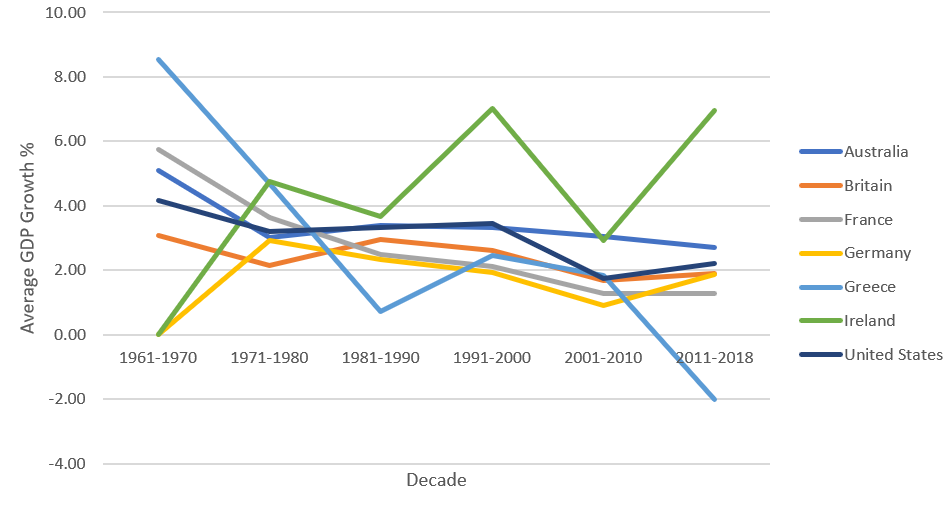
Entering the 1970s, this extended period of growth came to an end, a development that was exacerbated by the 1973 Oil Crisis. This began a prolonged period of substantially lower growth in the economies of the advanced capitalist countries (see Figure 1). This prolonged period of low growth has been punctuated by short booms and regular economic crises.

Figure 1: Average GDP Growth, World Bank National Accounts Data.

Penetration of capitalist relations into everyday life
An important aspect of the capitalist response to the over-accumulation crisis has been an attempt to find new avenues for investment and the extraction of profits. The focus for this drive started, and has continued, with the push for corporatising, and then privatising, government-owned corporations.

In the past 30 years, this has expanded to efforts to commodify substantial areas of what had previously been the private domestic domain, with the mass expansion of the services industry. This drive has resulted in the opening up of new aspects of social life for profit-making, as well as the intensification of working life – particularly for working women, who bear double and triple shifts as workers while continuing to carry out the central role in social reproduction.

The process of expanding commodification has been further intensified by the development of the gig economy. This has generated new technologies that have enabled capital to regularise social exchanges for profit. At the same time, capital has shifted substantial costs onto the gig workers themselves, in exchange for providing a platform linking workers with consumers – a platform that has intensified the capacity of capital to monitor and exploit labour.

The growth of the gig economy has also intensified crises in other parts of the economy, as previously dominant market players are forced to compete with numerous individual operators linked via platforms.

Financialisation
As the expansion of profits through the real economy became more difficult with the saturation of markets and problems of over-accumulation, capital shifted its focus towards investments in financial markets and the creation of new and novel financial instruments, expanding interest-bearing capital in both intensive and extensive forms.

This has resulted in a massive expansion in the volume of financial transactions and in the relative weight of the finance industry in economies. This process of increasing complexity and weight is called financialisation.

It can create the impression of a decoupling of the ‘real economy’ and ‘financial services’; however, in reality they remain intimately connected with the speculation in the financial markets essentially being a series of bets and counter bets on the real economy.

The immediate catalyst of the 2007-2008 global financial crisis was the failure of US sub-prime mortgages and its ripple effect through the bond market, which rapidly spread through other vulnerable sectors within both the ‘real economy’ and the ‘financial services’ sector.

Decline in wage growth
In 2019, in response to widespread public concern regarding record low wage growth, Australian finance minister Mathias Cormann described (downward) flexibility in the rate of wage growth as “a deliberate design feature of our economic architecture”.

This statement reflects not just the determination of individual capitalists to drive down wages, but the active efforts to transform the industrial relations environment in advanced capitalist countries to undermine the ability of workers and their unions to fight to defend wages and conditions, let alone advance them.

This process of undermining organised labour – central to the neoliberal project – is also based on a race to the bottom between jurisdictions. Employer groups, neoliberal thought leaders and governments point to efforts that have been made in other jurisdictions to erode workplace rights and be internationally “competitive”.

Lapavistas et al. argue that in response to the global financial crisis and sovereign debt crisis in the European Union’s Economic and Monetary Union (EMU) there has been a renewed pressure to increase labour productivity within all economies of the EMU.

This has placed downward pressure on wage growth, with German capital being the most successful in achieving this within the EMU. As a result, Germany has been best placed to sell goods and services to other member states and to markets outside the common market.

The impact of these dynamics can be seen in the ongoing low wage growth across the OECD, which demonstrate that the burden of low economic growth since the end of the global financial crisis has primarily been shifted onto working people (see Figure 2).

Figure 2: Wage Growth, OECD (2020), “Average annual wages”, OECD Employment and Labour Market Statistics (database).

This combined pressure to increase labour productivity while at the same time limiting wage growth has resulted in a decoupling of labour productivity and wages, which had historically been correlated (see Figure 3).

Figure 3: Decoupling of wages and productivity. Source: OECD (2018), OECD Economic Outlook, Volume 2018 Issue 2, OECD Publishing, Paris.

This decoupling has meant that while capital continues to experience growth – albeit at a rate insufficient to quell its insatiable hunger for growing profits – working people are failing to see any real benefit for their increased productivity.

As a result, in order to maintain spending power, working people became increasingly reliant on borrowing, whether in the form of credit cards or payday loans, to meet day-to-day spending costs (see Figure 4).

Figure 4: Household Debt as Percentage of Household Income, OECD (2020), Household debt (indicator).

Rising household debt ultimately exacerbates the problems of the declining purchasing power of the working class. This decline in purchasing power also negatively impacts on the capacity of economies to grow, deepening the crisis tendencies.

The long-run capitalist economic crisis that started with the end of the long boom, and which is now intensifying with the current COVID-19 pandemic, is prompting a more aggressive orientation by both state actors and individual capitalists.

This aggressive posture means that collective bargaining more readily lays bare the class struggle. For working people and their unions to be able to effectively respond to this environment will necessitate being prepared for direct challenges to capitalist power.

Failure to do so effectively and adequately will see a deepening of the shift of more and more of the product of workers’ labour into profits, leading to the further inequality not only within societies but within the working class itself.

-------------------------------------------------------------------------------
Originally published by the Irish Broad Left

Read more...

About This Blog

Revitalising Labour attempts to reflect on efforts to rebuild the labour movement internationally, emphasising the role that left-wing political currents can play in this process. It welcomes contributions on union struggles, internal renewal processes within the labour movement and the struggle against capitalism and imperialism.

  © Blogger templates The Professional Template by Ourblogtemplates.com 2008

Back to TOP  

Creative Commons Licence
This work is licensed under a Creative Commons Attribution-NonCommercial-ShareAlike 3.0 Australia License.