Saturday, October 3, 2020

Is increasing the superannuation gaurantee the solution to poverty in retirement?


Lisbeth Latham

In 2021 workers are scheduled to receive a point five per cent increase in the superannuation guarantee paid by employers, this increase has become the centre of a new struggle as the government is widely expected to again delay this increase. In response unions, particularly unions representing predominantly feminised workforces, have been trying to build public pressure on the government to not postpone the increase based on the need to combat the problem of retirement poverty particularly amongst women. Largely absent from this discussion has been the question of whether the superannuation system operating within Australia is an effective or appropriate mechanism for providing economic security for in their retirement.

Prior to the 1980s, superannuation schemes were primarily part of industry awards negotiated by unions, and they applied to only a minority of the workforce, predominantly men. The current compulsory employer superannuation contribution scheme was first established as part of the Prices and Incomes Accord under the Hawke Labor government in 1986. The initial employer contribution was set at 3%, this was funded as a deferred pay rise for workers, and thus whilst nominally “paid for” by employers was actually paid for by working people. The idea was the superannuation scheme would help provide a better standard of living for workers in retirement based on three pillars: 
  • a safety net consisting of a means-tested government-funded age pension; 
  • compulsory employer contributions to superannuation funds; and 
  • further contributions to superannuation funds and other investments.
As the scheme was envisioned not as a supplement to the aged pension, but a replacement for it, it was a mechanism by which the cost of supporting retired workers off of the state (and therefore capital), and back onto working people themselves. Moreover, with the majority of workers not expecting to be reliant on the pension, it was politically easier for successive governments to let the aged pension decline as a proportion of the median wage, albeit not by as much as other welfare payments, as a consequence those retirees who were unable to build up a sufficient superannuation fund, and who were forced to rely to rely on the aged pension face a retirement in poverty, highlighted by Australia having the second-highest poverty rates in the OECD amongst people aged over 65, with 35% per cent living in poverty against an OECD average of 14%.

In response to this growing problem of poverty of old age, the Rudd Labor government in 2012 legislated for a stepped increase in the compulsory employer contribution by point two-five of a per cent every year until it reached a super contribution of 12%. However, only the first two increases were made, as following the ALP losing government, the Abbot Coalition government postponed the remaining increases, and they won’t begin until July 2021. As we have gotten closer to the next increase pressure has been building for a further delay, now justified by the COVID pandemic, as a way for businesses to instead use the money to boost the economy by instead using the money earmarked for the increased super guarantee money for wage growth to boost the economy.

Of course, there is no reason to expect a further postponement of the superannuation payment will result in a boost to any part of the economy other than company profits. The previous postponement occurred during a period of record-low wage growth in Australia. Whilst companies will have been factoring the scheduled increase into their bargaining positions, there is no mechanism via which companies can be made to shift the expenditure into higher wages - they would more than likely just pocket it as profits.

However, while the logic for business and the LNP’s opposition to boosting the employer contribution is flawed and deeply cynical, this does not mean that increasing the contribution is an effective way to address poverty in old age amongst working people.

Increasing the employer superannuation contribution will not eliminate inequality in retirement, it is more likely to increase it. This is not to say it won’t boost the potential balances of retirees with projected lower balances, it will, but the primary beneficiaries of any boost in super contributions will be those workers who already have the largest balances. This is because the whole superannuation system is built on an unequal system, where women on average have lower incomes and are more likely to have breaks in their employment. Moreover, it does nothing for those members of the working class who are entirely excluded from the labour market due to injury, disability, illness, or caring responsibilities whose marginalisation from the labour market and resultant poverty extends into retirement.

Average Balances by Age Group 2016
Age Average Balance - Men Average Balance - Women
20-24 $5,294 $5,022
25-29 $23,712 $19,107
30-34 $43,583 $33,748
35-39 $64,590 $48,874
40-44 $99.959 $61,922
45-49 $145,076 $87,543
50-54 $172,126 $99,520
55-59 $237,022 $123,642
60-64 $270,710 $157,049

Source: Association of Superannuation Funds of Australia, Superannuation account balances by age and gender 2015-16, October 2017, pg. 9.

Adding to this problem is the fact that whilst Australia’s massive superannuation system is seen as being highly stable due to its size, it is built on and contributes to the instability of the financial markets. At the end of the June 2020 Quarter, the total value of Australian Superannuation assets was $2.9 trillion, approximately 155% of GDP. This massive volume of assets has pumped money into a system driven primarily by speculation - giving the sense superannuation is a guaranteed future income. However,, we have repeatedly seen massive amounts of wealth wiped out of the value of superannuation savings as a consequence of the inherent instability in the domestic and international financial systems - the bulk of which play no productive role in the real economy.

Following the 2008 Global Financial Crisis, the average balanced fund lost 22% of its value. Whilst the average asset value was back at pre GFC balance by 2012, that was just to get back to the level and part of that was based on contributions into the funds not gains in the value of assets. We can expect to see a continued cycle of funds losing huge amounts of wealth and having to rebuild it over time, delivering retirement insecurity and uncertainty to working people.

So what is the solution? While ideally, we would start from scratch with a more equitable pensions system that meets the needs of all working people - such an approach would face significant resistance including from working people, who would see it as a government raid on their retirement savings. In this context, the solution is to maintain the current three-pillar system, but shift the priority onto the old-age pension ensuring that it provides a liveable income to all, so rather than being a safety net is sufficient to provide a comfortable existence and can then be supplemented via other mechanisms. This emphasis would be achieved by generating income by withdrawing the tax-free thresholds from superannuation and instituting a truly progressive taxation system which substantially increases the tax rates on high-income earners, ramps up company tax, and closes the capacity of companies to offshore their tax liabilities.

-------------------------------------------------------------------------------
This article is posted under copyleft, verbatim copying and distribution of the entire article is permitted in any medium without royalty provided this notice is preserved. If you reprint this article please email me at revitalisinglabour@gmail.com to let me know.

Read more...

Thursday, September 17, 2020

Keynesianism Is No long-Term Solution To The Economic Crisis

Lisbeth Latham

The current COVID pandemic has caused massive financial damage to the global economy, damage which has been felt viscerally by working people in the form of dramatically reduced incomes and the loss of millions of jobs. As we progress through the pandemic and look hopefully towards its ending and eventual recovery, minds have begun to look towards what the eventual rebuilding of the economy might look like. Whilst capital, and its representatives in governments, are already looking towards an, even more, deregulated labour market and a general deepening of the neoliberal model, on the other hand, alternative models for recovery are being forward, most particularly that proposed the by the Australian Council of Trade Unions which draws its inspiration from the post-war recovery globally and most particularly in Australia post the Second World War. While this example has understandable appeal, it is well known, it refers to a period of massive and sustained economic growth. It is a deeply problematic model for recovery to the current period of crisis as it fails to understand the roots of the recovery post Second World War which will not be easily replicated but more importantly fails to recognise the broader reality of the global climate crisis that also confronts us, and which should mean we are wary of productivist solutions to this crisis.


The current moment of twin crises of the COVID pandemic and climate change makes it both opportune and vital that progressive forces put forward a vision of a potential course of action. A course which not only facilitates economic recovery but also addresses key questions economic justice. Specifically, this means charting both a course to enable the global transitioning of the economy away from its reliance on fossil fuels and build ever-higher profits. At the same time, this process must also focus on reducing economic inequality both intra- and internationally.

In the wake of the war, the Australian government engaged in a large scale and ongoing social spending which included the building of infrastructure, such as the Snowy River Scheme and helped the Australian economy and society for an extended period of prosperity and helped the Australian economy and society for an extended period of prosperity. This spending and development played a significant part in creating employment in a context which risked mass unemployment. With demobilising armed forces and the waves of refugees that found homes in Australia in the wake of mass displacement caused by the Second World War and reconfiguring of post-war Europe. However, while it is undoubtedly the case that significant government spending was a major factor in this growth; it is not the only story.

It is important to remember that the post-war boom, which was a global phenomenon, occurred in the wake both the destruction and stagnation caused by the great depression and then shattering of the global economy and destruction of capital goods which occurred during the Second World War. This was a period of extended destruction of capital, which resulted in mass immiseration, destruction, and loss of life. This created an opportunity for an extended period of growth - which would not have been possible without this previous destruction. It lay the foundation for extended capital accumulation as countries like Australia were able to profit from the rebuilding much of Europe and East Asia. The ability to experience extended periods of growth was also expanded and extended by the ongoing arms build-up and destruction associated with the Cold War and the imperialist interventions in Korea and Vietnam. In addition, there was an opening up of a wide range of markets to international competition, markets which had previously been closed due to colonial relationships.

The current economic crisis, as devastating and destructive as it is, has not recreated the circumstances of the post-war period in any way. While COVID has unleashed a significant economic crisis as a consequence of a long run over-accumulation of capital, the COVID crisis has primarily stalled the global economy, disrupted in supply chains, and reduced demand and spending power as millions of people have either seen their hours reduced or lost employment entirely. It has not, at least not currently, substantially damaged or reduced the volume of capital goods in the real economy. Particularly not at the level of destruction which would be necessary to enable an extended period of acceleration and growth in profitable investment in the real economy. Which means that it is highly unlikely for the current crisis to reproduce a similar period of growth post the current crisis to that of the post-war boom. 

The significance of this difference can be seen in the what happened to the economies of the advanced capitalist countries at the end of the long-boom, where government stimulus spending was no longer able to smooth the business cycle and enable ongoing growth, but instead resulted in a prolonged period of stagflation, which is characterised by low growth, high unemployment, and high inflation. Any extended attempt at smoothing the business cycle now is likely to result in a similar outcome, particularly, as I will discuss later, as capital is flush with surplus capital.
This is not to say that there should not be an effort to stimulate the economy. Instead, the object of any stimulus should not be modelled on the post-war recovery other than to say it is possible to carry out large scale government spending - just as the government spending of the second world war demonstrated the possibility of massive government spending in the post-war period.

Many small and medium, and some large, businesses will go bankrupt during the current crisis. Any government stimulus should be aimed at supporting these businesses to minimise the impact of any such collapse on the hundreds of thousands of workers employed by them. However, we can see the problem of excess capital in the system even now, where the stock markets globally continue to rise despite being the global economy being in a massive down-turn (admittedly much of this rise isolated to those sections of the stock market that have been seen as a “safe bet”, particularly tech stocks). So government spending in the post-COVID recovery would be best focused on either establishing worker cooperatives or state-run initiatives. Where spending does flow to the private sector it should be tied to the shifting of ownership in part or whole to the state and to establishment and expansion of workplace democracy in those organisations. With a focus then being on a discussion on refocusing these enterprises to meet the needs of society, the workers, their communities rather than achieving private profits.


Chart: All Ordinaries Index 2000 - 2020, source: Market Watch.

Beyond this problem - there is a deeper existential one. Our planet is on the verge of environmental collapse, the biggest threat is climate change, but we have a significantly broader problem, which even if we could achieve a change in the carbon budget, we would be faced with the fact that the planet cannot sustain the need of capitalism to constantly expand and grow. This drive towards growth and expansion is not driven by a commitment to meet human consumption needs - it is entirely disconnected from them and puts human life at risk and threatens to accelerate the metabolic rift being experienced by the planet.

As such while there is space for:
  • Expanding manufacturing for transitioning the Australian economy and those of other countries away from fossil fuel-based energy production;
  • Growing local manufacturing to reduce our reliance on importing manufactured goods and the associated environmental impact of large scale transport;
  • Supporting and funding the transition away from fossil fuels for countries of the global South supporting the development of their local manufacturing and agriculture;
  • Construction of public housing with an emphasis on better quality and more sustainable housing stock;
  • Expanding recycling industries as part of an effort to reduce our reliance on extractive industries for raw materials;
  • Expanding the scope and frequency of public transport;
  • Repairing and strengthening of public services, most notably health, education, and research which the crisis has demonstrated have been woefully under-resourced as a consequence of decades of neoliberalism;
  • Growth in employment in counteracting the destruction that capitalist development has wrought on the environment;
  • Shifting agricultural practices to more sustainable forms;
  • Establishment of a conservation body aimed at direct remediation of the environment and ecosystems
There is no space for a drive for an extended period of growth in the output of either capital or consumer goods.

It remains unclear how much work the focuses above would create. Collectively we need to start to re-envision what full-time work is. The focus on a five-day 38-hour workweek has resulted in both problems of unemployment and underemployment which combined was more than 13% prior to the onset of the pandemic in Australia. At the same time, workers in Australia who are employed full-time worked some of the longest hours in the Organisation for Economic Co-operation and Development. This meant that work is extremely unevenly distributed across the labour market. Rather than pushing for full employment based on 38-hour week model, we should be exploring how to more effectively share employment, particularly in socially and environmentally useful ways that will both enable working people to actually benefit from the last three decades growth in labour productivity by evening the spread of working hours, reducing income inequality across the workforce and ensuring those individuals those who are unable to work have their incomes lifted to a liveable level.

------------------------------------------------------------------------------- 

This article is posted under copyleft, verbatim copying and distribution of the entire article is permitted in any medium without royalty provided this notice is preserved. If you reprint this article please email me at revitalisinglabour@gmail.com to let me know.


Read more...

Tuesday, September 15, 2020

Superwealth: Understanding The Decoupling Of Stock Values From Real Economic Value


Lisbeth Latham

Global wealth inequality is reaching historic highs. Inequalities have been both highlighted and exacerbated by the current crisis. However, while the world’s super-rich are obscenely wealthy, most discourse around this issue fundamentally misunderstands and misrepresents the nature of much of this wealth – which, in turn, can distort our view of what addressing this inequality should look like.

Deindusrialisation and financialisation
As the global, post-war long boom came to an end in the late 1960s and early 1970s, capital began to intensify a range of processes that had been at play in the economies of the advanced capitalist countries. Most notable of these was the process of deindustrialisation, as capital shifted manufacturing from high-wage, heavily organised factories in the metropolitan centres of the Global North to the periphery – initially of the imperialist countries themselves, and then to former colonies and neo-colonies of the Global South.

This shift temporarily boosted profits and provided spaces for these profits to be reinvested, but this was possible only up to a point (though repeatedly, capital shifted from one low-wage country to the next in response to worker organisation and resistance). Capital still faced the problem of what to do with the new profits being generated, and to maintain profit growth the capitalist class sought desperately to find new areas to invest in.

While new technologies have developed and state-owned industries have been pried open through privatisation, the main source for investment and reinvestment of profits was in the financial markets, where new and more bespoke products, with ever more rapid exchanges and turnovers, were developed as mechanisms through which to make money. This process of shifting investment and money out of the real economy and into financial markets is known as financialisation.

The 60 stock exchanges around the world currently have a total capital value of $69 trillion. The growth in financial markets over the 45 years can be seen in the S&P 500 index, which tracks the value of the top 500 stocks and equities on the US New York Stock Exchange, NASDAQ and Cboe BZX Exchange.

The S&P 500 had an average closing price of 21.0 points in 1930. This rose to 86.18 in 1975, and to 3,050.00 in 2020. Similarly, the Irish Overall Index, which has measured the value of stocks on the Irish Stock Exchange since 1989, has grown from a closing price of 1,586 in 1989 to 6,464 on 3 August 2020.

The S&P 500 Index, Historical Chart 1928-2020.

Stock market detached from economic performance
This growth in the value of capitalisation on a stock exchange, while significant, does not necessarily reflect the same level of growth in the real-world performance of the underlying companies and equities. These two factors can be significantly out of step with each other, resulting in financial assets being either significantly over or undervalued.

When they are overvalued, which can occur for a range of reasons, a bubble can form. When the two values come back together, considerable losses, both notional and real, can occur (up until an individual sells their assets all gains and losses are purely notional).

So what does this mean for the wealth of people like Jeff Bezos, Bill Gates and Mark Zuckerberg? These individuals are undoubtedly obscenely wealthy, and they have significant political power based on their wealth and control of large companies that play a central role in the global economy.

However, as impressive as it can sound to say that Bezos is worth $190.6 billion, or that his wealth has increased by $74bn this year, much of this wealth is simply not real. These statements are supposed to sound impressive to build on the myth of these great capitalists ‘creating wealth’.

If we were to seize all of Bezos’s wealth and turn it over to the public good we would not gain $190.6bn. Instead, we would have a – not insubstantial, but far smaller – amount of money, and have a percentage share of a company with an annual revenue of $280.52bn and net profits of $11.588bn, profits that would be sharply reduced as we dismantled Amazon’s super-exploitative employment practices and its parasitic relationship to other businesses.

The reality is that the bulk of the growth in the “value” of Amazon – which has seen its share price increase to a high this year of $3,312.49 compared to an average price of $1,789.19 in 2019 – has not been driven by a significant increase in the performance of the company, but rather by a perception of Amazon and other similar companies as a safe bet by some investors, and by hedge funds looking to make money from speculation based on this perception.

The Financial Times reported on 20 August that we have entered a new renaissance for hedge funds using a macro investment strategy (strategies based on assessment of shifts in geopolitical and macroeconomic trends in countries), saying: “The main fund at Brevan Howard, the firm headed by billionaire Alan Howard, was up over 21 per cent in the first half of 2020; Paul Tudor Jones’s flagship fund at Tudor Investment Corporation has gained 8 per cent through July; and Chris Rokos’s Rokos Capital Management has climbed 24 per cent through to the end of July, according to investor documents and people familiar with the matter.”

It continued: “Caxton Associates has returned 31 per cent this year, according to investors, while a fund run by the firm’s chief executive Andrew Law is up 42 per cent. Meanwhile, Louis Bacon’s Moore Capital, which last year decided to eject the remaining external investors from its flagship funds after a long barren stretch, notched up a 25 per cent gain in seven months through July.”

None of this is to say that we should not aim to nationalise large companies, and put them to the use of meeting the needs of people. But we need to be aware that the amount of real value locked up in these companies is overstated, and has much more to do with stroking the egos of the rich and reinforcing ruling-class myths than it does with the actual potential social good these companies could perform.

-------------------------------------------------------------------------------  

Originally published by the Irish Broad Left.

This article is posted under copyleft, verbatim copying and distribution of the entire article is permitted in any medium without royalty provided this notice is preserved. If you reprint this article please email me at revitalisinglabour@gmail.com to let me know. 

Top image: Jeff Bezos. Photo by Michael Prince/Forbes.

Read more...

Friday, September 4, 2020

JobKeeper Exec Bonuses and Dividends Were Built into the System

Lisbeth Latham

In the last week, news has leaked regarding companies in receipt of JobKeeper wage subsidies either paying their executives large bonuses or paying out dividends to shareholders. This development has led to claims that these companies are rorting JobKeeper. However, while these payments are clearly immoral, far from being a rorting of JobKeeper, they are entirely consistent in the government’s intent of JobKeeper as primarily a subsidy to business.

Source: Unions NSW

When JobKeeper was legislated I described it as “for companies still employing people in work, the subsidy is more a subsidy to their profits rather than a wages subsidy”. This was because rather than provide a wage subsidy from which workers could build their income towards their pre-COVID level if work was available, the subsidy established an amount of payment which eliminated the need for a business to pay its workers wages for their work until they had performed the equivalent amount of work as the subsidy. This had the effect of both ensuring that hundreds of thousands of workers experienced a significant decline in their income whilst companies and organisations could redirect revenue that would normally have gone to covering wages to other things including paying executive bonuses and dividends to shareholders.

So while people are right to be angry at companies prioritising bonuses and dividends, we need to be clear - they aren’t “rorting” JobKeeper, they are using it precisely how it was designed to be used. The actions of these companies demonstrate the pressing need for a genuine wage subsidy scheme that guarantees the incomes of all workers regardless of contract type or residency status.

------------------------------------------------------------------------------- 

This article is posted under copyleft, verbatim copying and distribution of the entire article is permitted in any medium without royalty provided this notice is preserved. If you reprint this article please email me at revitalisinglabour@gmail.com to let me know.

Read more...

Sunday, August 30, 2020

A Transitional Programme for Today?

Lisbeth Latham

Radical Left movements across the globe face multiple challenges that place human survival at stake. At the same time, our movements are currently not strong enough to effectively challenge capitalism and the determination of the capitalist class and their representatives to prioritise profits over human life and survival of the planet.

This poses the question of how we can start to cohere and build the capacity of the popular classes and oppressed people to unite and struggle for a better world. One possible source of inspiration for strengthening the movement may be the Transitional Programme, which was written by Russian revolutionary Leon Trotsky in 1938 as part of a process to cohere and regroup consistently revolutionary forces.

What is the transitional programme?
The Transitional Programme, or The Death Agony of Capitalism and the Tasks of the Fourth International, was the key programmatic document of the Fourth International at its founding in 1938. The programme was drafted by Trotsky with the aim of bridging the historic divide between the revolutionary movement’s minimum programmes (demands raised within the movement, and particularly in parliamentary campaigns, regarding the reform of capitalism) and maximum programmes (the actions that would be taken upon the seizure of power by the working class).

The aim was to build into the minimum programme demands that would more sharply challenge the power of capital, and demonstrate to working people the limitations of democracy under capitalism while building their confidence in achieving something more – these were the “transitional demands”.

The context of the transitional programme
The transitional programme was written in late 1930s, a period during which the labour movement was surging in many countries, but had also suffered heavy defeats at the hands of fascism (Germany, Italy) or was involved in revolutionary struggles that would result in defeat at the hands of fascism (Spain).

It was also expected that the world was heading to a new inter-imperialist war that would be aimed at the overthrow of “actually existing socialism” in the Soviet Union.

Within this context, the tiny Trotskyist movement had been going through an extended period of seeking to unite and build a new revolutionary and anti-Stalinist pole within the workers movement, including the semi-mass centrist parties Workers Party of Marxist University (Spain), the Independent Labour Party (Britain), and the Revolutionary Socialist Party (Netherlands), which involved or were founded by left-oppositionists. This effort ultimately failed with only the Revolutionary Socialist Party participating.

In this context, the programme was aimed at providing an ideological weapon with which the small Trotskyist forces in the global workers movement could agitate around and build both influence within the movement and support for the programme, either in whole or in part.

The Transitional Programme is made up of three distinct types of demands. These are: 

  • immediate demands, primarily around economic issues; 
  • democratic demands around expanding and strengthening democratic rights; and 
  • transitional demands aimed at fundamentally challenging the power and authority of capital itself.

It is important to remember that the Transitional Programme was not intended as a final and finished document; it was instead intended as a framework for revolutionary organisations to develop their responses to known challenges, but also new challenges to the development and dynamics of the class struggle. So while it is possible to simply deploy an existing demand from the programme in response to the struggle of today, it is also just as viable to develop new responses to any challenges that emerge.

Immediate demands
Immediate demands are probably the simplest and easiest demands to understand and develop. They are aimed at responding to the immediate struggles of the day and are essentially based on the target of the demand either stopping doing something, or begin doing something.

Examples would be calls for a doubling of unemployment benefits or an increase in funding to higher education. A problem with immediate demands is that, once achieved, they can and will be undermined by capital and the state.

Democratic demands
Democratic demands seek to either defend or expand existing democratic rights or establish new ones. Examples of democratic demands include demands around expanding the franchise or citizenship, expanding rights and protections such the demand for marriage equality or anti-discrimination legislation, or expansion of community control over their own lives such as minority language rights or establishment of the right to recall elected representatives.

Again, these advances are always subject to being rolled back or subverted by capital and the state, such as the weakening and defanging of environmental protections that has transformed many such agencies into bodies that effectively authorise polluting the environment, rather than protecting the environment from pollution.

Transitional demands
Transitional demands go much further than either immediate or democratic demands. They don’t simply seek to address something happening right now but seek to fundamentally undermine the power of both capital and the state and shift power into the hands of working people. While still capable of being subverted (because everything is) they are far more robust than the other two types of demands.

Examples of transitional demands include:
  • Escalator clauses, through which, in addition to any negotiated pay rise, workers receive automatic pay rises in response to inflation. This acts to not only increase wages, but to protect wage gains from inflation, ensuring wage growth not just in absolute but relative terms;
  • Sliding hour and wages scales. This demand seeks to protect both jobs and wages of workers, particularly during periods of technological change, by responding to any attempt to shed jobs by requiring working hours for workers to be reduced instead of jobs being cut, and the hourly pay increased in order to maintain weekly wages. The demand means that the benefit of technology improvement flows onto working people in the form of reduced working hours rather than simply boosting profits and resulting in increased unemployment.

The nature of the transitional demand
A key debate that has existed around the transitional demand is (1) whether it is achievable under capitalism, or (2) whether it is simply a document for a transition period.

On the second point, this is clearly a misunderstanding of the role of the programme. While it was developed in a period where the Trotskyist movement expected and predicted an expansion of the class struggle in which the question of the transition to socialism would be posed, it was not the situation that they immediately faced, and their forces were not such that they would be in a position to be applying their programme.

Moreover, it does not make sense for many of the demands within the programme to be raised in periods of transition – whether this is a situation of dual power (where there are both capitalist and working-class organs of power existing side by side) or in a workers’ state (the working class would not need to be making demands in this situation, the organs of workers power would just act). Instead, it was an agitational document aimed at engaging workers in the here and now.

With regard to the first point, it is not knowable what capital, and its representatives in government, will concede, at least in the short-term, in the hope of maintaining control and power with the aim of subverting any concessions as the movement ebbs and recedes. The bigger and more conscious the movement, the more desperate capital will be to offer concessions in the hope of returning to a period of peace.

Moreover, individual transitional demands have been achieved and won by the labour movement. For example, cost-of-living allowances, which provide wage increases to workers in response to inflation, have been a feature of a significant number of US union contracts since the 1950s. This is a consequence of US unions, most notably the United Auto Workers, adopting the escalator clause as part of their bargaining demands as a consequence of the influence of Trotskyist-led locals pushing these demands in the late 1940s.

Transitional demands for today
While a modern-day transitional programme would feature a lot of the original demands, it does need updating in order to meet the challenges of today – particularly in relation to the challenges around climate change, indigenous rights and anti-racism struggles, globalisation and the #MeToo movement.

Such transitional demands could include, but should not be limited to:
  • Demands focused on expropriation and bringing major polluters under workers control to fund just transitions to environmentally sustainable zero-carbon economies;
  • Requirements that any company operating in multiple counties must abide by environmental, labour and anti-discrimination legislation not only in its ‘home’ country but in all the countries it operates in, with communities in other countries able to bring suits under these laws;
  • The defunding and disarming of police, with these services brought under the control of local communities of colour;
  • The criminalisation of efforts of officials holding power to discourage or undermine the prosecution of sexual assault allegations;
  • Free movement of all working people with the right to a liveable income for all working-class people, whether in employment or not;
  • Taxation on speculative financial transactions;
  • A four-day work week with no loss in pay (with commensurate reduction in working hours for workers who do not work full-time);
  • No bailouts or government contracts for companies based in tax havens;
  • Any government-funded bailouts must be tied to commensurate state equity in the firm, with the establishment of mechanisms for industrial democracy in the firms;
  • A ban on redundancies in profitable companies, or firms in receipt of bailout money;
  • Free paid training for workers who are in industries that are affected by the transition to a carbon-free economy.

The transitional programme and its associated demands is not a magical solution. The work of the Left will not be, and is not, completed by raising a particular demand, no matter how brilliant its formulation. The purpose of demands is to create mechanisms in which potential solutions to the problems confronting working people can be posed to them – with the aim of winning people to that solution, but also to the need for political action to achieve it.

By drawing people into action in support of concrete demands we can build the confidence and organisational capacity of the class to take action in their own interest and the social power of all working people. And by doing this, we can build a movement that is sufficiently confident and powerful to meet the existential challenges we are faced with. 

------------------------------------------------------------------------------- 

This article was originally published by the Irish Broad Left.

This article is posted under copyleft, verbatim copying and distribution of the entire article is permitted in any medium without royalty provided this notice is preserved. If you reprint this article please email me at revitalisinglabour@gmail.com to let me know.

Read more...

Sunday, July 19, 2020

Superannuation and the Morrison Government's Determination to Make Working People Pay for the Crisis

Lisbeth Latham

A central plank of the Morrison Government’s response to the economic uncertainty and crisis unleashed by the COVID pandemic has been its policy of allowing working people to draw down their superannuation accounts by $10, 000 in each of the 2019/2020 and 2020/2021 financial years. Hundreds of thousands of people have now accessed their accounts for a range of spending, and while the individual decision to draw down super accounts has been criticised by some commentators, the real question is what Australia now does in a context where the problem of retirement poverty is likely to have been exacerbated?

The government’s announcement that people could draw down their superannuation account - particularly by such relatively large amounts, was a tacit admission by the government that its broader economic response to the current crisis was an entirely inadequate response. The most notable example of this being JobKeeper the program, which actively excluded millions of workers and for millions more it was inadequate to enable them to meet their financial obligations. Why else would the government believe that people would need to draw up to $20, 000 from their retirement savings than if they knew that they were not going to meet their financial obligations drawing on the welfare system?

Drawing down superannuation savings wasn’t just an individual tragedy for those workers, there was and continues to be a real danger that the individual decisions to draw down accounts would cause liquidity problems for Australia’s massive superannuation system, and further exacerbate the decline of the financial markets with up to $50 billion drawn down. This situation has led to individual criticisms of workers who chose to draw down their accounts. With some media outlets critical of both people accessing funds without experiencing a personal loss of income and individual spending decisions. Apart from a severe misreading of what this spending represented - the majority of it consisted of either paying down debt, making significant large purchases that would otherwise incur debt, or meeting day to day, or week to week living expenses. Criticising individuals for drawing down their life savings in a context generalised system failure appears to be at best misguided if not totally disingenuous and malicious. People facing a collapse in their disposable income given access to their super were always going to access it - it that is why the government made it available. If anyone should be blamed for the money being accessed and spent it is the government.

The problem with the spending is not what people spent their superannuation money on, but that it was necessary. We know that a significant number of the people drawing down their superannuation accounts will have been women and people in less secure and lower-paid employment. These are groups are all at greater risk of experiencing poverty in retirement in a system that already produces some of the largest proportion of people over the age of 65 living in poverty within the OECD. With 2.5 million people expected to draw down their super, and more than 480, 000 people now having a zero superannuation balance. This problem of retirement poverty in Australia can only be expected to get worse. In addition, the running down of workers superannuation balances could have an immediate impact, as workers with less than $6, 000 in their superannuation accounts are no longer provided with default insurance by their fund.

Country    65+ Living in Poverty
Australia
   23.7%
France
   3.6%
Germany
   10.0%
Korea
   43.8%
Japan
   19.6%
Britain
   15.3%
US
   23.1%
OECD 
   14.2%

Table 1.0 Poverty Rate Amongst the Elderly. Source: OECD. 2020. OECD Income Distribution Database (IDD): Gini, poverty, income, Methods and Concepts. http://www.oecd.org/social/income-distribution-database.htm. Accessed July 18, 2020.


The problem of hundreds of thousands of older Australians retiring into poverty has been an issue in policy development. The main solution that has been put forward has been to lift the compulsory employer superannuation contribution from 9.5% to a higher figure, the most notable one being 12% which had been legislated to increase incrementally by the Rudd government. This increase was subsequently delayed by the Abbott government, with the increase to 10% not scheduled until July of 2021. It is unclear that this will go ahead, and the need to increase to 12% has been the focus of a number unions, most notably the Australian Services Union, Finance Sector Union, and Shop, Distributive, and Allied Employees Union. While there is an undoubted logic that the easiest and best way to address retirement poverty is to boost the amount of money going into workers’ superannuation accounts, this ignores the fundamental problems with the superannuation system:
  • It shifts the problem of supporting working people in their retirement from society as a whole to workers during their working life - which has contributed to and justified the inadequate pension system within Australia; 
  • It reproduces and exacerbates the income inequality that already exists in the Australian economy, most notably the gender wage gap; 
  • Australia’s super system props up financial markets - with the funds being worth $2.7 trillion in March 2020 - and makes workers retirement income and wealth entirely dependent on the stability of these markets (which experience shows is not at all reliable)

Given these serious limitations, limitations that have existed, and were built into, the superannuation system from its inception, what is the solution? It has to be a significant re-envisioning of Australia’s entire pension and welfare system to view that all people deserve a liveable income which guarantees a minimum quality of life irrespective of the ability of an individual to work. Work would then enable people to enhance and improve on that standard of living both now and into retirement. However, this universal welfare system would be funded both by steeply incrementing progressive income tax system combined with a concerted effort to ensure that corporations are levied increased tax levels which they are actually required to pay.

------------------------------------------------------------------------------- 

This article is posted under copyleft, verbatim copying and distribution of the entire article are permitted in any medium without royalty provided this notice is preserved. If you reprint this article please email me at revitalisinglabour@gmail.com to let me know.

Read more...

Monday, July 13, 2020

Capitalism’s Accumulation Crisis Prompts Attacks On Wages And Organised Labour

Lisbeth Latham

The central driver of the capitalist system is the drive for capitalists to constantly increase profits – failure to do so can be a trigger for a crisis within the capitalist system.

Since the end of the long boom in the early 1970s, capitalism, particularly in the advanced capitalist countries, has entered a period of long-run crisis under which individual capitalists have sought to find ways to continue to expand profits during a period of chronic over-accumulation.

This crisis has prompted the search for new avenues for profitable investment and the attempt to maximise returns on the existing capital in circulation. Despite sporadic periods of temporary growth, the past 50 years have been punctuated by regular national, regional, and global crises.

This protracted period of low growth, instability and crisis has seen capital and its representatives in government seek to adopt a range of strategies aimed re-establishing and stabilising growth. This strategy has at times been successful in the short term but ultimately has served to exacerbate capitalism’s crisis tendencies.

Capitalism’s over-accumulation crisis
Capitalism has an unquenchable thirst for the growth of profits. During the early period of industrial capitalism, this was easily achieved through the expansion of production. Its higher levels of productivity meant that capitalists could simply outcompete non-industrial producers, absorbing their markets and expanding profits.

As capitalism expanded, however, markets began to be saturated. While investing in better and more efficient machines made individual workers more productive, this expansion in productive capacity became more expensive to achieve and risked companies producing more goods than could be profitably sold (known as a crisis of overproduction).

This problem could be addressed by finding new goods to be produced and generating corresponding new consumer demand. Over time there becomes a limit on the extent to which such new areas for profitable investment in production can be made, and capitalists begin to have far more money than they can reinvest profitably in the production of goods (known as a crisis of over-accumulation).

Such a crisis becomes generalised, and the capitalist economy can enter a profound period of crisis. Historically these crises have only been overcome either through massive recessions that result in the destruction of sections of capital, or through wars that also consume and destroy vast amounts of production and productive capacity, opening up the possibility for new periods of capitalist growth.

A long-run decline in growth
In the period coming out of the second world war, capitalist economies experienced protracted periods of high growth. This growth was in part a consequence of the rebuilding of Europe and Japan after the destruction of the Great Depression and the war. But it was also a result of the continued high levels of arms spending, particularly by the US, during the Vietnam and Cold Wars.

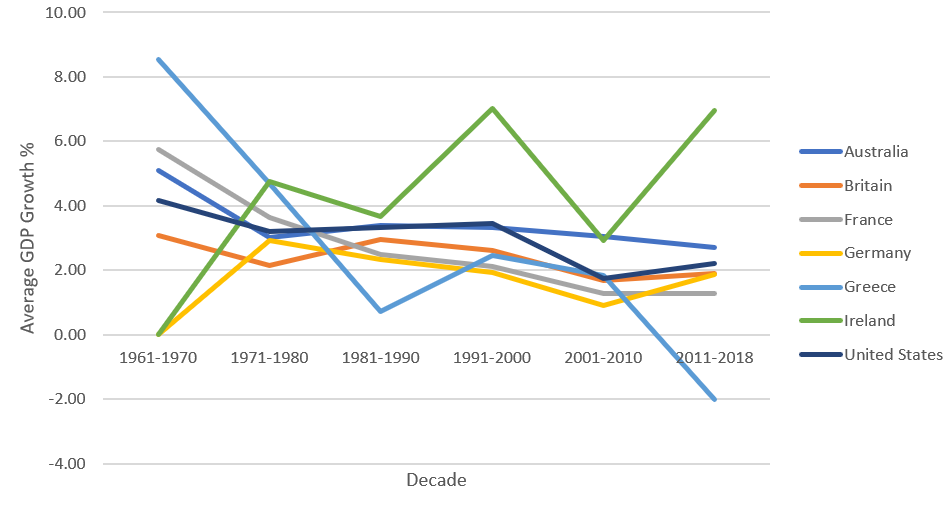
Entering the 1970s, this extended period of growth came to an end, a development that was exacerbated by the 1973 Oil Crisis. This began a prolonged period of substantially lower growth in the economies of the advanced capitalist countries (see Figure 1). This prolonged period of low growth has been punctuated by short booms and regular economic crises.

Figure 1: Average GDP Growth, World Bank National Accounts Data.

Penetration of capitalist relations into everyday life
An important aspect of the capitalist response to the over-accumulation crisis has been an attempt to find new avenues for investment and the extraction of profits. The focus for this drive started, and has continued, with the push for corporatising, and then privatising, government-owned corporations.

In the past 30 years, this has expanded to efforts to commodify substantial areas of what had previously been the private domestic domain, with the mass expansion of the services industry. This drive has resulted in the opening up of new aspects of social life for profit-making, as well as the intensification of working life – particularly for working women, who bear double and triple shifts as workers while continuing to carry out the central role in social reproduction.

The process of expanding commodification has been further intensified by the development of the gig economy. This has generated new technologies that have enabled capital to regularise social exchanges for profit. At the same time, capital has shifted substantial costs onto the gig workers themselves, in exchange for providing a platform linking workers with consumers – a platform that has intensified the capacity of capital to monitor and exploit labour.

The growth of the gig economy has also intensified crises in other parts of the economy, as previously dominant market players are forced to compete with numerous individual operators linked via platforms.

Financialisation
As the expansion of profits through the real economy became more difficult with the saturation of markets and problems of over-accumulation, capital shifted its focus towards investments in financial markets and the creation of new and novel financial instruments, expanding interest-bearing capital in both intensive and extensive forms.

This has resulted in a massive expansion in the volume of financial transactions and in the relative weight of the finance industry in economies. This process of increasing complexity and weight is called financialisation.

It can create the impression of a decoupling of the ‘real economy’ and ‘financial services’; however, in reality they remain intimately connected with the speculation in the financial markets essentially being a series of bets and counter bets on the real economy.

The immediate catalyst of the 2007-2008 global financial crisis was the failure of US sub-prime mortgages and its ripple effect through the bond market, which rapidly spread through other vulnerable sectors within both the ‘real economy’ and the ‘financial services’ sector.

Decline in wage growth
In 2019, in response to widespread public concern regarding record low wage growth, Australian finance minister Mathias Cormann described (downward) flexibility in the rate of wage growth as “a deliberate design feature of our economic architecture”.

This statement reflects not just the determination of individual capitalists to drive down wages, but the active efforts to transform the industrial relations environment in advanced capitalist countries to undermine the ability of workers and their unions to fight to defend wages and conditions, let alone advance them.

This process of undermining organised labour – central to the neoliberal project – is also based on a race to the bottom between jurisdictions. Employer groups, neoliberal thought leaders and governments point to efforts that have been made in other jurisdictions to erode workplace rights and be internationally “competitive”.

Lapavistas et al. argue that in response to the global financial crisis and sovereign debt crisis in the European Union’s Economic and Monetary Union (EMU) there has been a renewed pressure to increase labour productivity within all economies of the EMU.

This has placed downward pressure on wage growth, with German capital being the most successful in achieving this within the EMU. As a result, Germany has been best placed to sell goods and services to other member states and to markets outside the common market.

The impact of these dynamics can be seen in the ongoing low wage growth across the OECD, which demonstrate that the burden of low economic growth since the end of the global financial crisis has primarily been shifted onto working people (see Figure 2).

Figure 2: Wage Growth, OECD (2020), “Average annual wages”, OECD Employment and Labour Market Statistics (database).

This combined pressure to increase labour productivity while at the same time limiting wage growth has resulted in a decoupling of labour productivity and wages, which had historically been correlated (see Figure 3).

Figure 3: Decoupling of wages and productivity. Source: OECD (2018), OECD Economic Outlook, Volume 2018 Issue 2, OECD Publishing, Paris.

This decoupling has meant that while capital continues to experience growth – albeit at a rate insufficient to quell its insatiable hunger for growing profits – working people are failing to see any real benefit for their increased productivity.

As a result, in order to maintain spending power, working people became increasingly reliant on borrowing, whether in the form of credit cards or payday loans, to meet day-to-day spending costs (see Figure 4).

Figure 4: Household Debt as Percentage of Household Income, OECD (2020), Household debt (indicator).

Rising household debt ultimately exacerbates the problems of the declining purchasing power of the working class. This decline in purchasing power also negatively impacts on the capacity of economies to grow, deepening the crisis tendencies.

The long-run capitalist economic crisis that started with the end of the long boom, and which is now intensifying with the current COVID-19 pandemic, is prompting a more aggressive orientation by both state actors and individual capitalists.

This aggressive posture means that collective bargaining more readily lays bare the class struggle. For working people and their unions to be able to effectively respond to this environment will necessitate being prepared for direct challenges to capitalist power.

Failure to do so effectively and adequately will see a deepening of the shift of more and more of the product of workers’ labour into profits, leading to the further inequality not only within societies but within the working class itself.

-------------------------------------------------------------------------------
Originally published by the Irish Broad Left

Read more...

About This Blog

Revitalising Labour attempts to reflect on efforts to rebuild the labour movement internationally, emphasising the role that left-wing political currents can play in this process. It welcomes contributions on union struggles, internal renewal processes within the labour movement and the struggle against capitalism and imperialism.

  © Blogger templates The Professional Template by Ourblogtemplates.com 2008

Back to TOP  

Creative Commons Licence
This work is licensed under a Creative Commons Attribution-NonCommercial-ShareAlike 3.0 Australia License.