Lisbeth Latham
Radical Left movements across the globe face multiple challenges that place human survival at stake. At the same time, our movements are currently not strong enough to effectively challenge capitalism and the determination of the capitalist class and their representatives to prioritise profits over human life and survival of the planet.
This poses the question of how we can start to cohere and build the capacity of the popular classes and oppressed people to unite and struggle for a better world. One possible source of inspiration for strengthening the movement may be the Transitional Programme, which was written by Russian revolutionary Leon Trotsky in 1938 as part of a process to cohere and regroup consistently revolutionary forces.
What is the transitional programme?
The Transitional Programme, or The Death Agony of Capitalism and the Tasks of the Fourth International, was the key programmatic document of the Fourth International at its founding in 1938. The programme was drafted by Trotsky with the aim of bridging the historic divide between the revolutionary movement’s minimum programmes (demands raised within the movement, and particularly in parliamentary campaigns, regarding the reform of capitalism) and maximum programmes (the actions that would be taken upon the seizure of power by the working class).
The aim was to build into the minimum programme demands that would more sharply challenge the power of capital, and demonstrate to working people the limitations of democracy under capitalism while building their confidence in achieving something more – these were the “transitional demands”.
The context of the transitional programme
The transitional programme was written in late 1930s, a period during which the labour movement was surging in many countries, but had also suffered heavy defeats at the hands of fascism (Germany, Italy) or was involved in revolutionary struggles that would result in defeat at the hands of fascism (Spain).
It was also expected that the world was heading to a new inter-imperialist war that would be aimed at the overthrow of “actually existing socialism” in the Soviet Union.
Within this context, the tiny Trotskyist movement had been going through an extended period of seeking to unite and build a new revolutionary and anti-Stalinist pole within the workers movement, including the semi-mass centrist parties Workers Party of Marxist University (Spain), the Independent Labour Party (Britain), and the Revolutionary Socialist Party (Netherlands), which involved or were founded by left-oppositionists. This effort ultimately failed with only the Revolutionary Socialist Party participating.
In this context, the programme was aimed at providing an ideological weapon with which the small Trotskyist forces in the global workers movement could agitate around and build both influence within the movement and support for the programme, either in whole or in part.
The Transitional Programme is made up of three distinct types of demands. These are: - immediate demands, primarily around economic issues;
- democratic demands around expanding and strengthening democratic rights; and
- transitional demands aimed at fundamentally challenging the power and authority of capital itself.
It is important to remember that the Transitional Programme was not intended as a final and finished document; it was instead intended as a framework for revolutionary organisations to develop their responses to known challenges, but also new challenges to the development and dynamics of the class struggle. So while it is possible to simply deploy an existing demand from the programme in response to the struggle of today, it is also just as viable to develop new responses to any challenges that emerge.
Immediate demands
Immediate demands are probably the simplest and easiest demands to understand and develop. They are aimed at responding to the immediate struggles of the day and are essentially based on the target of the demand either stopping doing something, or begin doing something.
Examples would be calls for a doubling of unemployment benefits or an increase in funding to higher education. A problem with immediate demands is that, once achieved, they can and will be undermined by capital and the state.
Democratic demands
Democratic demands seek to either defend or expand existing democratic rights or establish new ones. Examples of democratic demands include demands around expanding the franchise or citizenship, expanding rights and protections such the demand for marriage equality or anti-discrimination legislation, or expansion of community control over their own lives such as minority language rights or establishment of the right to recall elected representatives.
Again, these advances are always subject to being rolled back or subverted by capital and the state, such as the weakening and defanging of environmental protections that has transformed many such agencies into bodies that effectively authorise polluting the environment, rather than protecting the environment from pollution.
Transitional demands
Transitional demands go much further than either immediate or democratic demands. They don’t simply seek to address something happening right now but seek to fundamentally undermine the power of both capital and the state and shift power into the hands of working people. While still capable of being subverted (because everything is) they are far more robust than the other two types of demands.
Examples of transitional demands include:
-
Escalator clauses, through which, in addition to any negotiated pay rise, workers receive automatic pay rises in response to inflation. This acts to not only increase wages, but to protect wage gains from inflation, ensuring wage growth not just in absolute but relative terms;
-
Sliding hour and wages scales. This demand seeks to protect both jobs and wages of workers, particularly during periods of technological change, by responding to any attempt to shed jobs by requiring working hours for workers to be reduced instead of jobs being cut, and the hourly pay increased in order to maintain weekly wages. The demand means that the benefit of technology improvement flows onto working people in the form of reduced working hours rather than simply boosting profits and resulting in increased unemployment.
The nature of the transitional demand
A key debate that has existed around the transitional demand is (1) whether it is achievable under capitalism, or (2) whether it is simply a document for a transition period.
On the second point, this is clearly a misunderstanding of the role of the programme. While it was developed in a period where the Trotskyist movement expected and predicted an expansion of the class struggle in which the question of the transition to socialism would be posed, it was not the situation that they immediately faced, and their forces were not such that they would be in a position to be applying their programme.
Moreover, it does not make sense for many of the demands within the programme to be raised in periods of transition – whether this is a situation of dual power (where there are both capitalist and working-class organs of power existing side by side) or in a workers’ state (the working class would not need to be making demands in this situation, the organs of workers power would just act). Instead, it was an agitational document aimed at engaging workers in the here and now.
With regard to the first point, it is not knowable what capital, and its representatives in government, will concede, at least in the short-term, in the hope of maintaining control and power with the aim of subverting any concessions as the movement ebbs and recedes. The bigger and more conscious the movement, the more desperate capital will be to offer concessions in the hope of returning to a period of peace.
Moreover, individual transitional demands have been achieved and won by the labour movement. For example, cost-of-living allowances, which provide wage increases to workers in response to inflation, have been a feature of a significant number of US union contracts since the 1950s. This is a consequence of US unions, most notably the United Auto Workers, adopting the escalator clause as part of their bargaining demands as a consequence of the influence of Trotskyist-led locals pushing these demands in the late 1940s.
Transitional demands for today
While a modern-day transitional programme would feature a lot of the original demands, it does need updating in order to meet the challenges of today – particularly in relation to the challenges around climate change, indigenous rights and anti-racism struggles, globalisation and the #MeToo movement.
Such transitional demands could include, but should not be limited to:
-
Demands focused on expropriation and bringing major polluters under workers control to fund just transitions to environmentally sustainable zero-carbon economies;
-
Requirements that any company operating in multiple counties must abide by environmental, labour and anti-discrimination legislation not only in its ‘home’ country but in all the countries it operates in, with communities in other countries able to bring suits under these laws;
-
The defunding and disarming of police, with these services brought under the control of local communities of colour;
- The criminalisation of efforts of officials holding power to discourage or undermine the prosecution of sexual assault allegations;
-
Free movement of all working people with the right to a liveable income for all working-class people, whether in employment or not;
-
Taxation on speculative financial transactions;
-
A four-day work week with no loss in pay (with commensurate reduction in working hours for workers who do not work full-time);
-
No bailouts or government contracts for companies based in tax havens;
-
Any government-funded bailouts must be tied to commensurate state equity in the firm, with the establishment of mechanisms for industrial democracy in the firms;
-
A ban on redundancies in profitable companies, or firms in receipt of bailout money;
-
Free paid training for workers who are in industries that are affected by the transition to a carbon-free economy.
The transitional programme and its associated demands is not a magical solution. The work of the Left will not be, and is not, completed by raising a particular demand, no matter how brilliant its formulation. The purpose of demands is to create mechanisms in which potential solutions to the problems confronting working people can be posed to them – with the aim of winning people to that solution, but also to the need for political action to achieve it.
By drawing people into action in support of concrete demands we can build the confidence and organisational capacity of the class to take action in their own interest and the social power of all working people. And by doing this, we can build a movement that is sufficiently confident and powerful to meet the existential challenges we are faced with.
-------------------------------------------------------------------------------
This article is posted under copyleft, verbatim copying and distribution of the entire article is permitted in any medium without royalty provided this notice is preserved. If you reprint this article please email me at revitalisinglabour@gmail.com to let me know.
Read more...
Lisbeth Latham
A central plank of the Morrison Government’s response to the economic uncertainty and crisis unleashed by the COVID pandemic has been its policy of allowing working people to draw down their superannuation accounts by $10, 000 in each of the 2019/2020 and 2020/2021 financial years. Hundreds of thousands of people have now accessed their accounts for a range of spending, and while the individual decision to draw down super accounts has been criticised by some commentators, the real question is what Australia now does in a context where the problem of retirement poverty is likely to have been exacerbated?
The government’s announcement that people could draw down their superannuation account - particularly by such relatively large amounts, was a tacit admission by the government that its broader economic response to the current crisis was an entirely inadequate response. The most notable example of this being JobKeeper the program, which actively excluded millions of workers and for millions more it was inadequate to enable them to meet their financial obligations. Why else would the government believe that people would need to draw up to $20, 000 from their retirement savings than if they knew that they were not going to meet their financial obligations drawing on the welfare system?
Drawing down superannuation savings wasn’t just an individual tragedy for those workers, there was and continues to be a real danger that the individual decisions to draw down accounts would cause liquidity problems for Australia’s massive superannuation system, and further exacerbate the decline of the financial markets with up to $50 billion drawn down. This situation has led to individual criticisms of workers who chose to draw down their accounts. With some media outlets critical of both people accessing funds without experiencing a personal loss of income and individual spending decisions. Apart from a severe misreading of what this spending represented - the majority of it consisted of either paying down debt, making significant large purchases that would otherwise incur debt, or meeting day to day, or week to week living expenses. Criticising individuals for drawing down their life savings in a context generalised system failure appears to be at best misguided if not totally disingenuous and malicious. People facing a collapse in their disposable income given access to their super were always going to access it - it that is why the government made it available. If anyone should be blamed for the money being accessed and spent it is the government.
The problem with the spending is not what people spent their superannuation money on, but that it was necessary. We know that a significant number of the people drawing down their superannuation accounts will have been women and people in less secure and lower-paid employment. These are groups are all at greater risk of experiencing poverty in retirement in a system that already produces some of the largest proportion of people over the age of 65 living in poverty within the OECD. With 2.5 million people expected to draw down their super, and more than 480, 000 people now having a zero superannuation balance. This problem of retirement poverty in Australia can only be expected to get worse. In addition, the running down of workers superannuation balances could have an immediate impact, as workers with less than $6, 000 in their superannuation accounts are no longer provided with default insurance by their fund.
| Country |
65+ Living in Poverty |
|
|
|
|
|
|
|
|
|
|
|
|
|
|
|
|
|
|
|
|
|
|
|
|
The problem of hundreds of thousands of older Australians retiring into poverty has been an issue in policy development. The main solution that has been put forward has been to lift the compulsory employer superannuation contribution from 9.5% to a higher figure, the most notable one being 12% which had been legislated to increase incrementally by the Rudd government. This increase was subsequently delayed by the Abbott government, with the increase to 10% not scheduled until July of 2021. It is unclear that this will go ahead, and the need to increase to 12% has been the focus of a number unions, most notably the Australian Services Union, Finance Sector Union, and Shop, Distributive, and Allied Employees Union. While there is an undoubted logic that the easiest and best way to address retirement poverty is to boost the amount of money going into workers’ superannuation accounts, this ignores the fundamental problems with the superannuation system:
- It shifts the problem of supporting working people in their retirement from society as a whole to workers during their working life - which has contributed to and justified the inadequate pension system within Australia;
- It reproduces and exacerbates the income inequality that already exists in the Australian economy, most notably the gender wage gap;
- Australia’s super system props up financial markets - with the funds being worth $2.7 trillion in March 2020 - and makes workers retirement income and wealth entirely dependent on the stability of these markets (which experience shows is not at all reliable)
Given these serious limitations, limitations that have existed, and were built into, the superannuation system from its inception, what is the solution? It has to be a significant re-envisioning of Australia’s entire pension and welfare system to view that all people deserve a liveable income which guarantees a minimum quality of life irrespective of the ability of an individual to work. Work would then enable people to enhance and improve on that standard of living both now and into retirement. However, this universal welfare system would be funded both by steeply incrementing progressive income tax system combined with a concerted effort to ensure that corporations are levied increased tax levels which they are actually required to pay.
-------------------------------------------------------------------------------
This article is posted under copyleft, verbatim copying and distribution of the entire article are permitted in any medium without royalty provided this notice is preserved. If you reprint this article please email me at
revitalisinglabour@gmail.com to let me know.
Read more...
Lisbeth Latham
The central driver of the capitalist system is the drive for capitalists to constantly increase profits – failure to do so can be a trigger for a crisis within the capitalist system.
Since the end of the long boom in the early 1970s, capitalism, particularly in the advanced capitalist countries, has entered a period of long-run crisis under which individual capitalists have sought to find ways to continue to expand profits during a period of chronic over-accumulation.
This crisis has prompted the search for new avenues for profitable investment and the attempt to maximise returns on the existing capital in circulation. Despite sporadic periods of temporary growth, the past 50 years have been punctuated by regular national, regional, and global crises.
This protracted period of low growth, instability and crisis has seen capital and its representatives in government seek to adopt a range of strategies aimed re-establishing and stabilising growth. This strategy has at times been successful in the short term but ultimately has served to exacerbate capitalism’s crisis tendencies.
Capitalism’s over-accumulation crisis
Capitalism has an unquenchable thirst for the growth of profits. During the early period of industrial capitalism, this was easily achieved through the expansion of production. Its higher levels of productivity meant that capitalists could simply outcompete non-industrial producers, absorbing their markets and expanding profits.
As capitalism expanded, however, markets began to be saturated. While investing in better and more efficient machines made individual workers more productive, this expansion in productive capacity became more expensive to achieve and risked companies producing more goods than could be profitably sold (known as a crisis of overproduction).
This problem could be addressed by finding new goods to be produced and generating corresponding new consumer demand. Over time there becomes a limit on the extent to which such new areas for profitable investment in production can be made, and capitalists begin to have far more money than they can reinvest profitably in the production of goods (known as a crisis of over-accumulation).
Such a crisis becomes generalised, and the capitalist economy can enter a profound period of crisis. Historically these crises have only been overcome either through massive recessions that result in the destruction of sections of capital, or through wars that also consume and destroy vast amounts of production and productive capacity, opening up the possibility for new periods of capitalist growth.
A long-run decline in growth
In the period coming out of the second world war, capitalist economies experienced protracted periods of high growth. This growth was in part a consequence of the rebuilding of Europe and Japan after the destruction of the Great Depression and the war. But it was also a result of the continued high levels of arms spending, particularly by the US, during the Vietnam and Cold Wars.
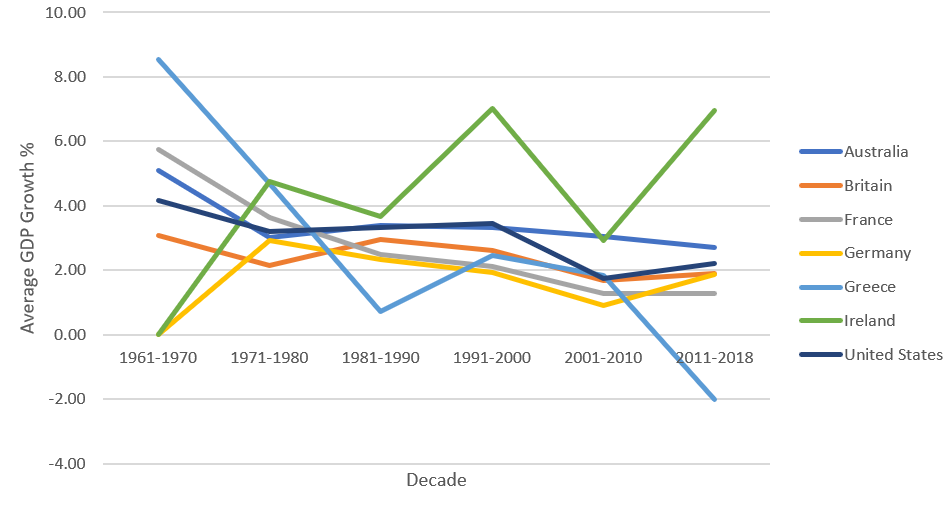
Entering the 1970s, this extended period of growth came to an end, a development that was exacerbated by the 1973 Oil Crisis. This began a prolonged period of substantially lower growth in the economies of the advanced capitalist countries (see Figure 1). This prolonged period of low growth has been punctuated by short booms and regular economic crises.
Penetration of capitalist relations into everyday life
An important aspect of the capitalist response to the over-accumulation crisis has been an attempt to find new avenues for investment and the extraction of profits. The focus for this drive started, and has continued, with the push for corporatising, and then privatising, government-owned corporations.
In the past 30 years, this has expanded to efforts to commodify substantial areas of what had previously been the private domestic domain, with the mass expansion of the services industry. This drive has resulted in the opening up of new aspects of social life for profit-making, as well as the intensification of working life – particularly for working women, who bear double and triple shifts as workers while continuing to carry out the central role in social reproduction.
The process of expanding commodification has been further intensified by the development of the gig economy. This has generated new technologies that have enabled capital to regularise social exchanges for profit. At the same time, capital has shifted substantial costs onto the gig workers themselves, in exchange for providing a platform linking workers with consumers – a platform that has intensified the capacity of capital to monitor and exploit labour.
The growth of the gig economy has also intensified crises in other parts of the economy, as previously dominant market players are forced to compete with numerous individual operators linked via platforms.
Financialisation
As the expansion of profits through the real economy became more difficult with the saturation of markets and problems of over-accumulation, capital shifted its focus towards investments in financial markets and the creation of new and novel financial instruments, expanding interest-bearing capital in both intensive and extensive forms.
This has resulted in a massive expansion in the volume of financial transactions and in the relative weight of the finance industry in economies. This process of increasing complexity and weight is called financialisation.
It can create the impression of a decoupling of the ‘real economy’ and ‘financial services’; however, in reality they remain intimately connected with the speculation in the financial markets essentially being a series of bets and counter bets on the real economy.
The immediate catalyst of the 2007-2008 global financial crisis was the failure of US sub-prime mortgages and its ripple effect through the bond market, which rapidly spread through other vulnerable sectors within both the ‘real economy’ and the ‘financial services’ sector.
Decline in wage growth
In 2019, in response to widespread public concern regarding record low wage growth, Australian finance minister Mathias Cormann described (downward) flexibility in the rate of wage growth as “a deliberate design feature of our economic architecture”.
This statement reflects not just the determination of individual capitalists to drive down wages, but the active efforts to transform the industrial relations environment in advanced capitalist countries to undermine the ability of workers and their unions to fight to defend wages and conditions, let alone advance them.
This process of undermining organised labour – central to the neoliberal project – is also based on a race to the bottom between jurisdictions. Employer groups, neoliberal thought leaders and governments point to efforts that have been made in other jurisdictions to erode workplace rights and be internationally “competitive”.
Lapavistas et al. argue that in response to the global financial crisis and sovereign debt crisis in the European Union’s Economic and Monetary Union (EMU) there has been a renewed pressure to increase labour productivity within all economies of the EMU.
This has placed downward pressure on wage growth, with German capital being the most successful in achieving this within the EMU. As a result, Germany has been best placed to sell goods and services to other member states and to markets outside the common market.
The impact of these dynamics can be seen in the ongoing low wage growth across the OECD, which demonstrate that the burden of low economic growth since the end of the global financial crisis has primarily been shifted onto working people (see Figure 2).
This combined pressure to increase labour productivity while at the same time limiting wage growth has resulted in a decoupling of labour productivity and wages, which had historically been correlated (see Figure 3).
 |
| Figure 3: Decoupling of wages and productivity. Source: OECD (2018), OECD Economic Outlook, Volume 2018 Issue 2, OECD Publishing, Paris. |
This decoupling has meant that while capital continues to experience growth – albeit at a rate insufficient to quell its insatiable hunger for growing profits – working people are failing to see any real benefit for their increased productivity.
As a result, in order to maintain spending power, working people became increasingly reliant on borrowing, whether in the form of credit cards or payday loans, to meet day-to-day spending costs (see Figure 4).
 |
| Figure 4: Household Debt as Percentage of Household Income, OECD (2020), Household debt (indicator). |
Rising household debt ultimately exacerbates the problems of the declining purchasing power of the working class. This decline in purchasing power also negatively impacts on the capacity of economies to grow, deepening the crisis tendencies.
The long-run capitalist economic crisis that started with the end of the long boom, and which is now intensifying with the current COVID-19 pandemic, is prompting a more aggressive orientation by both state actors and individual capitalists.
This aggressive posture means that collective bargaining more readily lays bare the class struggle. For working people and their unions to be able to effectively respond to this environment will necessitate being prepared for direct challenges to capitalist power.
Failure to do so effectively and adequately will see a deepening of the shift of more and more of the product of workers’ labour into profits, leading to the further inequality not only within societies but within the working class itself.
-------------------------------------------------------------------------------
Lisbeth Latham
Triumphalist comments about the end of capitalism or neoliberalism abounded in the aftermath of the global financial crisis in 2008, just as there are many people today who believe that the current crisis is the end of neoliberalism or capitalism.
Unfortunately, neoliberalism and – more importantly – the capitalist system will not just end of their own accord. Both, while prone to crisis, are extremely resilient, and are adept at turning their own crises into a rationale for deepening rather than reversing their dynamic.
It is not inevitable that the current crisis will see a strengthening of capitalism and its dominant ideological frame – they can both be defeated, but their defeat will not just happen. It will be the result of conscious resistance, not happenstance or luck.
Capitalism is prone to crisis. This tendency towards crisis, particularly in its late monopoly stage, is due to the ripening of a number of contradictions inherent to capitalism. However, capitalism is resilient as a system and has demonstrated over more than a century that there is no crisis it can’t overcome if the working class is prepared (i.e, can be made) to pay the price.
Importantly, crises – particularly destructive crises – help to renew capitalism, sweeping away uncompetitive capital, and creating the space for a renewal of capital accumulation, however briefly. Destructive crises also enable a renewed assault on the rights of working people and on social spending that working people have won in previous struggles.
This is a central feature of the neoliberal offensive over the past five decades of its history: to seize every crisis, impose its own doctrine, smash working conditions, privatise the economy, and dismantle the welfare state, shifting government spending to prop up profits rather than support working communities.
Neoliberalism constitutes a political project aimed at weakening the political power of the working class, asserting the political power of the capitalist class and seeking to establish profitable avenues for capital investment1.
Key features of neoliberal projects include:
- Facilitating the free movement of capital by removing barriers to capital investment and shattering trade barriers;
Increasing barriers to the movement of workers, which results in increasingly constrained rights and marginalisation for migrant workers (this includes open calls to movement being linked to migrants’ wealth);
- Prying open more aspects of social life for capital investment – privatisation and ownership of water, for example, exemplified by the 1999-2000 water wars in Cochabamba, Bolivia, between the community and the the Nestlé corporation;
- Opening government services to capitalist competition, whether through direct privatisation; corporatisation; ‘public-private partnerships’;
- Access by government agencies or the introduction of ‘voucher systems’ to enable government subsidisation of the entry of private capital into the provision of social services;
- At the same time, deregulating the cost of these services. This is often articulated in terms of enhancing consumer ‘choice’;
- Reduction in government social spending, primarily premised on the justification of the need to rein in deficits, although this has rarely been achieved. Throughout the neoliberal decades the US’s budget had regularly been in deficit. Instead spending reductions occur primarily as a consequence of declines in government income via the narrowing of the tax base to be more heavily reliant on working people, and a redirection of government spending away from social spending on the working class and the promotion of worker-funded retirement funds.
COVID response as a deepening of neoliberalism
As with the global financial crisis, the Covid-19 pandemic and its associated crisis has been described as the death knell of neoliberalism, if not capitalism. In particular, the massive government stimulus packages that have been enacted in many countries to prop up economies have been seen as a decisive shift in the outlook of these governments.
However, government spending is not necessarily in contradiction with neoliberalism. Moreover, as both Philip Mirowski and Naomi Klein have pointed out, neoliberals are adept at turning economic crises, which are clearly exacerbated by neoliberal policies, into opportunities to deepen neoliberal attacks. Neoliberal states, while ideologically promoting budgetary surpluses, have massive spending programs primarily aimed at subsiding capitalist profits.
While government responses to the Covid-19 pandemic have seen massive levels of spending on stimulus packages, this spending has overwhelmingly been directed at propping up profits. For example, wage subsidies are for the most part really a subsidy to business profits with mechanisms built in to allow stripping away of workers’ rights.
At the same time, the spending on stimulus has triggered widespread discussion among the media and establishment of the ‘dangers’ of government deficits and the need to limit the length of the stimulus packages, particularly subsidies, irrespective of the length and dynamics of the crisis.
In addition, there has been a discussion of the need to ‘pay’ for the response to the current crisis at the same time as enabling capital to recover and rebound. These calls lay the foundations for two parallel pushes. First, a move to further curtail social spending, most likely with accompanying privatisation of public services, which will result in both a massive increase in the cost of these services and a corresponding drop in quality. Secondly, a move to further reduce company taxes whilst shifting the burden of paying for government spending even more heavily into working people.
Building working-class power today
Given this trajectory, how do we build a better system – one in which workers lives are prioritised over profits? How do we build a world where nature is valued and protected?
While the call for the creation of socialism in the here and now is appealing, nowhere on the planet do working people have the level of organisation and confidence necessary to achieve this objective now. Instead, we must build the power and confidence of the working class as it exists today in defence of existing rights; in demanding steps forward, no matter how limited; in guaranteeing livelihoods, in the hope we can extend and expand them; and building the capacity to win more.
In the short term this means:
-
Ensuring that working people, whether they are in employment or not, and whatever their residency/visa status, have liveable incomes; and
-
Ensuring that all those workers engaged in employment have safe working conditions, which in the context of Covid-19 has never been more urgent.
In the medium to long term this will involve:
-
The struggle to maintain liveable incomes, particularly for those on government pensions;
-
Mass construction of energy-efficient and high-quality public housing;
-
Massive reinvestment in the public health system both in terms of capacity and working conditions for the workers within it;
Support for public research within the universities and independent research centres; and
- A just transition across the economy to move away from fossil fuels and to transform the economy to one based on meeting human needs rather than constant growth, in order to draw down the atmospheric carbon dioxide.
It is not enough to simply call for a better world, it is necessary to mobilise and struggle to achieve it. At the same time, it is necessary to recognise that with the extent of the pandemic and the necessity for social distancing, in most industries and social sectors social mobilisation and industrial action will be extremely difficult.
Our immediate demands of both governments and capital are for action to ensure economic livelihoods, and to ensure that workers and communities are able to operate in as safe a way as possible. As the economy reopens, our ability to disrupt and mobilise will increase, as will our political horizons and demands.
-------------------------------------------------------------------------------
This article was originally published at
Irish Broad Left.
Read more...




 Posts
Posts


