Lisbeth Latham
Radical Left movements across the globe face multiple challenges that place human survival at stake. At the same time, our movements are currently not strong enough to effectively challenge capitalism and the determination of the capitalist class and their representatives to prioritise profits over human life and survival of the planet.
This poses the question of how we can start to cohere and build the capacity of the popular classes and oppressed people to unite and struggle for a better world. One possible source of inspiration for strengthening the movement may be the Transitional Programme, which was written by Russian revolutionary Leon Trotsky in 1938 as part of a process to cohere and regroup consistently revolutionary forces.
What is the transitional programme?
The Transitional Programme, or The Death Agony of Capitalism and the Tasks of the Fourth International, was the key programmatic document of the Fourth International at its founding in 1938. The programme was drafted by Trotsky with the aim of bridging the historic divide between the revolutionary movement’s minimum programmes (demands raised within the movement, and particularly in parliamentary campaigns, regarding the reform of capitalism) and maximum programmes (the actions that would be taken upon the seizure of power by the working class).
The aim was to build into the minimum programme demands that would more sharply challenge the power of capital, and demonstrate to working people the limitations of democracy under capitalism while building their confidence in achieving something more – these were the “transitional demands”.
The context of the transitional programme
The transitional programme was written in late 1930s, a period during which the labour movement was surging in many countries, but had also suffered heavy defeats at the hands of fascism (Germany, Italy) or was involved in revolutionary struggles that would result in defeat at the hands of fascism (Spain).
It was also expected that the world was heading to a new inter-imperialist war that would be aimed at the overthrow of “actually existing socialism” in the Soviet Union.
Within this context, the tiny Trotskyist movement had been going through an extended period of seeking to unite and build a new revolutionary and anti-Stalinist pole within the workers movement, including the semi-mass centrist parties Workers Party of Marxist University (Spain), the Independent Labour Party (Britain), and the Revolutionary Socialist Party (Netherlands), which involved or were founded by left-oppositionists. This effort ultimately failed with only the Revolutionary Socialist Party participating.
In this context, the programme was aimed at providing an ideological weapon with which the small Trotskyist forces in the global workers movement could agitate around and build both influence within the movement and support for the programme, either in whole or in part.
The Transitional Programme is made up of three distinct types of demands. These are: - immediate demands, primarily around economic issues;
- democratic demands around expanding and strengthening democratic rights; and
- transitional demands aimed at fundamentally challenging the power and authority of capital itself.
It is important to remember that the Transitional Programme was not intended as a final and finished document; it was instead intended as a framework for revolutionary organisations to develop their responses to known challenges, but also new challenges to the development and dynamics of the class struggle. So while it is possible to simply deploy an existing demand from the programme in response to the struggle of today, it is also just as viable to develop new responses to any challenges that emerge.
Immediate demands
Immediate demands are probably the simplest and easiest demands to understand and develop. They are aimed at responding to the immediate struggles of the day and are essentially based on the target of the demand either stopping doing something, or begin doing something.
Examples would be calls for a doubling of unemployment benefits or an increase in funding to higher education. A problem with immediate demands is that, once achieved, they can and will be undermined by capital and the state.
Democratic demands
Democratic demands seek to either defend or expand existing democratic rights or establish new ones. Examples of democratic demands include demands around expanding the franchise or citizenship, expanding rights and protections such the demand for marriage equality or anti-discrimination legislation, or expansion of community control over their own lives such as minority language rights or establishment of the right to recall elected representatives.
Again, these advances are always subject to being rolled back or subverted by capital and the state, such as the weakening and defanging of environmental protections that has transformed many such agencies into bodies that effectively authorise polluting the environment, rather than protecting the environment from pollution.
Transitional demands
Transitional demands go much further than either immediate or democratic demands. They don’t simply seek to address something happening right now but seek to fundamentally undermine the power of both capital and the state and shift power into the hands of working people. While still capable of being subverted (because everything is) they are far more robust than the other two types of demands.
Examples of transitional demands include:
-
Escalator clauses, through which, in addition to any negotiated pay rise, workers receive automatic pay rises in response to inflation. This acts to not only increase wages, but to protect wage gains from inflation, ensuring wage growth not just in absolute but relative terms;
-
Sliding hour and wages scales. This demand seeks to protect both jobs and wages of workers, particularly during periods of technological change, by responding to any attempt to shed jobs by requiring working hours for workers to be reduced instead of jobs being cut, and the hourly pay increased in order to maintain weekly wages. The demand means that the benefit of technology improvement flows onto working people in the form of reduced working hours rather than simply boosting profits and resulting in increased unemployment.
The nature of the transitional demand
A key debate that has existed around the transitional demand is (1) whether it is achievable under capitalism, or (2) whether it is simply a document for a transition period.
On the second point, this is clearly a misunderstanding of the role of the programme. While it was developed in a period where the Trotskyist movement expected and predicted an expansion of the class struggle in which the question of the transition to socialism would be posed, it was not the situation that they immediately faced, and their forces were not such that they would be in a position to be applying their programme.
Moreover, it does not make sense for many of the demands within the programme to be raised in periods of transition – whether this is a situation of dual power (where there are both capitalist and working-class organs of power existing side by side) or in a workers’ state (the working class would not need to be making demands in this situation, the organs of workers power would just act). Instead, it was an agitational document aimed at engaging workers in the here and now.
With regard to the first point, it is not knowable what capital, and its representatives in government, will concede, at least in the short-term, in the hope of maintaining control and power with the aim of subverting any concessions as the movement ebbs and recedes. The bigger and more conscious the movement, the more desperate capital will be to offer concessions in the hope of returning to a period of peace.
Moreover, individual transitional demands have been achieved and won by the labour movement. For example, cost-of-living allowances, which provide wage increases to workers in response to inflation, have been a feature of a significant number of US union contracts since the 1950s. This is a consequence of US unions, most notably the United Auto Workers, adopting the escalator clause as part of their bargaining demands as a consequence of the influence of Trotskyist-led locals pushing these demands in the late 1940s.
Transitional demands for today
While a modern-day transitional programme would feature a lot of the original demands, it does need updating in order to meet the challenges of today – particularly in relation to the challenges around climate change, indigenous rights and anti-racism struggles, globalisation and the #MeToo movement.
Such transitional demands could include, but should not be limited to:
-
Demands focused on expropriation and bringing major polluters under workers control to fund just transitions to environmentally sustainable zero-carbon economies;
-
Requirements that any company operating in multiple counties must abide by environmental, labour and anti-discrimination legislation not only in its ‘home’ country but in all the countries it operates in, with communities in other countries able to bring suits under these laws;
-
The defunding and disarming of police, with these services brought under the control of local communities of colour;
- The criminalisation of efforts of officials holding power to discourage or undermine the prosecution of sexual assault allegations;
-
Free movement of all working people with the right to a liveable income for all working-class people, whether in employment or not;
-
Taxation on speculative financial transactions;
-
A four-day work week with no loss in pay (with commensurate reduction in working hours for workers who do not work full-time);
-
No bailouts or government contracts for companies based in tax havens;
-
Any government-funded bailouts must be tied to commensurate state equity in the firm, with the establishment of mechanisms for industrial democracy in the firms;
-
A ban on redundancies in profitable companies, or firms in receipt of bailout money;
-
Free paid training for workers who are in industries that are affected by the transition to a carbon-free economy.
The transitional programme and its associated demands is not a magical solution. The work of the Left will not be, and is not, completed by raising a particular demand, no matter how brilliant its formulation. The purpose of demands is to create mechanisms in which potential solutions to the problems confronting working people can be posed to them – with the aim of winning people to that solution, but also to the need for political action to achieve it.
By drawing people into action in support of concrete demands we can build the confidence and organisational capacity of the class to take action in their own interest and the social power of all working people. And by doing this, we can build a movement that is sufficiently confident and powerful to meet the existential challenges we are faced with.
-------------------------------------------------------------------------------
This article is posted under copyleft, verbatim copying and distribution of the entire article is permitted in any medium without royalty provided this notice is preserved. If you reprint this article please email me at revitalisinglabour@gmail.com to let me know.
Read more...
Lisbeth Latham
A central plank of the Morrison Government’s response to the economic uncertainty and crisis unleashed by the COVID pandemic has been its policy of allowing working people to draw down their superannuation accounts by $10, 000 in each of the 2019/2020 and 2020/2021 financial years. Hundreds of thousands of people have now accessed their accounts for a range of spending, and while the individual decision to draw down super accounts has been criticised by some commentators, the real question is what Australia now does in a context where the problem of retirement poverty is likely to have been exacerbated?
The government’s announcement that people could draw down their superannuation account - particularly by such relatively large amounts, was a tacit admission by the government that its broader economic response to the current crisis was an entirely inadequate response. The most notable example of this being JobKeeper the program, which actively excluded millions of workers and for millions more it was inadequate to enable them to meet their financial obligations. Why else would the government believe that people would need to draw up to $20, 000 from their retirement savings than if they knew that they were not going to meet their financial obligations drawing on the welfare system?
Drawing down superannuation savings wasn’t just an individual tragedy for those workers, there was and continues to be a real danger that the individual decisions to draw down accounts would cause liquidity problems for Australia’s massive superannuation system, and further exacerbate the decline of the financial markets with up to $50 billion drawn down. This situation has led to individual criticisms of workers who chose to draw down their accounts. With some media outlets critical of both people accessing funds without experiencing a personal loss of income and individual spending decisions. Apart from a severe misreading of what this spending represented - the majority of it consisted of either paying down debt, making significant large purchases that would otherwise incur debt, or meeting day to day, or week to week living expenses. Criticising individuals for drawing down their life savings in a context generalised system failure appears to be at best misguided if not totally disingenuous and malicious. People facing a collapse in their disposable income given access to their super were always going to access it - it that is why the government made it available. If anyone should be blamed for the money being accessed and spent it is the government.
The problem with the spending is not what people spent their superannuation money on, but that it was necessary. We know that a significant number of the people drawing down their superannuation accounts will have been women and people in less secure and lower-paid employment. These are groups are all at greater risk of experiencing poverty in retirement in a system that already produces some of the largest proportion of people over the age of 65 living in poverty within the OECD. With 2.5 million people expected to draw down their super, and more than 480, 000 people now having a zero superannuation balance. This problem of retirement poverty in Australia can only be expected to get worse. In addition, the running down of workers superannuation balances could have an immediate impact, as workers with less than $6, 000 in their superannuation accounts are no longer provided with default insurance by their fund.
| Country |
65+ Living in Poverty |
|
|
|
|
|
|
|
|
|
|
|
|
|
|
|
|
|
|
|
|
|
|
|
|
The problem of hundreds of thousands of older Australians retiring into poverty has been an issue in policy development. The main solution that has been put forward has been to lift the compulsory employer superannuation contribution from 9.5% to a higher figure, the most notable one being 12% which had been legislated to increase incrementally by the Rudd government. This increase was subsequently delayed by the Abbott government, with the increase to 10% not scheduled until July of 2021. It is unclear that this will go ahead, and the need to increase to 12% has been the focus of a number unions, most notably the Australian Services Union, Finance Sector Union, and Shop, Distributive, and Allied Employees Union. While there is an undoubted logic that the easiest and best way to address retirement poverty is to boost the amount of money going into workers’ superannuation accounts, this ignores the fundamental problems with the superannuation system:
- It shifts the problem of supporting working people in their retirement from society as a whole to workers during their working life - which has contributed to and justified the inadequate pension system within Australia;
- It reproduces and exacerbates the income inequality that already exists in the Australian economy, most notably the gender wage gap;
- Australia’s super system props up financial markets - with the funds being worth $2.7 trillion in March 2020 - and makes workers retirement income and wealth entirely dependent on the stability of these markets (which experience shows is not at all reliable)
Given these serious limitations, limitations that have existed, and were built into, the superannuation system from its inception, what is the solution? It has to be a significant re-envisioning of Australia’s entire pension and welfare system to view that all people deserve a liveable income which guarantees a minimum quality of life irrespective of the ability of an individual to work. Work would then enable people to enhance and improve on that standard of living both now and into retirement. However, this universal welfare system would be funded both by steeply incrementing progressive income tax system combined with a concerted effort to ensure that corporations are levied increased tax levels which they are actually required to pay.
-------------------------------------------------------------------------------
This article is posted under copyleft, verbatim copying and distribution of the entire article are permitted in any medium without royalty provided this notice is preserved. If you reprint this article please email me at
revitalisinglabour@gmail.com to let me know.
Read more...
Lisbeth Latham
The central driver of the capitalist system is the drive for capitalists to constantly increase profits – failure to do so can be a trigger for a crisis within the capitalist system.
Since the end of the long boom in the early 1970s, capitalism, particularly in the advanced capitalist countries, has entered a period of long-run crisis under which individual capitalists have sought to find ways to continue to expand profits during a period of chronic over-accumulation.
This crisis has prompted the search for new avenues for profitable investment and the attempt to maximise returns on the existing capital in circulation. Despite sporadic periods of temporary growth, the past 50 years have been punctuated by regular national, regional, and global crises.
This protracted period of low growth, instability and crisis has seen capital and its representatives in government seek to adopt a range of strategies aimed re-establishing and stabilising growth. This strategy has at times been successful in the short term but ultimately has served to exacerbate capitalism’s crisis tendencies.
Capitalism’s over-accumulation crisis
Capitalism has an unquenchable thirst for the growth of profits. During the early period of industrial capitalism, this was easily achieved through the expansion of production. Its higher levels of productivity meant that capitalists could simply outcompete non-industrial producers, absorbing their markets and expanding profits.
As capitalism expanded, however, markets began to be saturated. While investing in better and more efficient machines made individual workers more productive, this expansion in productive capacity became more expensive to achieve and risked companies producing more goods than could be profitably sold (known as a crisis of overproduction).
This problem could be addressed by finding new goods to be produced and generating corresponding new consumer demand. Over time there becomes a limit on the extent to which such new areas for profitable investment in production can be made, and capitalists begin to have far more money than they can reinvest profitably in the production of goods (known as a crisis of over-accumulation).
Such a crisis becomes generalised, and the capitalist economy can enter a profound period of crisis. Historically these crises have only been overcome either through massive recessions that result in the destruction of sections of capital, or through wars that also consume and destroy vast amounts of production and productive capacity, opening up the possibility for new periods of capitalist growth.
A long-run decline in growth
In the period coming out of the second world war, capitalist economies experienced protracted periods of high growth. This growth was in part a consequence of the rebuilding of Europe and Japan after the destruction of the Great Depression and the war. But it was also a result of the continued high levels of arms spending, particularly by the US, during the Vietnam and Cold Wars.
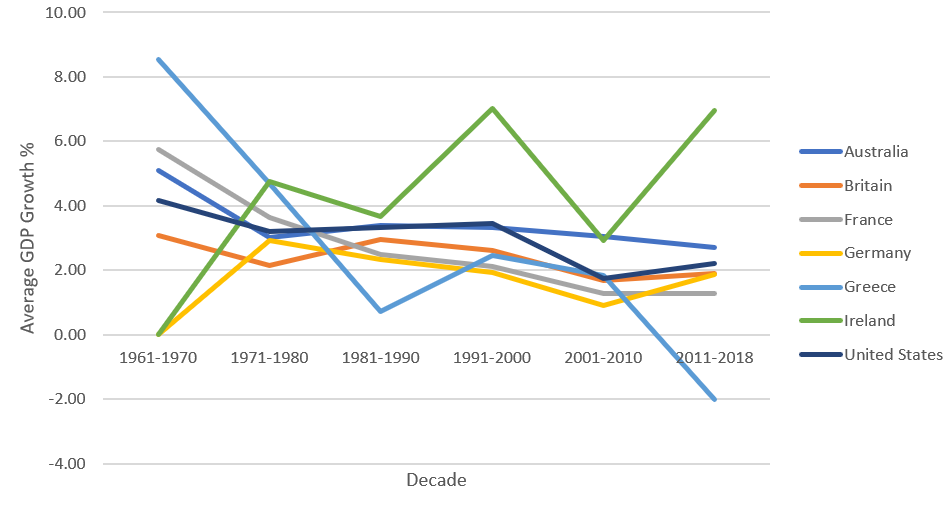
Entering the 1970s, this extended period of growth came to an end, a development that was exacerbated by the 1973 Oil Crisis. This began a prolonged period of substantially lower growth in the economies of the advanced capitalist countries (see Figure 1). This prolonged period of low growth has been punctuated by short booms and regular economic crises.
Penetration of capitalist relations into everyday life
An important aspect of the capitalist response to the over-accumulation crisis has been an attempt to find new avenues for investment and the extraction of profits. The focus for this drive started, and has continued, with the push for corporatising, and then privatising, government-owned corporations.
In the past 30 years, this has expanded to efforts to commodify substantial areas of what had previously been the private domestic domain, with the mass expansion of the services industry. This drive has resulted in the opening up of new aspects of social life for profit-making, as well as the intensification of working life – particularly for working women, who bear double and triple shifts as workers while continuing to carry out the central role in social reproduction.
The process of expanding commodification has been further intensified by the development of the gig economy. This has generated new technologies that have enabled capital to regularise social exchanges for profit. At the same time, capital has shifted substantial costs onto the gig workers themselves, in exchange for providing a platform linking workers with consumers – a platform that has intensified the capacity of capital to monitor and exploit labour.
The growth of the gig economy has also intensified crises in other parts of the economy, as previously dominant market players are forced to compete with numerous individual operators linked via platforms.
Financialisation
As the expansion of profits through the real economy became more difficult with the saturation of markets and problems of over-accumulation, capital shifted its focus towards investments in financial markets and the creation of new and novel financial instruments, expanding interest-bearing capital in both intensive and extensive forms.
This has resulted in a massive expansion in the volume of financial transactions and in the relative weight of the finance industry in economies. This process of increasing complexity and weight is called financialisation.
It can create the impression of a decoupling of the ‘real economy’ and ‘financial services’; however, in reality they remain intimately connected with the speculation in the financial markets essentially being a series of bets and counter bets on the real economy.
The immediate catalyst of the 2007-2008 global financial crisis was the failure of US sub-prime mortgages and its ripple effect through the bond market, which rapidly spread through other vulnerable sectors within both the ‘real economy’ and the ‘financial services’ sector.
Decline in wage growth
In 2019, in response to widespread public concern regarding record low wage growth, Australian finance minister Mathias Cormann described (downward) flexibility in the rate of wage growth as “a deliberate design feature of our economic architecture”.
This statement reflects not just the determination of individual capitalists to drive down wages, but the active efforts to transform the industrial relations environment in advanced capitalist countries to undermine the ability of workers and their unions to fight to defend wages and conditions, let alone advance them.
This process of undermining organised labour – central to the neoliberal project – is also based on a race to the bottom between jurisdictions. Employer groups, neoliberal thought leaders and governments point to efforts that have been made in other jurisdictions to erode workplace rights and be internationally “competitive”.
Lapavistas et al. argue that in response to the global financial crisis and sovereign debt crisis in the European Union’s Economic and Monetary Union (EMU) there has been a renewed pressure to increase labour productivity within all economies of the EMU.
This has placed downward pressure on wage growth, with German capital being the most successful in achieving this within the EMU. As a result, Germany has been best placed to sell goods and services to other member states and to markets outside the common market.
The impact of these dynamics can be seen in the ongoing low wage growth across the OECD, which demonstrate that the burden of low economic growth since the end of the global financial crisis has primarily been shifted onto working people (see Figure 2).
This combined pressure to increase labour productivity while at the same time limiting wage growth has resulted in a decoupling of labour productivity and wages, which had historically been correlated (see Figure 3).
 |
| Figure 3: Decoupling of wages and productivity. Source: OECD (2018), OECD Economic Outlook, Volume 2018 Issue 2, OECD Publishing, Paris. |
This decoupling has meant that while capital continues to experience growth – albeit at a rate insufficient to quell its insatiable hunger for growing profits – working people are failing to see any real benefit for their increased productivity.
As a result, in order to maintain spending power, working people became increasingly reliant on borrowing, whether in the form of credit cards or payday loans, to meet day-to-day spending costs (see Figure 4).
 |
| Figure 4: Household Debt as Percentage of Household Income, OECD (2020), Household debt (indicator). |
Rising household debt ultimately exacerbates the problems of the declining purchasing power of the working class. This decline in purchasing power also negatively impacts on the capacity of economies to grow, deepening the crisis tendencies.
The long-run capitalist economic crisis that started with the end of the long boom, and which is now intensifying with the current COVID-19 pandemic, is prompting a more aggressive orientation by both state actors and individual capitalists.
This aggressive posture means that collective bargaining more readily lays bare the class struggle. For working people and their unions to be able to effectively respond to this environment will necessitate being prepared for direct challenges to capitalist power.
Failure to do so effectively and adequately will see a deepening of the shift of more and more of the product of workers’ labour into profits, leading to the further inequality not only within societies but within the working class itself.
-------------------------------------------------------------------------------
Lisbeth Latham
Federal parliament passed the Coronavirus Economic Response Package (Payments and Benefits) Bill 2020 on April 8, which provided the enabling legislation for a range of stimulus measures the government has already announced, including the JobSeeker allowance.
While the creation of the JobSeeker allowance is significant, and has been welcomed by Australian Council of Trade Unions (ACTU) secretary Sally McManus as a “victory”, the package has a number of significant weaknesses.
Essentially, it outlines that the bulk of the economic crisis will be passed on to working people, particularly more marginalised workers.
The JobSeeker payment will provide qualifying employers with $1500 a fortnight per qualifying employee for six months.
There are qualifying thresholds for employers: those with less than $1 billion in turnover must also have lost more than 30% of their revenue; those with more than $1 billion in turnover must have lost more than 50%; and charities must have lost more than 15%.
When it became clear that there was to be a special category for charities, TAFEs and universities had hoped to be included under charitable organisations. But the government has since made it clear that the payment would only go to organisations providing direct charitable support.
For a worker to qualify, they must be either a permanent or fixed-term employee, and employed prior to March 1. A qualifying casual employee must also have been working for their employer for more than 12 months.
The $1500 JobSeeker payment essentially establishes a new income floor for qualifying employees, paid for by the government.
For around 30% of workers the subsidy reflects either an improvement on, or a maintenance of, their current incomes.
But for the majority of workers, it represents a wage cut and, for many, a significant one.
As the new act amends the Fair Work Act to make it easier for affected employers to change workers’ hours, direct them to take leave, relocate them and make changes to the work they do, any reduction in hours will result in a corresponding reduction in pay for workers, down to a minimum of $1500.
The subsidy is not the starting pay. Rather, a worker will need to work towards and surpass the equivalent number of hours if they are to receive close to their normal pay, as employers are only required to pay a qualifying worker whichever is greater of the $1500, or whatever the worker earns in a fortnight.
For companies still employing people in work, the subsidy is more a subsidy to their profits rather than a wages subsidy, with workers in effect providing $1500 unpaid labour each to the employer.
The failure of the government’s stimulus package to sufficiently protect workers’ incomes was highlighted by an ABC report on April 9 which stated that 617, 000 people have told the Australian Tax Office (up from 360,000 on April 3) that they will be seeking to draw on their superannuation accounts this financial year (after April 20).
If each of these draws the full $10,000 eligible, that will amount to $6 billion. This will not only undermine the future retirement of those workers, but it will impact all working people.
However, as inadequate as the package is, a far greater problem are the hundreds of thousands of workers who do not qualify for any subsidy right now.
These include more than 1 million casuals, workers on visas and workers employed in firms which have not met the revenue loss threshold, but are dismissing or standing down workers nonetheless.
The ACTU had been lobbying for a broader qualifying definition for casual workers, based on a reasonable expectation of further work, which is part of the test for casual employees qualifying for unfair dismissal protections.
Attorney General Christian Porter rejected the ACTU on the basis that it was “too broad”. He justified the government’s decision not to include more casuals on the basis that “casuals move between multiple employers”.
Porter would know that many casual workers rely on a single employer. It also ignores the reality that, while some new work being created, that is dwarfed by the numbers losing work.
The government’s refusal to include all visa holders in its wage subsidy protections, combined with Prime Minister Scott Morrison’s April 3 statement that struggling international students should “go home if they can’t support themselves”, is consistent with successive governments’ view that international students and other visa-holding workers are sources of income and cheap labour which can be disposed of at whim.
Leaving Australia is not a viable option; the government's callousness will simply force these workers into extremely insecure and exploitative situations.
The United Workers Union has launched an important campaign for no worker to be left behind, irrespective of visa status, with an amnesty for undocumented workers. It should be supported. We also need to demand that workers be given permanent residency and citizenship, should they request that.
-------------------------------------------------------------------------------
[Originally published in Green Left Weekly #1260]
This article is posted under copyleft, verbatim copying and distribution of the entire article is permitted in any medium without royalty provided this notice is preserved. If you reprint this article please email me at revitalisinglabour@gmail.com to let me know.
Read more...
Lisbeth Latham
Prime Minister Scott Morrison announced a $17.6 billion stimulus package on March 12, aimed at combating the expected economic slowdown resulting from the growing COVID-19 pandemic.
This was followed four days with statements that his cabinet was considering future stimulus measures, particularly targeting the tourism and hospitality sector.
The federal government’s priority is to pump money into small and medium-size businesses to encourage them to buy small capital goods. It claims this will boost spending and thus slow or reverse the slowdown.
This appears extremely unlikely, however, because the stimulus package is insufficient and poorly conceived.
Stimulating what?
The Australia Institute (TAI) argues the package is the right size but wrong shape.
TAI senior economist Matt Grudnoff said only 25% of the package — the part aimed at welfare recipients — was well directed, as these individuals would likely spend the money directly.
He argued small businesses though were unlikely to spend in the current circumstances and that “instant asset write-off and accelerated depreciation initiatives are likely to be under-subscribed”.
People on welfare will most likely quickly spend the one-off $750 cash payment in the government’s stimulus package because these payments are already well below the poverty line.
Rather than giving out a one-off payment that is roughly equivalent to $15 a week across the year, the economy would be better off if all welfare payments were raised to at least the poverty line.
But the slowdown is not being primarily driven by a lack of domestic spending, nor is this likely to become the main driver. The key issue is the economy grinding to a halt as people become sick and are unable to work.
The stimulus is unlikely to stop a downturn as the need for social distancing and self-isolation over the course of the pandemic means a slowdown is most likely inevitable.
Protecting incomes
During this time, many businesses will close, and some may never reopen. This will be a tragedy for the owners and tens of thousands of workers who face a loss of income — and, potentially, their livelihood.
Keeping people in jobs must be a priority of the stimulus package.
This does not mean businesses must stay open during the pandemic. Many will need to temporarily close.
Only workplaces providing food, power, water, health and other vital services should remain open. All energy must be directed to ensuring this is possible.
All other workers, including casuals, should be paid leave during periods of self-isolation, sickness and shutdown. Large businesses should wear the cost of temporary closure or reduced services, while those small and medium-sized businesses that are unable to should be supported to ensure they can pay workers and meet other essential costs.
This support should extend to sole traders, such as many tradespeople, artists, gig economy workers, musicians, performers and sex workers. Failure to do so will mean any resulting financial crisis will be much larger, and more deeply and longer felt than need be.
There have been calls for a moratorium on rent and mortgage payment. While such a move has understandable appeal, there are some issues with it.
For one, it would simply shift the problem to another part of the economy and create the possibility of a contagion of bad loans in the financial system.
Moreover, most Australians do not have savings and are already reliant on short-term credit to cover not just rent and mortgages but food and basic services. As such the priority has to be on maintaining incomes, rather than attempting to offset the consequences of their collapse.
Who pays?
The federal government has made much of the fact its initial stimulus package was a consequence of its “sound economic management”. The reality is the budget surplus only ever existed on paper and was primarily premised on huge underspending on the National Disability Insurance Scheme.
However, we should avoid some of the gloating that has crept into public discourse around the evaporation of the “surplus”, as it accepts the notion that a surplus is an inherently positive thing or represents “good economic management”. It risks celebrating the government’s attempt to provide certainty to global lenders over the provision of vital social services. Funding large-scale subsidisation of incomes across the economy will cost a small fortune.
In the short-term, it will need to be paid for from government revenue and borrowing, which is relatively cheap in the circumstances. Covering the cost in the medium-to-long-term, will require raising government revenue.
As the economy restarts, the focus will have to be on ensuring the rich pay taxes, not just by cracking down on tax minimisation and avoidance schemes, but by raising corporate taxes.
-------------------------------------------------------------------------------
[Originally published in Green Left Weekly #1257. It should be read in conjunction with my article
Working communities must not be made to pay for COVID-19 crisis]
This article is posted under copyleft, verbatim copying and distribution of the entire article is permitted in any medium without royalty provided this notice is preserved. If you reprint this article please email me at revitalisinglabour@gmail.com to let me know.
Read more...
Lisbeth Latham
Today (March 31) workers, students, unemployed and retirees will join the fourth mass mobilisation against the attemps of the Parti Socialiste lead government of Prime Minister Emmanual Valls to pass a new work law. This new legislation if passed will significantly reduce the rights of French workers The, legislation which is popularly referred to as El Khomri, in reference to labour minister Myriam El Khomri, will deepen the efforts of previous efforts by both the current PS government and earlier right-wing government’s to make workers and other popular sections of French society pay for capital’s crisis. Despite the mobilisations against the law, media commentary are seeking to portray these mobilisations as fruitless against the inevitable introduction of the "necessary" liberalisation of France’s labour laws. This dismissal has centred on the relatively small size of the current movement in comparison to previous French mass mobilisations around workers’ rights. This article will explore the proposed bill and the emerging movement against the new laws comparing this movement with previous mass French mobilisations within the world of work and examining the new challenges it faces within current political landscape in France.
The initial proposed bill contained significant attacks on both working conditions and unions, these included:
Increased number of consecutive weeks where workers can be required to work overtime – the French working week is 35 hours, however this can currently be increased to 44 hours (with paid overtime) for a period of 12 consecutive weeks. The bill would this to be extended 16 consecutive weeks – where an enterprise agreement had been reached this could be extended to 46 hours over a maximum of 16 weeks;
Capping of payments to workers who are unfairly dismissed at 15 months of salary;
Making It easier to for employers to force part-time employment – current provision requires that for part-time work to be implemented, the employer must give prior notification to the labor inspectorate in order to avoid abuse. The bill proposed that the employer be able implement part-time work unilaterally;
Removal of the legal entitlement to bereavement leave (presently set at two days) with local agreements determine whether workers have access to such leave and its duration;
Increase in the maximum duration of night work from 40 hours per week for three months to 40 hours a week for four months;
Increased use of "package-days" where work is expressed in days rather than hours – 50% of French managers already are employed on this basis – the change would extend the practice to more workers – with enterprises with less than 50 employees not needing an enterprise agreement to implement. The proposal would also remove responsibility for ensuring workers take minimum hours of rest between work days or days off;
Varying of work time over three years. Under France’s 35 hour week it is possible for hours to be averaged over a number of weeks (if the average over this time is not above 35 hours) then no overtime is paid. If there is no enterprise agreement then the maximum span of time that hours can be averaged over is four weeks – with an agreement the maximum is one year. The proposed change is that this be extended to three years. In companies with less than 50 employees were no agreement is in place the four weeks could be extended to sixteen weeks;
Increase in the work week for apprentices under the age of 18 – the current maximum working hours are 35 hours per week and eight hours a day – the new maximums would be 40 hours a week and ten hours – this increase would not need to be approved by the labour inspectorate;
Making it easier for employers to force through enterprise level agreements – current provisions requires that for an enterprise agreement to be valid it must be agreed to by one or more unions representing 30% of employees (based on votes France’s union representative elections) and that the agreement is not opposed by unions representing more than 50% of workers. The new law would allow a company referendum will validate an agreement even if the unions representing 70% of workers are opposed;
Companies would be able to reduce wages or increase working hours (with no increase in wages) even when company is not having financial difficulties. Currently can do this (for a maximum of two years) if they are facing financial difficulties if workers and unions agreed – the proposed change would allow companies to propose the change if they felt it would enable them to meet a business opportunity, to do so they would be able to bypass unions and put a vote to workers – if a majority approved the change any worker who refused to accept the change could be sacked without any redundancy payment;
Ending the right to 11 consecutive hours of rest between "package-days" – instead breaks would be able to be broken up with periods of work within these 11 hours. If a worker is on call then on call, the period that they on call and not engaged in work would count as part of the rest period;
Change of mission of occupational physicians – occupational physicians are currently primarily responsible for prevention of workplace injury, and is in place with a focus on the health of workers. Their objective is to maintain of employees to perform their duties - by proposing adaptations to them if necessary. The new bill would give physicians a new mission: to certify "the ability of the employee to exercise any of the existing tasks in the company" and "to ensure the compatibility of the worker's health the position to which he is assigned" – which is an inversion of the current role and significant attack on workplace safety;
Leave during natural disaster no longer be legally guaranteed - currently the length of leave for natural disasters is 20 days guaranteed by law. With the bill, it is the branch or company agreement that will define its duration and the conditions for access;
The duration and terms of a sabbatical would no longer guaranteed by law - the minimum duration of the sabbatical leave is currently set at a minimum of six months and a maximum of eleven months. With the bill, any access to a sabbatical, and its duration, would be defined in an enterprise or branch agreement;
Weakening of job training programs – currently young workers or older unemployed workers can enter into a "professional contract" which includes on the job training for a recognised qualification while receiving a subsidised wage – the bill would allow these contract to include more limited on the job training that would not result in a recognised qualification;
Increased use of three year wage deals – currently there are mandatory annual negotiations on wages. Since 2015, it is possible for an enterprise to hold its negotiations every three years if there is a majority agreement in place in that company. The bill will allow a branch agreement to be negotiated triennially based on 30% support in that branch of industry;
Allow for the state to finance private apprenticeship training providers;
Facilitate dismissals during the transfer of business - currently, when a company sells all or part of its business, jobs are maintained and work contracts are automatically transferred into the new structure. The bill will provide for a portion of employees to be transferred with the business, but will allow for the dismissal of others;
Allow for part-time worker to be paid less for additional hours – currently when part-time workers work hours in addition to their contract they get a differented payment of additional wages – for those hours that constitute upto 1/10 of the contracted hours they receive a loading of 10% on the additional hours worked and a loading of 25% for all hours in addition to this – only a branch agreement can change this arrangement to a flat additional payment of 10%. Under the bill all part-time workers would receive a 10% loading – this change will have a significant impact on gender equality as women workers make up 82% of all part-time workers in France;
Reduce notice period for changes in rosters – currently part-time employees must given seven days notice of a change in their work schedule – only a branch or enterprise can reduce this to a shorter period (with a minimum of three days). The bill provides for that the schedule change is possible for all part-time workers with three days notice;
Employers able to change paid leave arrangements at short notice - the law currently provides that employers should take into account workers’ family situations when determining dates for paid leave. Within a month scheduled beginning of a workers’ leave the employer has no right to change the start or finish dates of the leave. With the proposed bill, these mandatory measures were transformed into 'supplemental' provisions. They can be challenged by way of enterprise or branch agreement;
Under the bill enterprise agreements would have a maximum of 5 years – Current enterprise agreements last indefinitely, unless otherwise provided in the Agreement, or terminated by either party. The agreement can be unilaterally denounced by trade unions signatories or by the employer. In this case, the rights and entitlements within the agreement continue to apply until there is a new agreement. Once terminated there is a three-month notice period before renegotiation begins, allowing trade unions to prepare, inform and mobilize workers ... With the proposed bill, all enterprise agreements have a term of 5 years. The provisions of the agreement are immediately canceled and cease to apply, even if there is no new agreement. There is no notice period prior to the beginning of negotiations;
Overpayment: employment centre can draw directly on unemployment benefits - When an employment centre claims to have made a mistake in the payment of unemployment benefits and wishes to recover the overpayment it must get the approval of a judge. This ensures that the overpayment was actually made (sometimes it hasn’t been) and allows the unemployed person to arrange for repayments to be made in instalments. With the proposed bill the judge's approval is no longer mandatory. The employment centre will directly deduct the overpayment from following month’s benefits payment. If the employment centre made a mistake, it unemployed person to go to court to their money repaid. This risks unemployed workers suddenly facing having little or no money one month to another. The spreading of repayments, which has been previously easily accessed, will be much harder to obtain;
On call-time may be counted as rest time – in violation of the European Committee on Social Rights requirements that time when works are required to be on call not be counted as mandated rest-time between working time the proposed bill will allow this to occur;
Reduced protections for employees who invalidly made redundant - when a court declares a redundancy void the worker is entitled to reinstatement. When this is not possible the current law provides 12 months of salary compensation to a minimum. The new law will limit this to six months, and this will only be for works with at least two years of service with the company;
Lower allowances for dismissed sick and injured workers - when a worker is dismissed for incapacity following an industrial accident or an occupational disease and the employer took no steps to find alternative work or arangements – the dismissal is not valid. The current law provides for compensation of a minimum of 12 months of salary. The bill proposes that this be only 6 months salary;
Enterprise agreements will be able to reduce overtime payments – the Labour Code provides that the first eight hours of overtime attract a penalty rate of 25% with subsequent hours paid an additional 50%. Under the proposed bill management will be able through an enterprise agreement to reduce the overtime rate to a flat 10% rate.
The government has motivated these changes on the idea that France’s existing labour code deter investment in the French economy and discourage companies from taking advantage of business opportunities (for fear of a subsequent contraction in the business) – the reality is that much of the changes have a significant capacity to undermine job creation – this is particularly the case for the provisions for increasing the work week – even those that supposedly make investment "less risky" they don’t address the key cause of France’s economic woes (the ongoing effect of the GFC) nor do they address the reality that outside of a sharp decline in demand companies have the capacity to adjust employment numbers without recourse to redundancy through mechanisms of natural attrition.
Blaming the growth on precarious employment in France on "rigid employment laws" is undermined by the reality that more liberalised labour markets, like Australia, have extremely high levels of insecure and precarious employment.
The proposed bill has caused widespread anger across France – with opinion polls indicating 70% opposition. A change.org petition against the bill launched in February received 200, 000 signitures in the first four hours of being online, the petition has now been signed by more than 1.2 million people.
March 9 strikes and mobilisations
Strikes and mobilisations were called in 140 cities and towns across France for March 9. These protests were supported by the three most militant union confederations – the CGT (Confédération générale du travail – General Confederation of Labour), FO (Force Ouvri – Workers Force) and the trade union Solidaires – in addition the call for the mobilisation was supported the large education union the FSU (Fédération syndicale unitaire – United Union Federation)and the university and high school student unions UNEF (Union Nationale des Étudiants de France – National Union of Students of France), FIDL (Fédération indépendante et démocratique lycéenne Independent and Democratic Secondary Student Federation) and UNL (Union Nationale Lycéenne – National Union of Secondary Students). Between 250, 000 and 500, 000 people participated in the protests across France (both the unions and the interior ministry employ official protest counters to count the size of protests – these counters differ in their methodology as to who should be included as a participant in the protests – with police only including those who within the confines of the march on the street – whilst the union counters will tend to include those who are on the edges of protests along the footpaths – which particularly makes sense on big mobilisations).Think this is too long to be in brackets and needs some full stops and that. The largest of these was held in Paris with between 27, 000 and 100, 000 participating in three protests across the day. In addition to the protests a number largest of these was in the SNCF (France’s national rail system) where four main rail unions (including reformist unions such as the Confédération française démocratique du travail (French Democratic Confederation of Labour - CFDT) and the Union nationale des syndicats autonomes (National Union of Autonomous Trade Unions)) had issued a strike notice resulting in significant disruptions to rail services over a range of issues including the ongoing reduction in the SNCF workforce via natural attrition of some 25, 000 workers over the past decade.
At the Paris union march from the MEDEF (Mouvement des entreprises de France – Movement of the Enterprises of France) to the ministry of labour, CGT general secretary Philippe Martinez told the crowd that in the CGT’s call (reformatting) that the government withdraw the bill that "The message is clear. Mr Hollande and Manuel Valls to stop incorporating the proposals of employers".
Some of the student slogans at the March 17 and March 24 protests included:
“On strike until retirement!”
“Be young and shut up!”
“Less valls, more tango” - a play on valse (waltz)
“You do not let us dream, we will not let you sleep!”
"The night is made for kissing, not for work”
In the lead up to the March 9 mobilisation the government announced that the presentation of the bill to the council of state would be delayed from the scheduled date of March 9 until March 24 – this was to provide more time for the draft bill to be amended to take on criticisms from both within PS and concerns from the more moderate unions particularly the CFDT - with three aspects expected to be changed. In the wake of the protests El Khomri announced that she would take on board calls. Prime Minister Valls announced he would meet with student organisations to discuss their concerns.
The bill presented to (and adopted by) the council of ministers on March 24 had undergone considerable changes including:
- Return to a maximum of 12 consecutive weeks of overtime;
- The proposal to extend the maximum number of consecutive weeks of overtime will be subject to a consultation period up until October;
- Proposal to cap unfair dismissal payments has been removed however there has been an indicative scale in place since 2013 for during the conciliation stage of unfair dismissal cases – the government has indicated that it will change this scale by decree (avoiding the need to have the law passed) and extend the scale to apply to awards in cases that move to trial;
- The provision to remove bereavement leave from the Labour Code has been withdrawn but other forms of leave such as carers leave will be determined in the enterprise agreement;
- For a company to implement the spreading of overtime over three years an enterprise level agreement would not be sufficient, instead there would need to be branch agreement in place;
- Increase in the hours for young apprentices was withdrawn (although companies will be able to apply to the labour inspectorate for an increase);
- proposal to allow unilateral introduction of part-time work dropped;
- Proposal to extend "package days" was modified to stop employers being able to unilaterally implementing "package days" – any shift would require agreement with union representatives in the enterprise;
- In the revised bill, the referendum on adopting a contested enterprise agreement is called "consultation". Initially, these "consultations" will not be implemented for determining working hours, however the bill provides for referendum to eventually apply to all sections of the Labour Code including working hours;
- Removal of the entitlement leave for caring for parent or close family with illness or disability (currently set at three months) and would have to be provided in an enterprise agreement.
In addition a new change was included removing the minimum payment for wrongful dismissal – at present if a worker is unfairly dismissed they receive a minimum payment of six months if the company has more than ten employees and they have more than two years of experience – the new proposal is to strip this protection entirely meaning a worker who is wrongfully dismissed could receive nothing.
While MEDEF and other employer groups have been critical of the government for buckling to the movement– the unions leading the mobilisations are clear that they want the bill withdrawn in its entirety.
A limited Movement?
Much of the mainstream English language media coverage of March 9 protests (the later student protests have barely rated a mention) have focused on the fact that this mobilisation was smaller than previous mass union mobilisations in France, (new sentence) most notably the 2010 movement against Francois Fillon’s assault on pensions – which featured seven days of mass strikes and protests between September 7 and October 28 of that year involving more than two million people and ongoing strikes in a number of sectors most notably the oil industry.
While these observations are true, they fail to recognise either the different context in which the current movement is occurring. Much of these conditions act to undermines mobilising capacity of the unions; or that of the big union mobilisations across the last decade only one of these began with truly large union mobilisations, while the others grew into a larger movement from a more modest beginning.
Looking at the experience of the previous campaigns there arethree distinct experiences for the movements of 2006, 2009 and 2010. In 2009 the movement against the austerity policies that sought to make working people pay for the capital’s crisis began with two mobilisations of more than two million people on January 29 and March 19. By May Day protest numbers were down to 1.2 million people, and the movement dissipated after the summer holidays. By comparison the unsuccessful campaign against pension reforms in 2011 began with mobilisations of around 800, 000 in March of that year (this mobilisation was supported by the entire labour movement). While the campaign against the first employment contract (CPE) in early 2006 initially attracted limited union participation in the protests. Instead the movement was driven by hundreds of thousands of university and high school students whose action during February helped to overcome the resistance of a number of union confederations to participating in the movement (largely to regain control of the movement from the insurgent student). Once the unions came on board the protests and strikes grew rapidly. With 1.5 million and 2.71 million on March 18 and 28 respectively and 3.1 million on April 4, resulting in the scrapping of the law on April 10 (another anti-worker law – the equal opportunity law – remained in place but the movement split and dissipated in the wake of the scrapping of the CPE).
The last three big national labour movements in France all occurred under governments of the right. The defeat of the 2011 movement saw a shift away from street mobilisation into hopes that change could be achieved through the ballot box – demonstrated by through the PS victory in the 2012 presidential and national assembly elections and the rise of Front de Gauche’s (an alliance of left parties centred around the PCF and the Parti de Gauche) whose presidential candidate Jean Luc Melechon achieved a vote of 11.10% in the presidential election. Since the 2012 election the PS and its governmental allies have been a disappointment to much of its base and the social forces to its left– not only has the PS failed to reverse the pension changes but has also deepened the liberalisation of the labour market in the interests of capital. These actions have resulted in the electoral rise of the Marine Le Pen’s far-right Front Nationale – and electoral decline of the PS and more importantly the parties to its left.
Unlike the previous mass worker and student mobilisations – the current mobilisations have not been united (with the "reformist" worker and student organisations not supporting the March 9 protest). This division makes it more difficult to build as large protests as in the previous movements. As to bring the members and supporters of the reformist unions (particularly the CFDT - , France’s largest union by membership) into motion, they have to be appealed to over the heads of the leaderships of their unions. However the absence of these forces means that there is a stronger basis for ongoing mobilisation as differences in objectives between the two wings of the union movement (demands for total withdrawal of the bill by the militant class struggle unions vs. calls for consultation and modification of the proposed text of the bill by the reformist forces) are not expressed within the movement itself. This presents a greater opportunity for mobilisations to continue if the legislation is passed, particularly compared to 2011, when the reformist unions who had sought greater consultation by the Fillon government withdrew completely from the movement once the legislation passed – resulting in the almost immediate collapse of the campaign.
An additional factor impacting on the mobilisations against the El Khomri bill is the continuing state of emergency in France (the state of emergency was initiated in the wake of the terror attacks in Paris on November and has since been extended twice). From its inception the state of emergency has stifled the re-emergence of union mobilisations – with strikes cancelled in the week following November declaration of the state of emergency. The state of emergency has also provided a space in which the state has been able to exercise significant levels of repression particularly directed at students- both at student mobilisations and against student organising. The most notable case of repression was the assault by riot police and BAC undercover police on a 15-year-old high school student who had his jaw broken by police - the video of this violence was shared widely and forced the Minister of Education, Najat Vallaud-Belkacem tweet regret about "shocking violence violence against high school student" (the police officer is now facing criminal charges and is expected to go on trial in May). A number of universities have been closed administratively to stop them being used as organising spaces, whilst there have been reports of CRS riot police actively excluding union activists from university general assemblies to stop them from participating in the deliberation and votes on further actions in the campaign.
Despite these difficulties and challenges there are important signs that movement that can challenge and potentially defeat the bill is developing. The most important aspect of this has been both ongoing organisation of students through the holding of general assemblies of students at universities and schools but also the development of joint actions between works and students between the mass days of mobilisations – which was so central to the 2006 campaign against CPE, albeit at lower level than in 2006. Since the lead up to the March 9 protests, student unions have holding general assemblies in which students come together to decide on the course of action at their institution – including whether the institution should be operating. These meetings, particularly at universities involve hundreds of students.
Where to for the movement
Today’s protests are an important test for the campaign. The growth in the size of the protests from March 9 will be important to maintaining momentum and in bringing pressure to bare on the government MPs, particularly those from the PS who are divided over the law - with its right-wing objecting to the concessions to the movement, center supporting the amended bill and left-wing opposing it.
The early signs for a growth in the movement are good with more protests scheduled across both metropolitan France and the overseas territories than on March 9. Equally important a statement by the leadership of Solidaires indicates that their militants are reporting that at the local level at least, it appears likely that members, and possibly some branches, of the CFDT will participate in some of the actions despite that confederation’s leadership not supporting the strikes and protest. However, the experiences of 2006, 2009 and 2010 suggest that the growing may not be enough for the movement to force the defeat of the bill either in parliament or once if it is passed. For the movement to have a strong chance of success it will need to increase in intensity and again in both amongst students and workers there are signs this is possible. Amongst students the general assemblies of students, particularly at university continue to grow – with some meetings involving more than 1000 students on individual campuses. Moreover like in 2006, there are reports of students linking up with striking workers and helping to spread the movement. Amongst workers, in a number of sectors, most notably the SNCF, there are discussions of launching "renewable strikes" where workers meet in the local workplace each day to vote on whether to continue their strike action – with general assemblies of workers being organised for tomorrow (April 1). There has already been a further day of protest called by the "facs in the struggle" – the campuses whose general assemblies have voted to participate in the campaign – for April 5.
-------------------------------------------------------------------------------
This article is posted under copyleft, verbatim copying and distribution of the entire article is permitted in any medium without royalty provided this notice is preserved. If you reprint this article please email me at revitalisinglabour@gmail.com to let me know.
Read more...




 Posts
Posts


