Showing posts with label financial crisis. Show all posts

Monday, July 13, 2020

Capitalism’s Accumulation Crisis Prompts Attacks On Wages And Organised Labour

Lisbeth Latham

The central driver of the capitalist system is the drive for capitalists to constantly increase profits – failure to do so can be a trigger for a crisis within the capitalist system.

Since the end of the long boom in the early 1970s, capitalism, particularly in the advanced capitalist countries, has entered a period of long-run crisis under which individual capitalists have sought to find ways to continue to expand profits during a period of chronic over-accumulation.

This crisis has prompted the search for new avenues for profitable investment and the attempt to maximise returns on the existing capital in circulation. Despite sporadic periods of temporary growth, the past 50 years have been punctuated by regular national, regional, and global crises.

This protracted period of low growth, instability and crisis has seen capital and its representatives in government seek to adopt a range of strategies aimed re-establishing and stabilising growth. This strategy has at times been successful in the short term but ultimately has served to exacerbate capitalism’s crisis tendencies.

Capitalism’s over-accumulation crisis
Capitalism has an unquenchable thirst for the growth of profits. During the early period of industrial capitalism, this was easily achieved through the expansion of production. Its higher levels of productivity meant that capitalists could simply outcompete non-industrial producers, absorbing their markets and expanding profits.

As capitalism expanded, however, markets began to be saturated. While investing in better and more efficient machines made individual workers more productive, this expansion in productive capacity became more expensive to achieve and risked companies producing more goods than could be profitably sold (known as a crisis of overproduction).

This problem could be addressed by finding new goods to be produced and generating corresponding new consumer demand. Over time there becomes a limit on the extent to which such new areas for profitable investment in production can be made, and capitalists begin to have far more money than they can reinvest profitably in the production of goods (known as a crisis of over-accumulation).

Such a crisis becomes generalised, and the capitalist economy can enter a profound period of crisis. Historically these crises have only been overcome either through massive recessions that result in the destruction of sections of capital, or through wars that also consume and destroy vast amounts of production and productive capacity, opening up the possibility for new periods of capitalist growth.

A long-run decline in growth
In the period coming out of the second world war, capitalist economies experienced protracted periods of high growth. This growth was in part a consequence of the rebuilding of Europe and Japan after the destruction of the Great Depression and the war. But it was also a result of the continued high levels of arms spending, particularly by the US, during the Vietnam and Cold Wars.

Entering the 1970s, this extended period of growth came to an end, a development that was exacerbated by the 1973 Oil Crisis. This began a prolonged period of substantially lower growth in the economies of the advanced capitalist countries (see Figure 1). This prolonged period of low growth has been punctuated by short booms and regular economic crises.
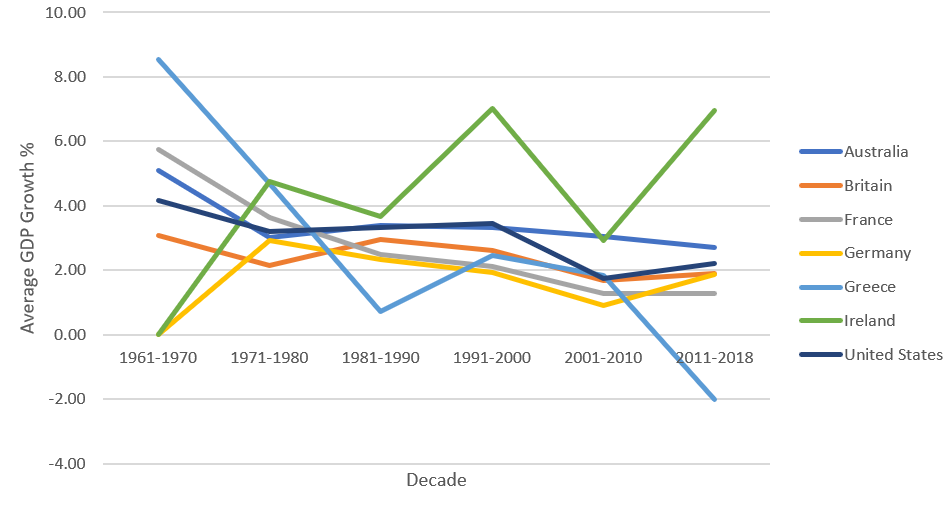
Figure 1: Average GDP Growth, World Bank National Accounts Data.

Penetration of capitalist relations into everyday life
An important aspect of the capitalist response to the over-accumulation crisis has been an attempt to find new avenues for investment and the extraction of profits. The focus for this drive started, and has continued, with the push for corporatising, and then privatising, government-owned corporations.

In the past 30 years, this has expanded to efforts to commodify substantial areas of what had previously been the private domestic domain, with the mass expansion of the services industry. This drive has resulted in the opening up of new aspects of social life for profit-making, as well as the intensification of working life – particularly for working women, who bear double and triple shifts as workers while continuing to carry out the central role in social reproduction.

The process of expanding commodification has been further intensified by the development of the gig economy. This has generated new technologies that have enabled capital to regularise social exchanges for profit. At the same time, capital has shifted substantial costs onto the gig workers themselves, in exchange for providing a platform linking workers with consumers – a platform that has intensified the capacity of capital to monitor and exploit labour.

The growth of the gig economy has also intensified crises in other parts of the economy, as previously dominant market players are forced to compete with numerous individual operators linked via platforms.

Financialisation
As the expansion of profits through the real economy became more difficult with the saturation of markets and problems of over-accumulation, capital shifted its focus towards investments in financial markets and the creation of new and novel financial instruments, expanding interest-bearing capital in both intensive and extensive forms.

This has resulted in a massive expansion in the volume of financial transactions and in the relative weight of the finance industry in economies. This process of increasing complexity and weight is called financialisation.

It can create the impression of a decoupling of the ‘real economy’ and ‘financial services’; however, in reality they remain intimately connected with the speculation in the financial markets essentially being a series of bets and counter bets on the real economy.

The immediate catalyst of the 2007-2008 global financial crisis was the failure of US sub-prime mortgages and its ripple effect through the bond market, which rapidly spread through other vulnerable sectors within both the ‘real economy’ and the ‘financial services’ sector.

Decline in wage growth
In 2019, in response to widespread public concern regarding record low wage growth, Australian finance minister Mathias Cormann described (downward) flexibility in the rate of wage growth as “a deliberate design feature of our economic architecture”.

This statement reflects not just the determination of individual capitalists to drive down wages, but the active efforts to transform the industrial relations environment in advanced capitalist countries to undermine the ability of workers and their unions to fight to defend wages and conditions, let alone advance them.

This process of undermining organised labour – central to the neoliberal project – is also based on a race to the bottom between jurisdictions. Employer groups, neoliberal thought leaders and governments point to efforts that have been made in other jurisdictions to erode workplace rights and be internationally “competitive”.

Lapavistas et al. argue that in response to the global financial crisis and sovereign debt crisis in the European Union’s Economic and Monetary Union (EMU) there has been a renewed pressure to increase labour productivity within all economies of the EMU.

This has placed downward pressure on wage growth, with German capital being the most successful in achieving this within the EMU. As a result, Germany has been best placed to sell goods and services to other member states and to markets outside the common market.

The impact of these dynamics can be seen in the ongoing low wage growth across the OECD, which demonstrate that the burden of low economic growth since the end of the global financial crisis has primarily been shifted onto working people (see Figure 2).

Figure 2: Wage Growth, OECD (2020), “Average annual wages”, OECD Employment and Labour Market Statistics (database).

This combined pressure to increase labour productivity while at the same time limiting wage growth has resulted in a decoupling of labour productivity and wages, which had historically been correlated (see Figure 3).

Figure 3: Decoupling of wages and productivity. Source: OECD (2018), OECD Economic Outlook, Volume 2018 Issue 2, OECD Publishing, Paris.

This decoupling has meant that while capital continues to experience growth – albeit at a rate insufficient to quell its insatiable hunger for growing profits – working people are failing to see any real benefit for their increased productivity.

As a result, in order to maintain spending power, working people became increasingly reliant on borrowing, whether in the form of credit cards or payday loans, to meet day-to-day spending costs (see Figure 4).

Figure 4: Household Debt as Percentage of Household Income, OECD (2020), Household debt (indicator).

Rising household debt ultimately exacerbates the problems of the declining purchasing power of the working class. This decline in purchasing power also negatively impacts on the capacity of economies to grow, deepening the crisis tendencies.

The long-run capitalist economic crisis that started with the end of the long boom, and which is now intensifying with the current COVID-19 pandemic, is prompting a more aggressive orientation by both state actors and individual capitalists.

This aggressive posture means that collective bargaining more readily lays bare the class struggle. For working people and their unions to be able to effectively respond to this environment will necessitate being prepared for direct challenges to capitalist power.

Failure to do so effectively and adequately will see a deepening of the shift of more and more of the product of workers’ labour into profits, leading to the further inequality not only within societies but within the working class itself.

-------------------------------------------------------------------------------
Originally published by the Irish Broad Left. 

Read more...

Monday, March 16, 2020

Morrison’s COVID-19 stimulus measures: wrong diagnosis, wrong medicine

Lisbeth Latham

Prime Minister Scott Morrison announced a $17.6 billion stimulus package on March 12, aimed at combating the expected economic slowdown resulting from the growing COVID-19 pandemic.

This was followed four days with statements that his cabinet was considering future stimulus measures, particularly targeting the tourism and hospitality sector.

The federal government’s priority is to pump money into small and medium-size businesses to encourage them to buy small capital goods. It claims this will boost spending and thus slow or reverse the slowdown.

This appears extremely unlikely, however, because the stimulus package is insufficient and poorly conceived.

Stimulating what?
The Australia Institute (TAI) argues the package is the right size but wrong shape.

TAI senior economist Matt Grudnoff said only 25% of the package — the part aimed at welfare recipients — was well directed, as these individuals would likely spend the money directly.

He argued small businesses though were unlikely to spend in the current circumstances and that “instant asset write-off and accelerated depreciation initiatives are likely to be under-subscribed”.

People on welfare will most likely quickly spend the one-off $750 cash payment in the government’s stimulus package because these payments are already well below the poverty line.

Rather than giving out a one-off payment that is roughly equivalent to $15 a week across the year, the economy would be better off if all welfare payments were raised to at least the poverty line.

But the slowdown is not being primarily driven by a lack of domestic spending, nor is this likely to become the main driver. The key issue is the economy grinding to a halt as people become sick and are unable to work.

The stimulus is unlikely to stop a downturn as the need for social distancing and self-isolation over the course of the pandemic means a slowdown is most likely inevitable.

Protecting incomes
During this time, many businesses will close, and some may never reopen. This will be a tragedy for the owners and tens of thousands of workers who face a loss of income — and, potentially, their livelihood.

Keeping people in jobs must be a priority of the stimulus package.

This does not mean businesses must stay open during the pandemic. Many will need to temporarily close.

Only workplaces providing food, power, water, health and other vital services should remain open. All energy must be directed to ensuring this is possible.

All other workers, including casuals, should be paid leave during periods of self-isolation, sickness and shutdown. Large businesses should wear the cost of temporary closure or reduced services, while those small and medium-sized businesses that are unable to should be supported to ensure they can pay workers and meet other essential costs.

This support should extend to sole traders, such as many tradespeople, artists, gig economy workers, musicians, performers and sex workers. Failure to do so will mean any resulting financial crisis will be much larger, and more deeply and longer felt than need be.

There have been calls for a moratorium on rent and mortgage payment. While such a move has understandable appeal, there are some issues with it.

For one, it would simply shift the problem to another part of the economy and create the possibility of a contagion of bad loans in the financial system.

Moreover, most Australians do not have savings and are already reliant on short-term credit to cover not just rent and mortgages but food and basic services. As such the priority has to be on maintaining incomes, rather than attempting to offset the consequences of their collapse.

Who pays?
The federal government has made much of the fact its initial stimulus package was a consequence of its “sound economic management”. The reality is the budget surplus only ever existed on paper and was primarily premised on huge underspending on the National Disability Insurance Scheme.

However, we should avoid some of the gloating that has crept into public discourse around the evaporation of the “surplus”, as it accepts the notion that a surplus is an inherently positive thing or represents “good economic management”. It risks celebrating the government’s attempt to provide certainty to global lenders over the provision of vital social services. Funding large-scale subsidisation of incomes across the economy will cost a small fortune.

In the short-term, it will need to be paid for from government revenue and borrowing, which is relatively cheap in the circumstances. Covering the cost in the medium-to-long-term, will require raising government revenue.

As the economy restarts, the focus will have to be on ensuring the rich pay taxes, not just by cracking down on tax minimisation and avoidance schemes, but by raising corporate taxes.

-------------------------------------------------------------------------------

[Originally published in Green Left Weekly #1257. It should be read in conjunction with my article Working communities must not be made to pay for COVID-19 crisis]

This article is posted under copyleft, verbatim copying and distribution of the entire article is permitted in any medium without royalty provided this notice is preserved. If you reprint this article please email me at revitalisinglabour@gmail.com to let me know.

Read more...

Sunday, May 12, 2013

Chicago Workers Open New Cooperatively Owned Factory Five Years After Republic Windows Occupation

[The occupation by UE members at Republic Windows was one of the first things I wrote about when I established this blog. Five years on - they set up a cooperative to run their old workplace. This story is from Democracy Now!]

Workers at the New Era Windows Cooperative are celebrating the grand opening of their new unionized, worker-owned and -operated business. Almost a year to the day after their window factory closed, a group of former workers have launched their own window business without bosses. They successfully raised money to buy the factory collectively and run it democratically. In 2008, some of the workers were involved in a famous six-day sit-in after Republic Windows and Doors gave workers just three days’ notice before closing the factory. The sit-in drew national attention and union workers reached a settlement where they each received $6,000 each. About 65 workers occupied the factory after their jobs came under threat again in 2012. We speak to two worker-owners of the just-opened New Era Windows Cooperative and a labor organizer who helped with their fight.
   

Transcript 

This is a rush transcript. Copy may not be in its final form.

JUAN GONZÁLEZ: In labor news, we go now to Chicago. Workers at the New Era Windows Cooperative are celebrating the grand opening of their unionized, 100 percent worker-owned and -operated business. Almost a year to the day after their window factory closed, a group of former workers have launched their own window business without bosses. They successfully raised money to buy the factory collectively and run it democratically.

AMY GOODMAN: In 2008, some of the workers were involved in a famous six-day sit-in after Republic Windows and Doors gave workers just three days’ notice before closing the factory. The sit-in drew national attention. Union workers reached a settlement where they each received $6,000. The Goose Island plant, run by Serious Energy, faced a second occupation in 2012. About 65 workers occupied the factory in an attempt to save their jobs again. This is an excerpt of a documentary produced by the workers’ union, United Electrical, Radio and Machine Workers of America.

ROCIO PEREZ: [translated] They gave us like an hour, more or less. They came and said, "OK, you have your papers. Now go." That is when we said, "No, we’re not leaving. This is where we’re staying."

RON BENDER: So we decided—we just said, "Hey, we’re going to stay here until, you know, you all give us some better answers than this."

FACTORY WORKERS: ¡Sí, se puede! ¡Sí, se puede!

CBS NEWS: This is a group ready for a fight.

MARK MEINSTER: We put it to a vote, and workers decided that they will be staying in the plant for the remainder of the weekend.

CBS NEWS: More than 200 of Republic Windows and Doors’ 300 union workers are staging a sit-in of sorts until they get what is legally owed to them. The union says company officials told employees they were closing shop because Bank of America would no longer extend Republic a line of credit. Bank of America wouldn’t confirm that, due to confidentiality concerns. Workers say the fact that Bank of America received $25 billion in the federal bailout makes this even more unacceptable.

ARMANDO ROBLES: I’m going to stay until the end. If they tell me I have to leave, well, they have to arrest me.

REPORTER: You’re prepared to be arrested?

ARMANDO ROBLES: I’m prepared to be arrested, if it’s necessary.

FACTORY WORKERS: ¡Y no nos vamos! ¡Aquí estamos y no nos vamos!

CBS NEWS: Translation: "We are here, and we are not going anywhere."

MELVIN MACLIN: We have been here overnight. We’ve been here since yesterday, and we aren’t going anywhere. We are committed to this.

CBS NEWS: Melvin Maclin is one of dozens of Republic Windows and Doors workers who is staying put in the company’s cafeteria until he gets his remaining vacation, healthcare and severance pay.

FACTORY WORKERS: You got bailed out! We got sold out!

PRESIDENT-ELECT BARACK OBAMA: These workers, if they have earned these benefits and their pay, then these companies need to follow through on those commitments.

REV. JESSE JACKSON: Workers all around the nation who are now facing massive layoffs, it’s your job, it’s your plant. Stay there and fight for them ’til justice comes. And justice will come.

AMY GOODMAN: That last voice, Jesse Jackson, Reverend Jesse Jackson. Excerpts from a video produced by the workers’ union, United Electrical, Radio and Machine Workers of America. We’re joined now by two of the workers featured in that video, Armando Robles and Melvin "Ricky" Maclin. They join us now from Chicago, Illinois, along with the Brendan Martin, president and founder of The Working World.

JUAN GONZÁLEZ: Armando Robles worked at Republic Windows and Doors for eight years. He then worked at the successor, Serious company, for another three years. He is one of 20 workers at New Era Windows Cooperative, a worker-owned company. Armando is also president of Local 1110 of the United Electrical, Radio and Machine Workers of America in Chicago, a maintenance worker at the former Republic Windows and Doors factory. And Melvin "Ricky" Maclin worked at Republic Windows and Doors for almost a decade. He then worked at the successor, Serious company, for three years. He’s also one of the workers at the newly opened cooperative. Welcome, all of you, to Democracy Now!

BRENDAN MARTIN: Thank you.

ARMANDO ROBLES: Thank you.

MELVIN MACLIN: Thank you.

BRENDAN MARTIN: Thanks for having us.

JUAN GONZÁLEZ: Armando, if we could start with you, the road you’ve traveled now, from the second closing now to reopening this cooperative, how did that come about?

ARMANDO ROBLES: It comes from an idea. The last time when I be on Democracy Now! in 2009, the first time, even though—I met Brendan Martin, which is on my left side. And then, after, we talked about creating a new—why we don’t make a cooperative? And it comes to—it sounds to me a great and a brilliant idea. But in that point, somebody was buying the Republic Windows and Doors machinery and—Serious Energy. But I was—in my mind, that, so when—and I told him, "You know what? Owners are owners, and they close factories. And we never know when this person is going to close the factory." This guy close, and we never [inaudible] to call Brendan Martin, take the offer and put the project in process. And at this point, it’s a great day for us. We’re going to open our cooperative. It’s called New Era Windows. And I’m really, really happy. It’s a lot of work we made. It’s a lot of learning process. But at this point, we have the factory now open.

AMY GOODMAN: Brendan Martin, talk about exactly what you did, how this new cooperative got organized.

BRENDAN MARTIN: Well, I came off of working in Argentina for about nine years with factories in a similar situation. They were closed down, and workers took them over and began running them. So then I met Armando Robles in New York in 2009 and mentioned this history to him. And he thought, "Wow! That seems kind of—that would be good." And then, three years later, in 2012, he and some of the other workers called up and said, "OK, remember that co-op idea? What if we—can we really make that happen?" And I said, "I’ve seen it happen before. Why not?" So I flew out to Chicago. We began talking about what it would mean to form a cooperative. And we began raising the money for the workers to buy the plant for themselves.

JUAN GONZÁLEZ: And, Ricky Maclin, after the first protest—and I remember being there in 2008 covering that when you all sat in—and then the second—the reopening and then the second closing—how did you feel in terms of the prospects for this factory being able to continue?

MELVIN MACLIN: After Serious had bought the old Republic plant?

JUAN GONZÁLEZ: Yes.

BRENDAN MARTIN: After they closed down the second time.

MELVIN MACLIN: After they closed down the second time, then Armando and I, we had been having a conversation, and we were discussing the possibility. And that’s where that it really started for me. I thought that it may could work. And we both said, "Well, we have to give it a shot." I mean, because at that time, I believe, I was like 58 years old. So, at 58, I can’t just roll up into a ball and die, so I have to do something. And so, we decided to fight, what we do best. And I remember the slogan, "We win what we fight for." So, we have been fighting for this plant, and today is really a beautiful day. Thank you.

AMY GOODMAN: So, Armando Robles, talk about what you’re going to make there. Talk about New Era, this New Era Windows Cooperative.

ARMANDO ROBLES: Could you repeat the question for me?

AMY GOODMAN: What are you making at the New Era Windows Cooperative? I mean, how do people get involved? What are the products you’re making?

ARMANDO ROBLES: We’re going to start making replacement windows, vinyl windows and commercial windows—it’s our goal—and for affordable price and a good-quality product for the workers. At the beginning of this, I think we, us, know how to make windows. But after all work done we have at this point, I learned so much in this year. We put a factory in place in all the right spots. Yesterday, we have our check from the city. They checked—the inspector, they inspect the whole building, and they approve us our job. So, not even do just windows, but we would like to make a New Era for the United States, helping people creating cooperatives and create our good-quality and affordable windows for the region and for the United States.

JUAN GONZÁLEZ: And, Brendan Martin, I would have to assume that the labor unions alone and labor union members could provide a steady demand for the products of the factory. Have you gotten any—any bites or orders yet from—pressed by other unions or other—or unionized workers?

BRENDAN MARTIN: We have actually gotten early interest in the windows from people in unions, from housing cooperatives, and just from people across the United States and in the Chicago area who support jobs being saved by their workers rather than destroyed by their owners. But without a doubt, we still need more support to come in. So, anybody out there—these are residential windows. Anyone who’s listening can buy them. They fit in anyone’s home. They’ll save you money on your energy bill and pay for themselves in a few years. So, please come to our website, newerawindows.com, participate in this project by buying some windows, and then go out and start your own cooperative. We do have a lot of interest from the community, but we need more of the community to pile in and make this happen.

AMY GOODMAN: Well, we want to thank you very much for being with us, and congratulations on opening day, Armando Robles and Ricky Maclin, workers at New Era Windows Cooperative, and Brendan Martin, president and founder of The Working World. As we move to our last segment—

BRENDAN MARTIN: Thank you, Amy.

ARMANDO ROBLES: Thank you, Amy.

AMY GOODMAN: Thanks so much.

Read more...

Tuesday, February 21, 2012

Greece: Social explosion, a question of months?

By Tassos Anastassiadis and Andreas Sartzekis
International Viewpoint
February 2012

“Kali phtochia chronia!” (“happy new year of poverty!”) instead of “Kali proto chronia!” (“happy new year!”): that was the ironic wish that the workers on the big daily newspaper “Eleftherotypia”, unpaid since the summer and on a rolling strike for a week, published during a message requesting support for their struggle. This humour is today indispensable, partly not to fall into despair before the situation of poverty which grows daily, and partly to maintain the flame of resistance, which in appearance has not weakened for a year and a half, but which obviously flickers from seeing a considerable, but disunited force held back by the union of the bourgeoisie and its international bodies.


Parallels between ancient Greece and current Greece are not lacking in recent times, and the “Greek tragedy” has been served up in all journalistic sauces. In the country which invented democracy to put an end to debt slavery, the European bourgeoisie imposes its reactionary approach: even if the institution of slavery is not (yet) re-established, the poverty into which the Greek people have been plunged at a growing speed greatly resembles a modern slavery. In the new situation where the government of the technocrat Loukas Papadimos has no legitimacy originating from the parliamentary elections of 2009, it is clear that the popular response, to be effective, should link economic programme and reappropriation and extension of democratic processes. Every day, 2,400 new workers are thrown into unemployment, which has officially reached 17.7% (12.4% a year ago), with 21.5 % of women affected and 35.3% of youth. 50% of the unemployed have been out of work for more than one year. 30,000 civil servants were awaiting dismissal on December 31, and the haemorrhage will continue in 2012 with the aim of dismissing 150,000 civil servants by 2015 (in a country with just over 11 million inhabitants), education and the army being alone officially “preserved”. Second tier pensions above 150 Euros should fall by 30% minimum and the wages in the public sector should continue to fall (an employee of the Agricultural Development Ministry with a seniority of between 5 and 7 years should see their wage cut from 1 600 to 1 225 Euros). All taxes have been increased (budget 2012).

Paul Tomsen — the best known personality of the troika (IMF, EU and ECB), today de facto in charge of the country’s affairs —says on the one hand that the imposition over the last six months of the fiscal burden on a part of the population which can no longer pay is an error, and on the other demands two measures: the suspension of collective agreements (to impose flexibility and the alignment of wages with productivity) and the closure of a certain number of public enterprises (which in his view have ceased to fulfil the function for which they were created). Obviously, no question of asking the people for a democratic opinion on the utility of these enterprises!

In the centre of Athens, the official figure for homelessness is 20,000. All the social indices are catastrophic and get worse at dizzying speed. For example, the suicide rate, traditionally quite low in Greece, around 2.8 per 100,000 inhabitants, more than doubled in 2011, climbing to 6! Six people out of 10 reduced their overall food intake in 2011, whereas 1 in 11 has been fed by the soup kitchens distributed by various networks (town halls, churches, NGOs and so on). According to Médecins du Monde, if the urgency of the “humanitarian crisis” was until now in Uganda, now it is in Greece. Not to forget the explosion of AIDS, above all among drug addicts: in one year a terrifying increase (around 1,500 % or a 16 fold increase), because of the destruction of all services of shelter and treatment for marginalised youth.

Thus the urgency of a democratic reappropriation of its choices by the Greek people depends of course to the state of the left forces and their proposals, which we deal with below. But it also depends on the recent developments and choices made by the parties who have formed a “national unity” government. It amounts in fact to one of the last cards of the Greek bourgeoisie facing a still growing rise of popular resistance. This is the reason for the haste with which the Socialist prime minister, Giorgos Papandreou, called in late October for the organisation of a referendum, taking (nearly) all his European partners by surprise. In fact, this question of a referendum on the measures to deal with the debt has come up at three times since the establishment of the austerity measures.

In Spring 2010, it was the radical left Syriza which during the first workers’ mobilisations (halted after the death of three bank employees during a fire due to Molotov cocktails launched by mysterious hooded figures, never identified), campaigned for a referendum for or against the measures. The response given then by the anti-capitalist left was that the referendum was taking place in the street and the objective was a rolling general strike.

This point then re-emerged in the spring of this year, when Papandreou did not miss an opportunity to publicly declare his wish for a referendum… once a maximum of austerity measures had been taken! Not one left or right force followed him on this terrain, and the workers’ movement continued its mobilisations, forcing its national union leaderships, dominated by PASOK, to organise general strikes: in the Athens demonstration of October 19, involving at least 300,000 workers and youths, the feeling emerged, all the more admirable after a year of unprecedented attacks against living standards, that basically power was in the street and that it was possible and in any event necessary to go further than this immense demonstration. Even if the day after the mobilisations were less massive, this popular force inspires fear in high places, with dissent apparent among the cadres of PASOK, in particular at the trade union level (the resignation of the leader of the Public Federation ADEDY was understood as a rejection of the policies of his party).

In this context, the announcement of a referendum on the policy of the government, the day after the demonstrations of October 28, had a dual effect: surprise at the haste of the prime minister, but also indifference before a reheated dish. Even Syriza did not applaud and continued to request, like the KKE (Communist Party), the holding of immediate parliamentary elections.

Even if the referendum was abandoned on the “diktat of Merkozy”, this question merits some comments. First, the anger of Sarkozy is to be compared with the moderate reaction of Germany: according to some sources, Papandreou discussed this “coup” with the German finance minister, the final objective being to force the leader of the Greek right, Antonis Samaras, to accept the formation of a national government and to abandon his demagogic posture of condemnation of austerity measures to better win the elections tomorrow!

A question little posed on the Greek left: even in this context, would it be necessary to take up the challenge and demand the referendum? To pose the question is to answer it: the KKE like Syriza wants parliamentary elections above all and the anti-capitalist left has no desire to lose time in discussions on Papandreou’s manoeuvre. We are not in the French situation of 2005, where a unitary framework for the left “no2 was possible. Such a framework is not unhappily in the traditions of the Greek left and to build on this opportunity would have taken a lot of time, whereas the referendum would have taken place in mid December.

What is more, the question imposed would not have been as simple as “for or against the austerity measures?” but would have concerned staying in the Euro zone and thus in the EU and one can count on the climate of fear that the Greek bourgeoisie would create through its parties, media and perhaps its provocations. The reappropriation of a democratic process does not then pass by the political coup of the referendum, but rests on a more favourable terrain, that of the resistance struggles.


An extremist government, deprived of credibility
The “referendum” episode concluded then on what was sought by Papandreou, the EU and the IMF for several months: a national unity government. Let us be clear – while the propaganda presents it as a measure of good sense, stressing the technocratic character of the prime minister, it should be designated for what it is — a dangerous extremist government. First because it is made up of dangerous fanatics of the “only road possible”, that of the markets, that the government has the prime if not the only task of “reassuring”. What of the interests of the people? Not a word during the formation of this government of so called national unity! Its leader, Papadimos, has been quite correctly presented as a key element of the policy of massaging of the Greek accounts to enter into the euro. This fanaticism would be all the stronger in that the government has no popular legitimacy: the majority vote in autumn 2009, was for a PASOK government whose (minimum!) programme included social measures.

We now have in Greece the full political dictatorship of the markets. The introduction in this government, 37 years after the fall of the military dictatorship, of adorers of that junta, incarnated in the ministers and secretaries of state (three in total) of LAOS is repugnant. LAOS could be compared to the French Front national, its leader Karatzaféris trying like Marine Le Pen to play the card of respectability, then of credibility as final card for the bourgeoisie. The extremism of this government has already been shown in the draft budget. E. Venizelos, the PASOK minister of the economy, boasts that there are no new austerity measures, but the draft budget in fact envisages 3.6 billion Euros of various supplementary taxes.

The viability of this government poses a basic question: what form of regime comes after it, knowing that the bourgeoisie has exhausted nearly all its traditional forces of power. Papadimos responds saying that there are no limits of time to his government, and says the future elections will not be held before April, which leaves time to get the murderous measures passed.

The leader of New Democracy (ND), Antonis Samaras, demanded elections on February 19 and explained without fear of ridicule that in any case this is not a national unity government (its party has six ministers and secretaries of state!). There is a crisis in the ranks of the ND, between the declared centrists and the populist line. Implosion is possible (a former “centrist” minister has been excluded). As for LAOS, to play the card of the “higher interest of the country” as its caudillo has done and thus participate directly in the austerity measures could deprive this party of the popular base it has won in the previous elections. That is verified already in an anonymous appeal from the cadres and activists of this party that it leave this government, which has already obliged the caudillo to insinuate that if the government is no longer effective, it will withdraw its ministers. The risk in case of visible disaffection for LAOS is that the recourse to the far right passes by the openly neo Nazi movements like the Golden Dawn (Chryssi Avgi), who have made a breakthrough in the Athens municipal elections.

As to PASOK, its survival could be at stake. It can be seen on several fronts: disputes in the leadership between Papandreou and his “internal troika”, growing disillusionment among cadres and base. In the future elections the polls give PASOK only 15-20 %. The main thing is the condemnation by the PASOK rank and file of the anti-social policy of their party, accentuated by a manifest anger at the entry of the far right into the government (which was only rejected by two deputies out of 153!). A question which is now important is that of the perspectives to offer to these thousand of former supports and hundreds of activists and cadres of PASOK. In the end it will be the ability to develop victorious struggles which will be determinant in the coming months.
 
A workers’ resistance to support at the European level
> The workers’ resistance as reflected in the national strike days called by the union leaderships linked to PASOK constitute an astonishing, not to say admirable, phenomenon. An example was the immense demonstration of October 19, which swept aside sectarianism (isolation of the KKE) and gave the massive feeling that it was possible to go further The contradiction is all the more flagrant. On the one hand, this radicalism, and on the feeling that the international bourgeois coalition is stronger, and the integration of a feeling of defeat, more evident undoubtedly in the local struggles. That highlights the importance of a European strike day called by the European unions, which could have a stimulating effect on the mobilisations in Greece.

The mobilisations by sector or enterprise are numerous and sometimes allow partial victories over the employer or the state. Numerous strikes have taken place in transport, a strike has broken out against the neoliberal university reform, and the taxis are on strike against the “opening” (to the big companies) of the profession and so on. One of the most significant struggles currently concerns the audiovisual and press sector (press, television, radio, magazines, and internet). It is a model on the one hand by the cruelty of the employers attack and on the other by the dynamic of resistance. Massive layoffs, brutal pay cuts have affected every company in the sector. Tens of thousands of workers are no longer paid or in any case not paid on time with most companies paying wages months late. The television channel “Alter” has not paid its 700 employees for a year, and the big Athens newspaper “Eleyfhterotypia” stopped paying its 840 employees this summer. This “fashion” of not paying wages extends across all sectors.

However, there is resistance to this daily violence in the workplaces. After months of working for free, the workers at “Alter” decided to occupy the head office of the television and turn it into a centre of solidarity (collecting food to organise their own survival) and being to broadcast programmes (rudimentary for the moment) which have become a centre of popularisation of the struggle of several sectors and factors. Similar projects are now being discussed by the workers at “Eleftherotypia”.

The most emblematic struggle currently is at the steel factory of Halivourgia in Aspropyrgos, in the Athenian suburbs, against redundancies and wage cuts. This struggle is led by workers linked to the pro-KKE union current PAME and is characterised not only by its combativity, but also by the very broad support it has from the near and distant population, demonstrations, broad union and political support. For example, the intervention of our comrade Yannis Felekis, historic leader of the Greek section of the Fourth International, OKDE-Spartakos, was warmly received by the strikers!
 
On the left: internationalist solutions
Obviously the developments inside a mass party like PASOK should be observed by the left. The latter should be able to offer them a framework, but without concession. It isn’t about offering former bureaucrats a chance to “redden” a little and reforge their careers, but to open as much as possible perspectives which can only be 100% left, taking account of the urgency resulting from the political impasses of the bourgeoisie. Indeed, from this viewpoint, the Greek left (to the left of PASOK), marked by its profound history, is lagging in relation to the blows borne by the workers, and in its responses in terms of alternative power. Whereas the intense mobilisations of all these months should have led to a permanent coordination of the sectors in struggle and on the road of self organisation, the rank and file unions, linked to the radical and anti-capitalist left, are still not in a position to offer an immediate extension to the general strikes of 24 or 48 hours. It is not enough to demand the rolling general strike for it to be credible. This goes back of course to the division on the ground, with the trade union structure of the KKE (PAME). But in the last instance that relates to the reformist character of the KKE and Synaspismos, the central party of the radical coalition Syriza.

As for the KKE, the mystery remains: how has this party, which was drained of its youth in the 1990s, and adopted a caricatured and openly Stalinist “Marxist” discourse, continued to organise combative workers and radicalised youth? In fact, more than a theoretical response, the true objective is to know how to offer unitary perspectives of struggle to these activists. Indeed it is not always thus in the daily practices of the radical or anti-capitalist left: the extra-parliamentary left has fallen into the trap of the KKE leadership in ignoring this party. Indeed, this is a crucial issue, not only in terms of activist forces but still more in terms of political perspectives. It is flagrant that on these two terrains, the KKE leadership has no working class response to the situation. Its trade union positioning, despite the leftist accents, reflects a sentiment of defeat, which excludes any great working class battle. Hence the importance of centralisation of the struggles and the perspective of a workers’ Europe, faced with a slogan of exit from the EU which represents a nationalist reflex to the Stalinist history of this party, valuing a “good” national bourgeoisie against the monopolies! At the political level, the sole slogan advanced by the KKE is that of popular power… around the KKE. Which amounts to having as sole perspective its own electoral strengthening! Faced with this impasse common struggles at the base and the advancing of unitary slogans for victory are the sole instrument which would allow advance.

As for Syriza, the regroupment of Synaspismos with the forces of the revolutionary left, the internal relation of forces remains unchanged. To speak of Syriza is above all to speak of the reformist party Synaspismos and its leader, Alexis Tsipras. The main force to its left, the KOE, has been absent in Syriza, even if it remains officially a member. The efforts of different currents or independent members — like the veteran anti-Nazi Manolis Glezos — do not change the situations. The debates inside Synaspismos dominate the orientation of Syriza. Advancing the idea of a left government, Syriza certainly provides a perspective for disoriented PASOK voters and the polls give around 30% for forces to the left of PASOK. But this political response is hardly credible today faced with the sectarianism of the KKE but also faced with divergences — Synaspismos is favourable to the renegotiation of a part of the debt. It is both too vague (what left forces?) and too precise (Synaspismos retains the perspective of a government of the parliamentary left!) to respond to current needs. At the rank and file level Syriza activists are involved in numerous resistance struggles and this common work allows discussions between all the forces of the anti-capitalist left.

Nonetheless things advance at the rhythms of the crisis and struggles and social mobilisations. For example convergences have begun on the revolutionary left, first through the process of construction of the Anti-capitalist left, Antarsya. Its congress attracted 900 delegates, representing 3,000 members. It examined notably a new question for most of the revolutionary left forces: that of real unitary fronts of struggle, which might seem obvious but is not always so in Greece! Rapprochements could thus take place with the revolutionary forces inside Syriza, thanks to a common work on the ground as in the committees against the closure of the electricity meters of those who can’t pay their bills.

In the daily struggles links are made and political cleavages are approached from an open angle, to the point that strategic questions are now posed in a new fashion. For example, the idea of “poor Greece attacked by international capital and various imperialisms “ has gained in credibility, to the point that cleavages on the left take place inside the current around Synaspismos, traditionally tempted by the idea that the EU was “progressive” in itself! But at the same time, the fact that the crisis in Greece is only the vanguard of a crisis and a brutal capitalist policy which extends from one country to another, shows that the overall response can only come by attacking the social roots, namely capitalism, which has no frontiers. In terms of demands the possible implosion of the EU or the euro zone imply new discussions on “exit from the euro” as transitional demands or necessary implication of a situation where a single country, like Greece, tries to free itself from the yoke of capitalist finance. That requires the stressing of the necessary self-organisation of struggles, and the coordination of these struggles not only at the national level, but at the same time at the international level, with a political dynamic which can only be that which overthrows the logic of war and the poverty of capitalism.

-------------------------------------------------------------------------------
 
-Tassos Anastassiadis is a member of the leadership of OKDE-Spartakos, Greek section of the Fourth International, which is part of the coalition of the anti-capitalist Left, Antarsya.

-Andreas Sartzekis is a member of the leadership of OKDE-Spartakos, Greek section of the Fourth International, which is part of the coalition of the anti-capitalist Left, Antarsya.

Read more...

Wednesday, December 7, 2011

We've got the power to win

by Sean Vernell, UCU national executive 
Socialist Worker
10 December 2011
  

N30 was a historic day for the trade union movement. It could be a turning point in the fight to defend our pensions and stop the government’s austerity measures.

We are constantly told trade unions are in decline and don’t hold the power they once had. But the 30 November strike gave the lie to this.

It saw the rebirth of trade unions as a united mass movement. Working people saw a glimpse of their power and their ability to change things.

Every mass strike lights up the way forward and shows how change can be won.

Workers often have to put up with bullying managers and stress over workloads. But on the day of the strike these concerns seemed a million miles away.

At work the next day, employers faced workers who are more confident, less compliant and more determined to take control of their lives.

This is what every government and boss fears. And their only response is to whip up fear and division.

The government paraded around the media reminding public– sector workers how lucky they were to have pensions at all because many private workers don’t.

It offered a deal to buy off older workers with a promise that the “reforms” would not affect them.

Recognise
But this attempt to divide workers failed miserably. That’s because ordinary workers recognise that this is not simply a fight for themselves. It is also, crucially, about younger workers’ futures.

The strike was a great success. And it had a deeper impact than protesting or letting off steam.

Public sector workers are in this fight to win. There was a clear consensus among strikers that a one-day strike would not be enough to win.

It is important to push a strategy for all-out action. But the key issue facing us now is how to escalate as soon as possible.

The speed at which we move is important for two reasons.

First, another five month gap before the next strike will allow the government time to get better organised.

Second, any delay in action will send a message that the unions aren’t serious about this fight.

The strategy put forward must match the seriousness of the task. Otherwise workers will simply ask why they are losing pay for a strategy that will not win.

Coordinated

Some unions have already passed motions calling for further nationally coordinated action as soon as possible, including the NUT and the PCS.

Local joint union mobilising committees that were set up for N30 should meet and be part of coordinating the next step.

This should include winning unions that weren’t part of N30 to join future action.

The UCU national executive met on Friday last week. We unanimously passed a motion outlining a possible strategy as a way forward to be proposed to the other unions.

The motion called for another day of nationally coordinated action as early as possible in the spring term.

This would mean from January onwards. This would be followed immediately with coordinated regional action.

The motion calls for “this action to be rolled out across the country creating a Mexican wave effect acting as a bridge to the next day of nationally coordinated strike action” and “this action to end with a 48 hour nationally coordinated strike.”

We need to ensure that this debate is had in every workplace. Don’t delay—hold branch meetings right away to discuss the next steps and pass motions calling for escalation.

Some union leaders are looking for a way out. They need to feel the pressure from below to stop them making a shoddy deal.

A victory on pensions will pave the way for a wider challenge to the brutal austerity programme of this government.


Read more...

Saturday, October 15, 2011

Community Action Against Auctioning People's Property

This video was posted on Kathleen Hanna's Blog.

Community action against the foreclosure and auctioning of people's property in Brooklyn. Nine activists were arrested as part of the protest


Read more...

Saturday, February 5, 2011

A European strategy for the left?

Michel Husson
International Viewpoint
January 2011

Michel Husson offers a contribution to the debate on how the European left should respond to the economic crisis and argues that leaving the euro is not currently an option for countries which use it.

The global effects of the crisis have been made even worse by what is happening in Europe. For thirty years the contradictions of capitalism have been overcome with the help of an enormous accumulation of phantom rights to surplus value. The crisis has threatened to destroy them. The bourgeois governments have decided to preserve them claiming that we have to save the banks. They have taken on the banks’ debts and asked for virtually nothing in return. Yet it would have been possible to make this rescue conditional on some assurances. They could have banned speculative financial instruments and closed the tax loopholes. They could even have insisted that they take responsibility for some of the public debt that this rescue increased so dramatically.


We are now in the second phase. Having shifted the debt from the private sector to the public the working class has to be made to pay. This shock therapy is delivered through austerity plans which are all broadly similar – a cut in socially useful spending and hiking up the most unfair taxes. There is no alternative to this form of social violence other than making the shareholders and creditors pay. That is clear and everyone understands it.

The collapse of a ruling class plan

But the European working class is also being asked to pay for the collapse of the ruling class project for Europe. The ruling class thought that it had found a good system with the single currency, the budgetary stability pact (“Stability and Growth Pact”), and the total deregulation of finance and the movement of capital . By creating a competition between social models and wage earners squeezing wages became the only means of regulating inter-capitalist competition and intensifying the inequalities that benefitted only a very narrow stratum of people in society.

However this model put the cart before the horse and wasn’t viable. It presupposed that the European economies were more homogeneous than they actually are. Differences between countries increased due to their place in the global market and their sensitivity to the euro exchange rate. Inflation rates didn’t converge and interest rates favoured property bubbles and so on. All the contradictions of a curtailed programme of European integration which the Euro liberals are discovering today existed before the crisis. But these are blowing apart under speculative attacks against the sovereign debts of the most exposed countries.

Underneath the abstract concept of “financial markets” there are mainly European financial institutions which speculate using capital which states lend to them at very low interest rates. This speculation is only possible due to the states’ policy of non-intervention and we should understand it as a pressure applied to consenting governments to stabilise budgets on the back of the people of Europe and to defend the banks’ interests.

Two immediate tasks

From the point of view of the working class it’s obvious what has to be done: we have to resist the austerity offensive and refuse to pay the debt which is nothing but the debt from the banking crisis. The alternative plan on which this resistance must be based demands another way of sharing society’s wealth. This is a coherent demand. It is in fact against the squeezing of wages, in other words the appropriation of an increasing portion of surplus value by capital.

The alternative requires a real fiscal reform which takes back the gifts which for years have been given to businesses and the rich. It also implies the cancellation of the debt. The debt and the interests of the majority of the population are completely incompatible. There can be no progressive outcome to the crisis which does not put the debt in question, either by defaulting on it or restructuring it. In any case some countries will probably default and it’s therefore important to anticipate this situation and say how it should be managed.

Leaving the euro?

The offensive, which the peoples of Europe are facing, is undeniably made worse by the European straightjacket. For example the European Central Bank, unlike the Federal Reserve in the United States, cannot monetise public debt by buying treasury bonds. Would leaving the euro allow the straightjacket to be loosened? That is what some on the left like Costas Lapavitsas and his colleagues are suggesting for Greece as an immediate step. He proposes that it is done immediately without waiting for the left to unite to change the euro zone, something he thinks is impossible.

This idea is put forward elsewhere in Europe and is met with an immediate objection that even though Britain is not part of the euro zone it has not been protected from the climate of austerity. It is also easy to understand why the far right, such as the Front National in France wants to leave the euro. By contrast it is hard to see what could be the merits of such a slogan for the radical left. If a liberal government were forced to take such a measure by the pressure of events it is clear that it would be the pretext for an even more severe austerity than the one we have experienced up to now. Moreover it would not allow us to establish a new balance of forces, which is more favourable to the working class. That is the lesson that one can draw for all the past experiences.

For a left government leaving the euro would be a major strategic error. The new currency would be devalued as that is, after all, the desired objective. But that would immediately open up a space, which the financial markets would immediately use to begin a speculative offensive. It would trigger a cycle of devaluation, inflation and austerity. On top of that, the debt, which until that point had been denominated in euros or in dollars would suddenly increase as a result of this devaluation. Every left government which decided to take measures in favour of the working class would certainly be put under enormous pressure by international capitalism. But from a tactical point of view it would be better in this test of strength to use membership in the euro zone as a source of conflict.

It is basically true that the European project based on the single currency is not coherent and is incomplete. It removes a variable of adjustment, the exchange rate, from the set of different prices and salaries inside the euro zone. The countries in the periphery thus have the choice between the German path of freezing wages or suffering a reduction in competitivity and loss of markets. This situation leads to a sort of impasse and there are no solutions that can be applied straight away: going backwards would throw Europe in a crisis which would hit the most fragile countries hardest.; and beginning a new European project seems out of reach at the moment.

If the euro zone explodes the most fragile economies would be destabilised by speculative attacks. Not even Germany would have anything to gain because its currency would appreciate in value uncontrollably and the country would undergo what the Unites States is today trying to impose on several countries with its monetary policy.[ii]

Other solutions exist which need a complete recasting of the European Union: a budget which is financed by a common tax on capital and which finances harmonisation funds and investments which are both socially and ecologically useful and richer countries help poorer ones with their public debt. But again this outcome is not possible in the short term, not through lack of alternative plans but because implementing them requires a radical change in the balance of forces at the European level.

What should we do at a very difficult moment like this? The struggle against the austerity plans and refusing to pay the debt are the launch pad for a counter offensive. We then have to make sure that the resistance is strengthened by arguing for an alternative project and work out a programme which offers both “practical” answers as well as a general explanation of the class content of the crisis.[iii]

The specific task of the radical, internationalist left is to link the social struggles happening in each country with arguing for a different kind of Europe. What are the ruling classes doing? They are facing up to the policies they have to follow because they are defending interests which are still largely nationally based and contradictory. Yet as soon as they have to impose austerity measures on their own working classes they present a solid united front.

There are better things to do than emphasise the very real differences that exist between the countries. What’s at stake is having an internationalist point of view on the crisis in Europe. The only way of really opposing the rise of the far right is by suggesting other targets than the usual scapegoats. We can affirm a real international solidarity with the peoples who are suffering most due to the crisis by demanding that the debts are shared equally across Europe. Thus we have to oppose an alternative project for Europe to that of the European bourgeoisie which is dragging every country backwards socially. How is it possible not to understand that our mobilisations, which are faced with coordination of the ruling class at a European level, need to be based on a coordinated project of our own? While it is true that struggles happen in a national framework they would be strengthened by a perspective like this instead of being weakened or led down nationalist dead ends. The students who demonstrated in London chanting “all in this together, all in this together” are a symbol of this living hope.

For a European Strategy

The task is as difficult as the period which the crisis has opened. However the radical left must not get locked into the impossible choice and start the risky adventure of leaving the euro and a utopian idea of currency harmonisation. We could easily work on some intermediate targets which challenge the European institutions. For example:
 

  • The states of the European Union should borrow directly from the European Central Bank (ECB) at very low rates of interest and private sector banks should be obliged to take over a a certain proportion of the public debt. 
  • A default mechanism should be put in place, which allows public sector debt to be written off in proportion to tax breaks for the rich and money spent on bank bailouts.
  • Budgetary stabilisation has to be reformed by a fiscal reform which taxes movements of capital, financial transactions, dividends, large fortunes, high salaries and incomes from capital at a standard rate across Europe.

We have to understand that these objectives are neither further or closer away than an “exit from the euro” which would be beneficial to working people. It would definitely be absurd to wait for a simultaneous and co-ordinated exit by every European country. The only strategic hypothesis that one can then conceive of must take as its starting point the experience of a social transformation which starts in one country. The government of the country in questions takes measures, for example imposing a tax on capital. If it is thinking clearly it will anticipate the retaliation for which it will be the target and will impose controls on capital. By taking this fiscal reform measure it is openly in conflict with the rules of the European game. It has no interest in unilaterally leaving the euro. This would be an enormous strategic mistake since the new currency would immediately come under attack with the aim of pulling down the economy of the “rebel” country.

We have to give up on the idea that there are “technical” shortcuts, assume that conflict is inevitable and build a favourable balance of forces of which the European dimension is a part. One point of support for that is the ability to damage capitalist interests. The country, which starts, could restructure the debt, nationalise foreign capital etc, or threaten to do it. The “left” governments of Papandreou in Greece or Zapatero in Spain have not even dreamed of doing this.

The main point of support comes from taking the measures cooperatively. This is completely different from classic protectionism, which basically always tries to gain ground by nibbling at parts of the global market. Every progressive measure on the other hand is effective to the extent that it is shared across a number of countries. We should therefore be talking about a strategy, which is based on the following idea: we are willing to tax capital and we will take the necessary steps to protect ourselves. But we are also hoping for these measures, which we propose, to be implemented across Europe.

We can sum up by saying that rather than seeing them in opposition to each other we have to think hard about the link between breaking the neoliberal European project and our project of creating a new Europe.

[ii] Michael Hudson, “US Quantitative Easing Is Fracturing the Global Economy”, http://gesd.free.fr/hudsonqi.pdf [iii] Bloco de Esquerda (Left Bloc) Portugal: “On the crisis and how to overcome it”, May 23rd 2010, http://gesd.free.fr/bloco510.pdf

-Michel Husson is an economist, in charge of employment at the Institut de recherches economiques et sociales (IRES) in Paris. He is member of the Fondation Copernic, a left-wing think tank, and of the Scientific Council of ATTAC. He has just published Un pur capitalisme, Lausanne 2008, Éditions Page Deux. You can consult his writings on http://hussonet.free.fr.


Read more...

Monday, January 17, 2011

Stop the Auction!: UE Seeks Solidarity

by Jane Slaughter
Labor Notes

United Electrical Workers (UE) members in Massachusetts are once again gearing up to stop the company that closed their plant from auctioning off its equipment for scrap. They’re asking New England union members to come to Taunton, south of Boston, January 19 to blockade the Haskon Aerospace factory, a maker of door seals and silicone gaskets for aircraft, and prevent the auction from taking place.

Besides UE members from throughout the Northeast, Jobs with Justice chapters, local unions, the Massachusetts Nurses Association, the Jewish Labor Committee, students and professors from Stonehill College, local residents, and the Greater Southeastern Massachusetts Central Labor Council will be there.

The Taunton City Council backs the union’s bid to keep open the 80-year-old plant, which has provided jobs for generations of residents. The council voted unanimously to take Haskon’s equipment by eminent domain, planning to then sell it to a buyer or to the workers themselves. But the council needs permission from the state legislature, which won’t convene till January 21.

Haskon’s parent company, Esterline Technologies, postponed the scheduled auction once in response to union pressure, but has generally been highly uncooperative, on everything from severance pay to health insurance to the fate of the presses. The company has demanded that workers pay more than triple what an appraiser says the presses and equipment are worth.

The UE members were offered solidarity by a Canadian Auto Workers local experienced in fighting a plant auction. President Gerry Farnham’s CAW Local 195 blockaded an auction in November 2009 to keep a Chrysler supplier from selling off equipment while it still owed workers hundreds of thousands of dollars in severance, vacation, and other benefits.

The company had employed 80 CAW members. “We strategized here in Windsor [Ontario] with all the brother and sister locals around,” Farnham said. “I called a meeting of all the presidents. I told them, ‘I have two facilities I have to block.’

“We had retirees out, we really mobilized our people. They had picket signs with what they were owed—$25,000, $30,000—so the media and people in the community could put a face to a person who’d worked there 25 years and wasn't going to receive a penny.”

Farnham said the Windsor area was lucky because a local union with a problem can call a flying squad to come to its aid. His call resulted in 200 workers and supporters forcing their way through the door of the Radisson Hotel, running up the stairs (the elevators were shut down), and taking over the auction room. The auction was halted.

“Had we not reacted in the manner in which we did,” Farnham said, “there is no doubt in any of our workers’ minds they would not have received one penny.” Earlier, workers had occupied their plant, chaining the doors shut for four days to keep the company from removing equipment. They eventually received $650,000 from Chrysler and from Comerica bank.

See Keep Haskon Jobs in Taunton! for updated information. Call Peter Knowlton, UE regional president, at 774-264-0110 if your union is sending a delegation to the Haskon plant, 336 Weir St. in Taunton. They’re asking for support at 8 a.m. on Wednesday, January 19.

Further information on the campaign are available on Labor Notes and from UE.

Read more...

Saturday, November 6, 2010

The same vote in the Assembly or Senate, we do not let go!

Sandra Demarcq
November 3, 2010
Published in: Hebdo Tout est à nous!

The government is keen to silence protest, claiming that the mobilization is over. We will show them otherwise.

The pension counter-reform has been passed by both houses against the wishes of millions of demonstrators and a large majority of the population. Central to the government's austerity plan to make the majority of the population pay for the crisis, this law - extending the legal age of retirement and the contribution period in particular – in the end does nothing, as demonstrated in May last report of the Policy Board (COR) and as has been understood by the millions of demonstrators. This is just an excuse to decrease drastically the amount of new pensions and to leave some space to private insurance. Worse, one of the amendments voted by the Senate and retained in the final text, grabbed the steering of pension to prepare a report for the first half of 2013 on the implementation of systemic reform, scheduling and a new social attach. So it's a great scam and a real coup on the part of the government.


Les syndicalistes "Solidaires" sautent : grève générale !
Uploaded by frasol. - Up-to-the minute news videos.


On the morning of the day of demonstrations and strikes of 28 October, ministers and commentators of all kinds were unanimous in attempting to bury the movement once again. They all reported breathlessly, the end of the mobilization, while the day was attended by 2 million demonstrators in full during school holidays, with parades also even more dynamic and aggressive than previous days. So it was very, very far from being a failure. Instead, this new day has demonstrated once again the roots of the movement, the denial not only of the Pensions Act but also for any of Sarkozy's policies tailored to business and the wealthy. Through this movement, employees in the private and the public, youth, pensioners also reject layoffs, job losses, rising unemployment and employment insecurity, poor working conditions, wages lower, but still also the whole aspect of this racist and secure government that has still not grasped the depth of the dissatisfaction caused by its arrogant policy.

After the vote, the government wants to whistle the end of the mobilization. We are told in every tone and every wave that now the law is passed, we can no longer be resist or even continue to state that a "law of the republic" would be "undemocratic". A democracy would be for Sarkozy and his clique to impose a social regression against the wishes of those it effects? In any case, the determination is still there. And in the past weeks links were forged between workers of different sectors, local actions of all kinds, such as blockades, collective action, general meetings, and which has developed a significant layer of motivated activists, will not easily be removed by a single vote.

It is true that in the week just past, the renewed strikes were suspended in many areas, especially in garbage services in Marseille, SNCF and the refineries, the marked pause in the pace of mobilisation up to that point. But pockets of resistance persist as in territorial agents in the Paris region or in waste where employees are on strike for their wages and working conditions. Already, it is expected before the new day's event on 6 November in many cities, protests, rallies the students' initiative in conjunction with other sectors. The movement can rebound in other forms, other struggles. Many of us know that the solution to our problems is not the perspective of a plural left government in 2012, headed a Socialist Party that votes in the National Assembly lengthening the contribution period or the requisitioning of the municipal employees strike in Marseille, with the "left" who, when she has a majority, leads de facto right-wing policies as are in Europe, like our friends in Greece or Spain. It is in our struggles to forge able to make those have caused the crisis pay for it, capable of challenging capitalism.

In raising the head, winning the battle of public opinion against the propaganda of the ruling classes, we have already scored points.


Read more...

Wednesday, September 22, 2010

France: Workers mobilise Against Vote on Pension Bill

Lisbeth Latham

As expected France’s National Assembly, on September 15, passed the Pensions Bill that will reduce workers access to pensions. The National Assembly debate and vote was met with small protests and other actions by workers. With the Bill set to go to the Senate, France’s unions are looking to expand the campaign to defend workers’ pension rights.

The Bill was passed by 329 to 233, reflecting the large majority which the Union for a Popular Movement of President Nicolas Sarkozy and Prime Minister Francois Fillon have in the National Assembly. If the Bill is passed by the Senate it will increase the minimum age at which workers can retire from 60 to 62 years and increase the period that workers must work to qualify for the full pension from 40 to 41.5 years.


During the session, thousands of activists protested Place de la Concorde — across the Seine River from the Assembly – calling on the government to scrap the legislation. Other protests were held across France. These protests followed protests and strikes involving close to 3 million workers on September 7.

On September 9, the coalition of seven union confederations that is leading the campaign had issued an open letter to the President, Government, and Parliamentarians. In the letter they argued that bill would increase inequalities within French society, without addressing the long term challenges facing France and that workers should not be made to pay the price of a financial and economic crisis which they were not responsible for.

Following the September 7 mobilisations unions called a national strike to coincide with start of the Senate debate. The Senate debate has postponed until October 5, the strike will go ahead, with the Union Coalition calling on September 16, for workers to strengthen the mobilisation which had been called for September 23. A further meeting of Confederations is scheduled for September 24 to set the next stages in the struggle.

Read more...

Saturday, June 5, 2010

French workers mobilise to defend pensions

Lisbeth Latham

Thousands of workers across France protested on May 27 against the President Nicholas Sarkozy’s planned attacked on the French pension system. The protests were called by a inter-union coalition including the General Confederation of Labour (CGT); French Democratic Confederation of Labour (CFDT); United Union Federation (FSU); National Union of Autonomous Unions and Solidaires. They follow the failure of the government to withdraw or modify the planned changes to the pension system following mobilisations on March 23 and May 1.


The Sarkozy government is pushing for the age that workers can receive their pensions, currently set at 60, by two or three years. The plan will also require that the period that a person must work to qualify for a full pension from 40 to 41 years. These increases are being motivated based on the aging French population, however unions believe that the changes will have significant impact on working people. This push has been given additional impetus with the ongoing budgetry crisis in Europe. With the government and business claiming that workers should accept the changes in the pension system as they are not as severe as the reduction in social spending that has occurred in Greece, Ireland, Italy, Portugal and Spain. The government has also sort to undermine public anger by indicating that the draft legislation that will made available on June 20 would exclude workers in both the energy and transport industries.

Unions have rejected government and employer arguments in support of changes to the pension system. Agence France on May 27, reported Bernard Thibault, CGT Secretary, as saying “only a show of force on the streets can defend the 60-year retirement age and the social achievements that Nicolas Sarkozy is methodically attacking”. A statement issued by Solidaires, Unitaire et Democratic Rail (Solidarity, Unity and Democracy Rail – Solidaires affiliate in France’s rail system) on May 27 said that like the governments of Greece, Spain, Italy and Britain, the French government is trying to make the people and employees pay for the crisis of capitalism but “it is not our crisis to pay”.

According to the CGT, the unions’ call for mobilisation drew more than a million workers into the streets in 176 protests, an increase a significant increase from the 600-800, 000 estimated for the March protests. Both the police and conservative media have attempted to down play the size of the mobilisations, with the police estimating the numbers at 395, 000. The impact of strikes was varied across different sectors of the economy. All trains to Spain were cancelled, along with about half of high speed trains between provincial cities. A May 28 joint statement from unions estimated that 30% of workers in France Telecom participated in the protests.

Despite the growth in the movement in defence of pensions, the Sarkozy government is moving forward with its attacks. In response the Inter-Union coalition on met on May 31 to discuss the campaign in defence of pensions, and issued a joint statement. This statement argued that the government had failed to take any action to secure the economic situation, beyond targeting workers, ignoring the demands that had been made by unions, the government had treated unions with contempt ignoring the protests and refusing a genuine debate of its policies – which was “unacceptable!” The statement called for another day of action for June 24, which will coincide with debate on legislation in parliament.

Read more...

Wednesday, October 21, 2009

Solidaires Appeal for National Demonstration in Paris on October 22

October 22: national demonstration in Paris for employment and against dismissal
Solidaires’ Appeal

Every day, those responsible for the crisis want employees to pay the price: layoffs, partial unemployment, deteriorating working conditions, wage freezes ... _

Meanwhile, the large industrial groups and banks are arrogant with their financial results. The directions of firms benefit from crisis by being able to cheaply restructure and with the wholesale destruction of jobs.


They benefit from public subsidies paid to them without any control or requirement to recompensate.

Given this, it is urgent to demand the employers and the Government to implement alternative policies that prioritize employment and guarantees employees’ purchasing power and improved working conditions ... rather than dividends for shareholders and capital gains for financial markets.

For several months, important struggles have occurred in companies to resist these attacks, particularly in the chemical, pharmaceutical and metal industries.

The Trade Union Solidaires supports those who struggle daily in their companies: Michelin, Rohm and Haas, Goodyear Dunlop, Freescale, Chaffoteaux, Continental, Molex ... and so many others trying to maintain employment or obtain allowances to enable them and their families to survive.

The Trade Union Solidaires fully supports and participates in all initiatives that promote convergence, coordination and development of the mobilizations.

In this sense, with its unions in the chemical pharmaceutical industry, Solidaires calls for mass demonstrations in Paris October 22, as a positive response to the proposal of the CGT (Confédération générale du travail – General Confederation of Labour)for a national demonstration on that day. Already, at several companies, union branches of the CGT and SUD (Solidaires Unitaires Démocratiques – Solidarity Unity Democracy) have decided to call together October 22. Solidarity proposes to prepare in as many companies as possible to ensure that October 22 is as united as possible, so that this day is an important step in building a relationship of forces generally.

All Together Thursday, October 22 in Paris.
Meet: 1 pm Place Denfert Rochereau


Read more...

Wednesday, September 30, 2009

Solidaires on Crisis and Recovery

The text below is a rough translation of the leaflet issued by the French trade union Solidaires. The original text can be read on the Solidaires' website.

A return under the signs of the crisis

Extreme Reaction!
The opening began with a powerful act, sentencing, on 1 September, of employees at Continental to suspended prison sentences. We are reassured, employers will not be able to transfer production after pocketing state subsidies for years, but they have not been brought to justice!

A few days later we learned that the bank had provisioned billions of euros to pay bonuses to its traders to reward them for their speculation. The banks, which have been saved by public money, that is to say ours, all to the good. The Stock Exchange along with the 10% richest households who own half of the total assets of the French were therefore do not have to worry. But For the 400, 000 people who have been dismissed since the start of the year are right to worry because despite the rhetoric, the crisis is not over for them and the job losses will continue.


The government attacks too. The summer was conducive to mischief, such as changing the legislation on Sunday working. The proposed change of status of La Poste – establishing it as a public-limited company, the first stage of privatization, the announcement of an increase in cost of hospital treatment, reductions in medicine reimbursement, attacks against pensions, excluding losses jobs in the civil service.

The question is whether all this will still continue or if we will be able to bring a halt and force a change in policy. From this point of view, the unity between unions built over the past six months is a considerable asset. However, decisions taken after the great day of 19 March, which saw more than three million people in the street, were not up to the situation and failed to engage in the arm wrestle necessary to make the government yield.

It is the responsibility of the union movement to make proposals for action that enable effective mobilization of employees: supporting the national struggle in progress, to coordinate and prepare an inter-union general strike.
________________________________________
The crisis is not over!
Unsurprisingly, the slightest tremor of the economic situation is presented as the beginning of the end of the crisis. Beyond the indecency of speaking of an end to the crisis while layoffs continue, unemployment explodes and purchasing power decreases, some take their desires for reality.

Financial System has not been cleaned up
The financial crisis seems over. The banks were bailed out with public money and were able to restore their profits without changing their usual behavior. However, nothing has fundamentally solved. Firstly, the problem of "toxic assets" from the subprime crisis is not yet resolved whether in the United States or in Europe. The International Monetary Fund (IMF) reported in April that there remains 750 billion dollars to depreciate in European banks!

In addition, a number of bombs remain hidden in the financial system. First, the leveraged buyout (LBO), takeovers through debt. In France alone, LBOs accounted for 60 billion Euros, of which half are non-refundable because of the crisis. More generally, banks may suffer the backlash of insolvent companies that cannot honour their debts. On the other hand, banks in countries of Central and Eastern Europe are on the verge of bankruptcy. But these banks belong to large western banks. Finally, the risk of new bubbles is possible because banks have revived in speculative operations, hence the increase in share prices.

Risk of recessionary spiral
The economic crisis is in full swing with the explosion of unemployment (9.4% in France) while the effects of the stimuluses, which in Europe and particularly France, were of low magnitude, are depleted. Governments, in view of budget deficits, are likely to limit government spending, which will inevitably have effects on economic activity. Household debt could no longer play its role of training, because, even beyond the fact that banks are reluctant to lend money in the current situation, households are already heavily indebted and for those who can are instead making precautionary savings.

There is therefore a strong risk that the recession will be fueled by two factors: first household demand will decline because of falling employment and purchasing power and secondly public expenditure cannot substitute for private demand.

In the best case, we will see a generally stagnant economy with mass unemployment for an extended period ... except with the adoption of a radical change in economic policy.

Therefore, the Trade Union Solidaires is fighting for a redistribution of the wealth produced which is favorable to employees with the objective of meeting the social needs and to meet environmental requirements.
________________________________________
Citizen voting on Post Saturday, October 3
The future of public service for all users. Is to translate this idea into reality as the National Committee against the privatization of La Poste has asked the president to hold a referendum on the future of La Poste.

The president decided to ignore this request and moved to have to have the Council of Ministers adopt the bill by July 29, with the intention of having parliament pass it before the end of the year. In this situation, the postal workers have begun a process of mobilization and the National Committee decided to appeal directly to our citizens and organize a referendum October 3 throughout France.

The aim is to force the government to reconsider its position to start a real public debate on the future of public postal service. Many contacts were made, especially with associations of elected officials, and mayors' s engage one after the other to hold consultations on the territory of their municipality.

Pour tous renseignements : http://www.appelpourlaposte.fr For information: http://www.appelpourlaposte.fr
________________________________________
Carbon tax: inefficient and unfair
For an environmental levy to be effective, it requires both that the amount be a deterrent to encourage people to change their behaviour, and for people to actually have the opportunity to change their behaviour, otherwise this fee is completely unfair. It is clear that the carbon tax that the government wants to build does not meet either of these conditions.

All experts indicate that the amount must be at least € 32 per tonne to be effective. Now we face reality of the government action, who only decided to charge a 17 €. The idea of a green tax is trampled, emptied of its contents and lack inevitable result he will lose all credibility.

Moreover, the fact that this tax does not touch electricity will encourage increased consumption of electricity instead of imposing new building standards and more broadly encouraging restraint in energy consumption. The example of transport which remains the largest emitter of CO2, illustrates the government’s incoherence.

Everyone says it is transferring traffic from road to rail. But the government recently lowered the axle tax and announced additional tax offsets to help businesses on the road. Meanwhile, the SNCF does not recover all its business tax and announced the removal of its 60% least profitable freight wagons.

Consumer behavior will not change if alternatives are not available. To encourage less car use requires the improvement of the quality and speed of mass transport. Lower consumption of energy for heating requires a policy of massive renovation of buildings. Offering a choice for an alternative consumption requires a policy of transferring traffic from the road to more environmentally friendly modes of transport, redirecting investment to renewable energy and environmentally sustainable projects, protection and collective financing of global public goods such as energy, forests, land and water ...

The carbon tax will not stop the rich continuing to behave as before and the other being struck blind for behaviour they have in most cases have not selected and they will often be unable to change.
________________________________________
Solidaires supports the International Day of mobilization for decent work at the call of the International Trade Union Confederation (ITUC) on 7 October
________________________________________
Retirements the heavy blows are being prepared
François Fillon makes no secret the government wants to postpone the age of retirement to 67 years to the delight of the MEDEF. The Council Directing Retirements (COR) is preparing for the beginning of 2010 a new report discussing its projects in order to end the current pension system. The reforms, or rather counterreforms of Balladur in 1993 and 2003 and by Fillon through the special schemes of 2007 and measures taken for the supplementary pensions in the private sector, have already led to a decrease in the level of pensions.

And yet government and MEDEF want to continue.

The argument is always the same: we should work longer as life expectancy increases. Yet the fact that it increased for several centuries did not previously prevent the reduction of working time or the age of retirement. It is however possible to balance the pension system by increasing slightly the contributions employers. The competitiveness of firms, which we are always hearing of, could at the same time be saved if we lowered the dividends to shareholders, which have increased considerably in recent years, by the same amount.

Obviously the MEDEF and the government deny that they are committed to raising the age of retirement by seven years! More pernicious still is the project discussed the COR, which seeks to overturn the current system to establish a system by points based on "actuarial neutrality”. Each employee would accumulate during his career a number of points whose value is determined by the agency following the retirement needs of the moment. Not only the pension would depend on the entire career and not of the best years, or six months in the public service, but the employee in this system is not guaranteed the amount they will receive. This is now implemented with private sector supplementary pensions.

The introduction of actuarial neutrality, whereby the money collected during the period of retirement must match those paid during working life, involves the introduction of life expectancy at the time of retirement as a variable for calculating pension.

As life expectancy increases, the pension would drop ... requiring workers to work longer. Moreover, such a system would be particularly disadvantageous to women whose life expectancy is higher than men and as they are also victims of discontinuous and precarious careers, could potentially have their pensions amputated.
________________________________________
Retirement for women: the sham of government communications

Currently, women working in the private sector women receive a two year benefit when they have a child. The government, after trying to challenge this provision, has announced its support.

In fact, it has decided to make the benefit for one year and leave the choice of another year to be taken by either the man or woman.

While women have already a much lower pension than men - 44% of women validate a full pension against 86% of men - such action would further exacerbate inequalities. Moreover, rejecting in the private sphere that which is a public policy is unacceptable.

Read more...

About This Blog

Revitalising Labour attempts to reflect on efforts to rebuild the labour movement internationally, emphasising the role that left-wing political currents can play in this process. It welcomes contributions on union struggles, internal renewal processes within the labour movement and the struggle against capitalism and imperialism.

  © Blogger templates The Professional Template by Ourblogtemplates.com 2008

Back to TOP  

Creative Commons Licence
This work is licensed under a Creative Commons Attribution-NonCommercial-ShareAlike 3.0 Australia License.