
France: Hundreds of thousands join protests/strikes in defence of railway workers and public sector
Lisbeth Latham
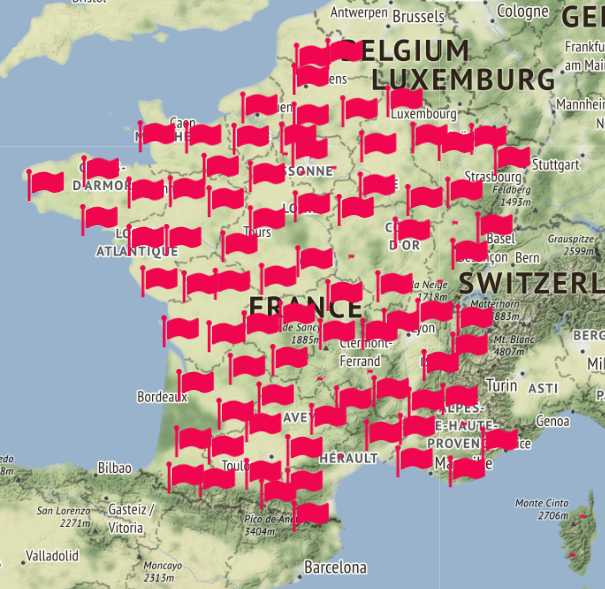 On March 23, more than 500, 000 people joined 180 protests across France to oppose looming changes to both the French National Railway Corporation (SNCF) and to France's Public sector. These changes are seen as direct pushes to privatise the SNCF and to break the social mission of France's public sector. While these were the primary drivers of the mobilisations numbers were also bolstered by striking air traffic controllers calling for increased recruitment, teachers concerned that increases in teacher numbers announced for the new school year will be insufficient to enable teachers to deliver on the government's pledge to deliver additional teaching in areas of teaching priority, and university and high school students campaigning against changes to university entrance.
The largest mobilisations occurred in Paris where marches by 25, 000 rail workers linked with 40, 000 public sector workers, teachers, air traffic controllers, hospital workers and students.
The rail workers march achieved a significant mobilisation of the SNCF workforce. This was despite not all rail unions supporting the mobilisation, the CFDT did not support the mobilisations at all, although a number of its militants participated, and that there had not been a firm call by the CGT (the largest union within SNCF) for a strike with the union instead simply calling on workers to mobilise. The size of the protest had also been undermined by SNCF management cancelling services which would have brought workers from regional centres to Paris for the mobilisation - l'Humanite reported that some 6, 000 workers were unable to make the trip to Paris as a consequence and instead joined the public sector mobilisations in their cities and towns.
As a consequence of strikes, SNCF services were disrupted with some 50% of regional services, 60% of TGV high-speed trains, and 75% of intercity trains being cancelled. In addition, three-quarters of the high-speed trains between the centre of Paris and its suburbs were also cancelled. 40% of short-haul flights to and from Charles de Gaul and Orly airports were cancelled, while 30% of flights to and from France's other airports were also cancelled. Whilst the teachers' strikes were supported by 14.5% of teachers resulting in school closures across France.
The rail strikes are primarily driven by concerns over plans for the SNCF to be further broken up and privatised in line with European Union directives. Whilst union mobilisations often have a wide resonance in France - the government has been actively trying to paint rail workers as privileged and the mobilisations as aimed at protecting this privilege. This push does seem to have had some resonance with l'Monde reporting an opinion poll conducted in early March found that the rail strike was seen as unnecessary 58% of respondents.
The public sector mobilisations are driven by ongoing concerns over Macrons campaign pledges during the 2017 elections to cut the public sector by 120, 000 jobs and the government's recent decision to freeze the sectors normal wage indexation and to reintroduce a measure where public servants will not receive pay for the first day of any period of sick leave. In addition on March 7, the government began a nine-month period of consultation around "reforms" to the public service - which has generated concern over the possibility of increased reliance on contract workers rather ongoing employment and the introduction of performance pay. In addition, there is a fear that the reforms will lead to a greater corporatisation of France's public sector following the trajectory of the public sector in other countries such as Britain, the US, Australia. Despite these concerns, both the CFDT and UNSA refused to support the public sector strike with the CFDT leadership arguing it is too early to mobilise against the reforms. Despite these two unions not supporting the action, the mobilisations were only slighter smaller than the public sector strike in October 2017 which had been supported by all public sector unions.
On Thursday evening, a number of general assemblies were held across France by militants including by student activists. A number of these were attacked by armed gangs. The worst example of this was at the University of Montpellier 2 where the Dean of the Faculty of Law had invited and facilitated the gangs entrance into the Law Building where students were occupying - the widespread anger generated by this attack across the French progressive movement forced the Dean's suspension and his and another academic being charged by police. These attacks have given impetus to student organising and helping to build campus GAs - with subsequent GAs at Montpellier involving more than 2000 people.
The unions supporting the mobilisation have been clear that this is a start of a new round of mobilisation. Workers at Air France also struck on March 23, with 30% of flights cancelled as a result and their second strike on March 30 saw 25% of flights cancelled. Air France's unions have called a further four days of strike action for April 3, 7, 10, and 11.
Unions within the SNCF began three months of rolling strike action at 5 pm on April 2, workers will carry out 48-hour strikes every three days. The trade union Solidaires initially called on their members in the public service to take public action in support of the public service on that day in the form of "gathering, actions, leafleting, demonstration ... outside of train stations, hospitals, financial centres, Post offices, job centres". The CGT has also called for a national day of protest of protest for April 17. The New Anti-Capitalist Party, which last week hosted a meeting of France's left organisations to build united supported for the strikes and protests - is calling for April 17 to be transformed into a general strike. On March 28, Solidaires held an extraordinary National Council meeting to discuss "the best ways to build interprofessional convergences between the sectors mobilized ... It is up to the workers and each sector to decide what to do next". At this meeting, Solidaires resolved to issue an unlimited strike notice for the entire public sector beginning on April 3. In announcing their strike action Solidaires stated "we know that to win, we must anchor and strengthen each mobilization to make them the most massive and visible. It is also necessary to create bridges between the employees and the users. As well as it is the general assemblies of strikers who must decide the modalities of actions and the renewal of the strikes, we must associate the whole population with the defence and the improvement of the public services, our common goods". While Solidaires is a smaller union within France's public service, their notice aimed at constructing GAs will enable it to draw members and supporters of the other public sector unions and non-aligned workers into their discussions regarding ongoing action in defence of the public sector.
While there is a clear convergence of struggles within France, there remain considerable divisions with the movement - with the left unions still struggling to unify themselves and draw in the more conservative unions. As Solidaires said in their March 22 statement "union unity is essential to face a government that seeks to reduce collective rights, to oppose and divide the population thinking that it can hide that it is at the service of the rich". Read more...


 Posts
Posts


