Showing posts with label Macron. Show all posts

Thursday, July 4, 2024

France: Responses to the spectre of a National Rally government


Lisbeth Latham

As expected the far-right National Rally (NR) and its allies emerged as the largest party in the first round of the French elections - with the potential to form government in the wake of the second round of elections on July 7. Demonstrating the extent to which the elections are seen as an existential crisis in French life, with a turnout of 66.71%, the highest turnout since the 1997 elections. In response, the coalitions of both the left, centre, and centre-right have moved to try to limit the performance of NR by taking a strategic approach to the second round to limit NR’s final seat tally. While such an approach is important, it poses significant risks for the left parties.

Candidates of RN and its allies the Union of the Far-Right (UXD) received 33.21% of the vote, the highest vote in the history of RN or its predecessor the National Front. This vote was down on the peak of RN’s support in opinion polls leading up to the elections. Based on this vote, candidates of the RN and UXN were elected in 38 constituencies and qualified for the second round in 444 constituencies. Which would allow them to potentially win a majority of seats and form government.

The New Popular Front (NFP) emerged as the second-largest party receiving 28.22% and winning 32 constituencies outright, with 415 candidates advancing to the second round. While this was consistent with NFP’s performance in opinion polls, it reflected a significant advance over the constituent parties’ performance in the 2022 elections - where New Ecological and Social People’s Union totaled 26% of the vote.

In response to this performance the parties of the left have been clear that the key threat is RN, and have sought to limit the number of RN candidates that will be elected in the second round. "Our guideline is simple and clear: not a single more vote for the National Rally," said France Unbowed (FI) leader Jean-Luc Mélenchon.

If no candidate reaches 50% in the first round, the top two contenders automatically qualify for the second round, as well as all those with 12.5% of registered voters. In the run-off, whoever wins the most votes take the constituency. RN candidates have qualified for run-off elections in 298 constituencies in which three or more parties have qualified.

Based on this Raphaël Glucksmann, who headed the Socialist party’s candidates in the European elections last month, called for all the candidates who finished third in the first-round to withdraw in order to forge a united barrier against the far right.

“Are we ready to hand over our country – the country of Victor Hugo, of Voltaire, of Rabelais – to the Le Pen family?
“That’s the only question that matters. It’s become a referendum and that’s why we’re asking all the third-place candidates to withdraw immediately, and why we’re asking people to vote, unambiguously and unhesitatingly, for democratic republicans whether they be on the left or the right, in order to stop the National Rally. We have seven days to avoid a catastrophe the likes of which France has never known in its history.”

Supporters of President Emmanuel Macron, who received 21.28% of the vote, have generally endorsed withdrawing candidates where they are the third candidate in a run-off. However, they have not been consistent in doing so. With leaders opposing withdrawing where the first or second candidate is from Melenchon’s FI, on the basis that, as Bruno Le Maire, France’s Finance Minister said “For me, France Unbowed is a danger for the nation, just as the National Rally is a danger for the Republic”. Despite this 224 candidates have withdrawn for the second round, reducing the number of four-way races from five to 2, and the number of three-way races from 306 to 89. The number of two candidate races has increased from 190 to 409. RN will be pitted against the NFP in 149 of these, while 134 elections will see RN contenders run against candidates from Macron's supporters.

The withdrawal of the third candidates substantially reduces the chances of RN being able to form a government. This could create a situation where the Macronists are reliant on votes of either RN or the parties of NFP. This creates a significant risk of the left, particularly with the threat of the far-right, being pressured to support either directly or indirectly a government of “republican unity”, an eventuality that can only further strengthen RN’s claims of being the party against the failings of the political mainstream elite.

In this context, the key will not just be what happens in the elections on July 7, but what happens in the streets after. As the National Confederal Committee of the General Confederation of Labour (CGT) said in a July 1 statement, “Nothing is written. The CGT will do everything to prevent the worst and win social and environmental progress. Through mobilization in the streets and at the ballot box, the world of work can and must win!”

------------------------------------------------------------------------------- 

This article is posted under copyleft, verbatim copying and distribution of the entire article is permitted in any medium without royalty provided this notice is preserved. If you reprint this article please email me at revitalisinglabour@gmail.com to let me know.

Read more...

Saturday, November 21, 2020

France: Support for the Collective Against Islamophobia in France in the face of the attacks of Macron and Darmanin!

Nouveau Parti Anticapitaliste
November 20, 2020


Last night, we learned that the Ministry of the Interior had just notified, by mail, the Collective Against Islamophobia in France (Collectif contre l’islamophobie en France - CCIF) of its intention to initiate a plan to dissolve. Gerald Darmanin[1] thus carried out his threatened action and claimed to be acting "in accordance with the instructions of the President of the Republic and the Prime Minister".

By attacking this organization whose role is to combat Islamophobic violence and discrimination, especially including through the support of victims and the publication of an annual report on Islamophobia in France, the government is taking a further step in its authoritarian state policy.

While the content of the pre-bill "separatism" (renamed "strengthening republican principles") has just been made public, confirming that the government continues its headlong authoritarian and Islamophobic rush, the desire to silence the CCIF and, through it, those who stand up against stigmatisation and discrimination against Muslims, is revolting.

Thus, the Minister of the Interior who wants to ban the denunciation of police violence also wants to prohibit the denunciation of Islamophobia. Everyone should understand that these are two sides of the same policy, whose aim is to silence any criticism of their "republican order", at a time when the government's bankrupt failure to manage the health crisis makes it fear social explosions.

The NPA condemns this attack on the CCIF and assures its facilitators and volunteers of all its support in their indispensable action against Islamophobia. It is the whole of the social movement and the labour movement that should now stand against this new authoritarian measure: the future of the anti-racist struggle and, more generally, all the struggles of our social camp are at stake.

[1] Minister of the Interior in the government of Prime Minister Jean Castex

Read more...

Monday, October 8, 2018

France: Joint Union/Student Call for Strikes and Mobilisations on October 9

CGTFOSolidarityUNEF UNL

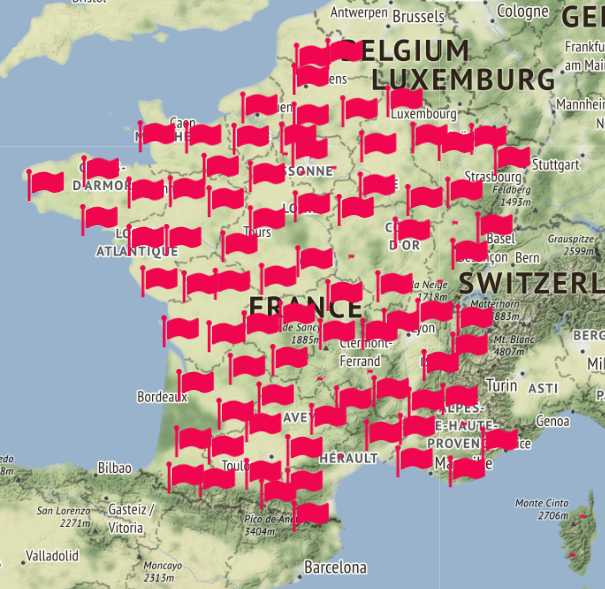
Map of October 9 Mobilisations
Originally published August 30 2018 For union organisations of employees, university students and high school students – the General Confederation of Labour (CGT), Workers Force (FO), Solidarity, National Union of Students of France (UNEF) and the National Union of Secondary Students (UNL) - met on 30 August 2018, a statement is necessary and is reinforced, that of an ideological policy aimed at the destruction of our social model, promoting in particular the explosion of inequalities and the breakdown of the collective rights.

This policy as well as the measures recently announced by the government, are part of a logic of individualisation which undermines solidarity and social justice, essential values of the social cohesion and undermining once again the weakest, the most precarious and the poorest.
These include: 
  • threats to the rights of employees and job applicants to unemployment insurance; 
  • the questioning of the right of young people to a future through the introduction of selective entry to higher education and the waste that is universal national service; 
  • undermining of the public service, in particular CAP 22[1]; 
  • job destruction through deindustrialisation;
  • attacks on our health system; 
  • The destruction of our pension system; 
  • Freezing of social benefits;
The signatory organisations call on the Government to hear the multiple social expectations that have been expressed in public and the private sectors, by working people, young people, unemployed and retirees, and that it no longer be guided an obsession to decrease public spending. At a time when an explosion of dividends in France and in the world is once again being announced, it is time to pursue a policy of sharing wealth, to increase wages, pensions and the social minima.

Faced with this situation and regressive decisions in opposition to the legitimate demands of workers and youth, it is time to defend the foundations of our social model and win new rights.

That is why, the signatory organisations have decided to make October 9 a major day of day of mobilizations and strikes by unions, university and high school students.

Concerning the day of mobilization and strikes, the Trade Union Solidarity will authorise it during the meeting of its national leadership next week.

The signatory organisations invite the other trade unions and youth organisations to join them widely and be part of the mobilisation process.

Paris, 30 August 2018 

1 Public Affairs Committee 2022 report aimed at deepening the neoliberal restructuring of the French public sector with the aim of "improving" public accounts by €30 billion.

Read more...

Saturday, May 12, 2018

France: Call of the National Student Coordination

Original in French available here
6 May 2018
We mobilized from 20 universities, gathered on the 5th and 6th of May at the Faculties on Strike at the University of Nanterre, and reiterate our determination to achieve the withdrawal of the ORE law [which increases selection processes for entrance processes from the current guaranteed entrance for anyone with a 10/20 from the Baccalaureate (BAC) exams], abandonment of the student plan and the roll back the of the government's whole antisocial policy. From the rail reform to the Asylum-Immigration Act, to the increase in the CSG [General Social Contribution - a compulsory payment which helps to fund France's pension system]and the reform of the BAC, Macron, the proud representative of the interests of employers, attacks us on all fronts.


For two weeks, despite the holidays and the arrival of the mid-year exams, thousands of students, in the street and in general assembly, pursue with determination their strike movement. Everywhere, convergence is intensifying with employees, railway workers, hospital workers and high school students, with a view to ending the ongoing pro-employer project. This particularly scares the government because it is this strategy that will allow us to win against a government that seeks to break our social gains for the benefit of a minority.

Faced with the growth of the youth and employee movement, the government is trying to break the student movement by all means, as a stakeholder in interprofessional mobilization. As if the intervention of the CRS in Nancy, Censier or Clignancourt, was not enough, Minister Vidal plays on the anguish provoked by the exams to try to break the strike. Final exams are replaced by online mid-year exams, homework assignments, or relocated to stop mobilization and avoid blockages. The government and the university presidents argue that they standing in defence of the value of the diplomas and the future of the students to justify the holding of the mid-year-exams. But if the strike movement continues in the universities, it is precisely because of the desire of students to defend their conditions of study, save their future working conditions, and to ensure continued access to a degree for all.

In view of the national situation, we reaffirm our determination to continue our mobilization against the ORE law and will not allow the exams to interfere with our commitment. That's why we invite all the teaching-research academics, BIATSS (Librarians, Engineers, Administrators, Technicians, Service and Health staff) and students to take all the forms of action that seem most relevant to them. (10 améliorable (50% pass mark), partial boycott, automatic pass, etc.)

In the event that the examinations are held, we call for the holding of general assemblies at the beginning of the mid-year examinations, as done at Paris-1, to allow students to meet and decide collectively, regarding the holding or not of the examinations. These General Assemblies should thus decide on the score to be applied for all (resulting from the cancellation of the examination). They will also be a means for disrupted universities to maintain collective frameworks for discussion and decision-making as part of the strike.

We applaud and support the choice of the staff gathered in the CNU (National Council of Universities) to go on strike until the withdrawal of the law and to call for the retention of notes.

Anger at this government is expressed in many sectors: in hospitals, the SNCF, the private sector and the universities, among others. This is the response of our social camp against the all-out attacks of employers. The scale of demonstrations in early May has shown, one year after the election of Macron, that young people and employees are determined to inflict a defeat. Thus, we call to amplify the strike and the blockages underway in the universities and to descend massively in the street. We call on students to make May 9, a day of a railway strike, a national date for mobilization and local action coordinated nationally. Already, the trade unions of Education and the National Coordination of the Universities call to mobilize on May 16th, we call the students and high school students to make this date a day of strikes. We will also join the May 22 strike called by the public service, the day of publication of the first results of Parcoursup [the new website which will publish student admission into university].

In the coming weeks, many sectors will take to the streets, especially on May 14 and 15, respectively for the railway and hospital workers. We call on students, where possible, to support these strikes and join them. However, we deplore the scattering of sectoral mobilization dates that push the isolation of our respective struggles. In the face of a government that is attacking us all the time, we are stronger when we take to the streets together, at the same time. That is why we are calling on employees and high school students to join us on May 16 and 22, with the aim of spreading the renewable strike in as many sectors as possible. It is by the total blockage of the economy that this government can be bent.

In order to expand the movement, we seek to actively connect with other sectors in struggle. Thus, we will take part in the general assemblies of railway workers, the gatherings in support of the hospital workers and we will address the striking high school students who will meet for a new National School Coordination, May 26th and 27th in Paris.

We demand:
- the repeal of the ORE law, the abandonment of the Parcoursup system and the maintenance of compensation and catch-up system [a process for determining whether a student who failed to attain a passing average for a unit (due to missing a piece of assessment) can still have the unit count towards their degree].
- a massive investment by the State to meet the needs of the universities, in order to guarantee free, critical and open education for all.
- stop the prosecution of mobilized students, stop police interventions on universities.
-the CNE affirms its unwavering support to all the sectors in struggle and their demands against the anti-social measures of the Macron government: against the cuts to public services, the general precariousness of the world of work and all the racist and xenophobic laws

We warn about the rise of reactionary acts and ideologies and condemn the attacks of fascist militia in the universities, as well as the blocking of the migrants on the border by groups the of extreme right.

We are calling for a next National Student Coordination on May 19th and 20th at Toulouse 2 Le Mirail University. We are particularly interested in universities that have not yet participated in the CNE so that they send delegations to help develop the coordination of the student movement at the national level.

Read more...

Tuesday, April 3, 2018

France: Hundreds of thousands join protests/strikes in defence of railway workers and public sector

Lisbeth Latham

On March 23, more than 500, 000 people joined 180 protests across France to oppose looming changes to both the French National Railway Corporation (SNCF) and to France's Public sector. These changes are seen as direct pushes to privatise the SNCF and to break the social mission of France's public sector. While these were the primary drivers of the mobilisations numbers were also bolstered by striking air traffic controllers calling for increased recruitment, teachers concerned that increases in teacher numbers announced for the new school year will be insufficient to enable teachers to deliver on the government's pledge to deliver additional teaching in areas of teaching priority, and university and high school students campaigning against changes to university entrance.

The largest mobilisations occurred in Paris where marches by 25, 000 rail workers linked with 40, 000 public sector workers, teachers, air traffic controllers, hospital workers and students.

The rail workers march achieved a significant mobilisation of the SNCF workforce. This was despite not all rail unions supporting the mobilisation, the CFDT did not support the mobilisations at all, although a number of its militants participated, and that there had not been a firm call by the CGT (the largest union within SNCF) for a strike with the union instead simply calling on workers to mobilise. The size of the protest had also been undermined by SNCF management cancelling services which would have brought workers from regional centres to Paris for the mobilisation - l'Humanite reported that some 6, 000 workers were unable to make the trip to Paris as a consequence and instead joined the public sector mobilisations in their cities and towns.


As a consequence of strikes, SNCF services were disrupted with some 50% of regional services,  60% of TGV high-speed trains, and 75% of intercity trains being cancelled. In addition, three-quarters of the high-speed trains between the centre of Paris and its suburbs were also cancelled. 40% of short-haul flights to and from Charles de Gaul and Orly airports were cancelled, while 30% of flights to and from France's other airports were also cancelled. Whilst the teachers' strikes were supported by 14.5% of teachers resulting in school closures across France.

The rail strikes are primarily driven by concerns over plans for the SNCF to be further broken up and privatised in line with European Union directives. Whilst union mobilisations often have a wide resonance in France - the government has been actively trying to paint rail workers as privileged and the mobilisations as aimed at protecting this privilege. This push does seem to have had some resonance with l'Monde reporting an opinion poll conducted in early March found that the rail strike was seen as unnecessary 58% of respondents.

The public sector mobilisations are driven by ongoing concerns over Macrons campaign pledges during the 2017 elections to cut the public sector by 120, 000 jobs and the government's recent decision to freeze the sectors normal wage indexation and to reintroduce a measure where public servants will not receive pay for the first day of any period of sick leave. In addition on March 7, the government began a nine-month period of consultation around "reforms" to the public service - which has generated concern over the possibility of increased reliance on contract workers rather ongoing employment and the introduction of performance pay. In addition, there is a fear that the reforms will lead to a greater corporatisation of France's public sector following the trajectory of the public sector in other countries such as Britain, the US, Australia. Despite these concerns, both the CFDT and UNSA refused to support the public sector strike with the CFDT leadership arguing it is too early to mobilise against the reforms. Despite these two unions not supporting the action, the mobilisations were only slighter smaller than the public sector strike in October 2017 which had been supported by all public sector unions.

On Thursday evening, a number of general assemblies were held across France by militants including by student activists. A number of these were attacked by armed gangs. The worst example of this was at the University of Montpellier 2 where the Dean of the Faculty of Law had invited and facilitated the gangs entrance into the Law Building where students were occupying - the widespread anger generated by this attack across the French progressive movement forced the Dean's suspension and his and another academic being charged by police. These attacks have given impetus to student organising and helping to build campus GAs - with subsequent GAs at Montpellier involving more than 2000 people.


The unions supporting the mobilisation have been clear that this is a start of a new round of mobilisation. Workers at Air France also struck on March 23, with 30% of flights cancelled as a result and their second strike on March 30 saw 25% of flights cancelled. Air France's unions have called a further four days of strike action for April 3, 7, 10, and 11.

Unions within the SNCF began three months of rolling strike action at 5 pm on April 2, workers will carry out 48-hour strikes every three days. The trade union Solidaires initially called on their members in the public service to take public action in support of the public service on that day in the form of "gathering, actions, leafleting, demonstration ... outside of train stations, hospitals, financial centres, Post offices, job centres". The CGT has also called for a national day of protest of protest for April 17. The New Anti-Capitalist Party, which last week hosted a meeting of France's left organisations to build united supported for the strikes and protests - is calling for April 17 to be transformed into a general strike. On March 28, Solidaires held an extraordinary National Council meeting to discuss "the best ways to build interprofessional convergences between the sectors mobilized ... It is up to the workers and each sector to decide what to do next". At this meeting, Solidaires resolved to issue an unlimited strike notice for the entire public sector beginning on April 3. In announcing their strike action Solidaires stated "we know that to win, we must anchor and strengthen each mobilization to make them the most massive and visible. It is also necessary to create bridges between the employees and the users. As well as it is the general assemblies of strikers who must decide the modalities of actions and the renewal of the strikes, we must associate the whole population with the defence and the improvement of the public services, our common goods". While Solidaires is a smaller union within France's public service, their notice aimed at constructing GAs will enable it to draw members and supporters of the other public sector unions and non-aligned workers into their discussions regarding ongoing action in defence of the public sector.

While there is a clear convergence of struggles within France, there remain considerable divisions with the movement - with the left unions still struggling to unify themselves and draw in the more conservative unions. As Solidaires said in their March 22 statement "union unity is essential to face a government that seeks to reduce collective rights, to oppose and divide the population thinking that it can hide that it is at the service of the rich".

Read more...

Sunday, March 25, 2018

France: Joint Declaration - Defend all public services! Solidarity with railway workers and railway workers!

Originally published March 19,  2018
Original in French

For years, successive governments have chosen to support privatization of transport against the interests of the climate, equality and society: underinvestment in rail and massive investment in motorways and cars, privatisation, which particularly promotes the explosion of the transport goods by heavy trucks.

Since 1997 and the creation of the French Rail Network (RFF - a subsidiary company which was created to run the infrastructure France's rail network it was succeeded by SNCF Réseau), the French National Railway Corporation (SNCF) is still more segmented, enabling the breaking the social character of the railways and to continue the privatization recommended by the European "directives". Today Macron pushes the logic, the destruction of the SNCF. Throughout Europe, the revenues he wants to achieve will result in the disappearance of lines, the explosion of prices, dilapidated facilities and trains, the disappearance of freight. It is the whole population that pays the price three times: financially, by creating territorial inequality and in its health impacts caused by the resultant pollution.

After 20 years of increased liberalisation, the accumulation of European directives pushing in this direction, Macron proposes to complete the privatisation of public rail service via ordinances with dramatic consequences for the users and the development of the territories. To get there, he seeks to vilify railway workers, making them look like privileged people who, just like Macron says of pensioners, students, and the unemployed, would ruin France. The reality is different: they are fighting to save the jobs of future generations.

The train is not only a means of locomotion, it is a public service, an essential tool for ecological transition and it is unbearable that it can stop at the doors of major cities. The battle for public rail service is first and foremost a battle for equality.

Faced with this government, which wants to complete the transformation of a public service supposed to be guided by the general interest of a CAC 40 company [the 40 largest French companies], the railway workers are not accountable for anything. Neither do students who lose part of their PLA, retirees who see the CSG increase, health care workers, teachers, unemployed or all civil servants. No more than migrants who suffer under contemptable policies.

Macron and Philippe want to make scapegoat? We collectively affirm that the railway workers are the victims of the liberal policies that have been going on for so many years, which explain the rise of the far right across Europe.

They want us divided? We answer that we will be on the street on March 22 to defend access to public service, starting with the railway, the railway, but also all officials and the interest of users.

Signatories Libertarian Alternative (AL); Europe Ecology-The Greens (EELV); Ensemble; Democratic and Social Left (GDS); Generation; France Insoumise Parliamentary Group; New Anti-Capitalist Party (NPA); New Deal; French Communist Party (PCF); French Workers Communist Party (PCOF); Left Party (PG); Republic and Socialism.

Read more...

Sunday, November 26, 2017

Olivier Besancenot: "Emancipation rather than rebellion"

By Bénito Perez
Originally published in Le Courrier
26 November 2017

The face of the radical left in France during the 2000s, the anti-capitalist activist took a step back but keeps a sharp eye on the political and social field.

Is it because Olivier Besancenot had never come to Lausanne? A large crowd on the night waiting to hear the spokesman of the Nouveau Parti Anticapitaliste (New Anti-Capitalist Party - NPA) on Monday, November 13 for a fruitful evening exchange at Espace Dickens. The 200 people clustered in the small room Lausanne contrasts with the alienation experienced on the other side of the border, by the movement that succeeded the Revolutionary Communist League. It must be said that the former postman of Neuilly, twice a candidate for the French presidency in 2002 and 2007 (with more than 4% of the vote each time), now moved behind the counter at the Post Office, and in the shadow Philippe Poutou of the NPA, has lost none of his verve and his way with words. For two hours, he captivated his audience, plumping the shaky morals, deflating illusions of no future. Good grace, he even lent the little provocation guests: phosphorous on the success of France Rebellious (France Insoumise - FI) (where the NPA had failed), in the gathering of much of the left behind the single plume of Jean-Luc Mélenchon. Echos.

Being rebellious in France today?
"Being rebellious is to refuse to obey the economic oligarchy and the political and cultural class that impose an unsustainable situation that is France and wider Europe. It is denied that the public coffers are empty to benefit the rich and businesses and then justify the sacrifices imposed on the vast majority of the population. For thirty years, this policy allows capital to take even more work. This will not stop itself. After attacking taxation and public services, they now weaken labour law and social security, tomorrow they will denounce too many paid holidays. They always have something to undermine at work to give the capital".


Where is Emmanuel Macron? 
"Emmanuel Macron and his men know perfectly the fragility of their political legitimacy. They know they have benefited from simultaneous attacks from the right and the left. That is why they are acting by ordinances. And quickly. Macron has understood that social and security issues are linked. The inclusion of the state of emergency law and the adoption at a run of the labour code reform are two sides of the same coin. When conducting an unpopular social policy, we know that there will be trouble and they are preparing repression. 

"Macron and social forces he represents have decided to pursue the second. For them, the time of cyclical market reforms has passed, it is now to tackle the structures. The crisis of capitalism, which we saw explode in 2008 but which persists, requires urgent deep "reforms". We have always seen a crisis of overproduction and over-accumulation. Their solution, which of course is not one, through the optimization of the power of capital over labour. Since Sarkozy, all presidents have made this political contradiction: 'France is on the brink. It is urgent to move ahead '! 

"Obviously, they realize that their promises do not come true, that the productivity gains that liberal reforms would bring are not benefits to workers. But they have their explanation: it is the fault of "zombie capital", this small charming name they give to non-performing economic sectors considered. Where reforms have not yet tendered their benefits, unlike other sectors. Hence the need to continue privatization, etc., etc. " 

The Front National risk 

"The vast majority of French are unhappy with the policy. But the default alternative for lack of better alternative, their anger is not expressed, it steeps. Or when they speak, they speak badly. The country where I come from is going through a terrible political, social and moral period, which is extremely tense. The leadership crisis within the FN does not eliminate the risk of the extreme right, because its ideas, is deeply rooted as the default alternative. Despite a bad campaign, the FN received 11 and a half million votes! 

"In this context, insubordination also means daring to fight against this nauseating atmosphere. Being clear on our values. Showing our support for the mass naturalisation of undocumented workers, and explain why. At the risk of losing votes at first. " 

Crisis of the Left 

"The weakening of the left and of the social movement, it's a collective trust issue more than collective consciousness. Part of the radical left think the exploited did not understand their situation and need to have it explained to them. For me, it's the opposite. They do not have professors red or pink, green or black: they are better placed than anyone to see that the system is crazy, unequal and based on the exploitation and discrimination. The problem is whether to have the conviction that anything else is possible. In France, we have not had a victorious major social struggle since 2006 and the contract of first employment. It was millions in the streets, attempted strikes renewable, but we lost! All over. 

"Still, the crisis goes well beyond France, everywhere the labour movement is disintegrating, everywhere the power relations deteriorate and populist movements and far-right are progressing. To the left, Greece was the big missed opportunity. We need to take stock. Why for example, when Syriza had moderated its claims, has it been crushed? " 

Towards unity of action 

"Rebellion cannot be imagined without emancipation. We are not up against a power in order to submit to a leader. The only form of authority that we should recognize is collective and pluralistic. We tried to convey this to the leadership of FI. There are signs that it begins to perceive it. Given the situation of the social movement, the urgency for organizations of the radical left, the movement which spans from Benoît Hamon [former socialist presidential candidate, ed] to Mélenchon, the Communist Party to Workers Struggle must convene soon and formalize our united agreement for the withdrawal of the Labor law and ordinances. 

The FI has a special responsibility because it has 19% [in the presidential elections], and gathered huge crowds, including a lot of militants ready to fight. A new radical social movement is now emerging. You see it in ecology movement, in the struggles of migrants, anti-nuclear, even in the labour movement. But the FI can not represent them all. Impossible. I never could. Sing the Marseillaise? You must not ask me, I could not! But that's okay, we can still do great things together!". 

Islamophobia 

"In part, the stigma of the Muslim community in France is not surprising. This country has been unable to do its work addressing its colonial history and the Algerian Revolution. On the other hand, it must be noted that part of the left is in the process of falling into stigmatising the community. It says something about the degree of regression of the public debate in France! 

"That said, the debate is not simple: how to reconcile the defence of secularism, women's rights and the fight against Islamophobia? The discussion runs through the left and even the NPA. " 

Wanting to govern 

"Although we have been describing it for years, we have not quite believed in the depth of the crisis of the system. If an alternative is needed, then we need to presume to govern. And think seriously about the policy we could take against our two enemies: the state and capital equipment. Take the latter: we must not tell stories, it will not be stripped so that we can finance the beautiful social program on which we would be elected. If we do not ask the question of the property accumulated by capital, we will never bend them. And it is not enough to create a public bank which remains subject to private competition: it will never argue in public service. This implies indeed an expropriation of the banks and the creation of a monopoly. 

"The state apparatus, too, will not just give up. That's why we put on the table the idea of de-professionalization of politics (limitation and revocation of mandates, revenue cap). Change does not happen just by changing the heads on top of the state. It will do that by involving everyone. 

"If you do not want the bureaucratic body separated from the rest of society, one must be aware of his total character, rooted in deep phenomena as the division of labour, the separation of manual and intellectual tasks or as professionalisation of power. Most people have internalized the idea that they could not represent themselves. That intermediaries are needed. That politics is a matter for serious people. When we introduce a postman or an autoworker for president, they say it's great ... but not credible. We must break this straitjacket. Speaking today, is the first act of resistance. Refusing to let others take it for us, this is the first act of emancipation. " 

THE NPA STILL ALIVE AND "ESSENTIAL" 

The NPA is the direct heir of the famous Communist League, which will be banned in the wake of May 68 and the Revolutionary Communist League. The formation founded by Alain Krivine and Daniel Bensaïd, member of the Fourth International (Trotskyist), had known, after the ebb of the 1980s, a certain success since the mid-1990s, driven by the emergence of the alternative globalisation movement and large strike movements (1995-2006) in France against the social security reforms or the First Employment Contract. 

Scuttling 

After the success in 2005 of the unitary campaign of the left against the European Constitutional Treaty and both candidates rather successful Olivier Besancenot presidential (2002 and 2007), the LCR nevertheless chose to scuttle to give birth in February 2009, a New Anti-Capitalist Party (NPA), meant to break organizational barriers between the various traditions of the radical left. But after a promising start, the LCR / NPA from 4000 to 10 000 members, the young party ebbs quickly. 

"We made the mistake of believing that alone we could collect all the left of the French left. But it is far too diverse and committed to its banner to gather in this way, "admits Besancenot today. 

Divided on strategic issues but also on political issues such as secularism, the new formation seen swathes leave, especially to the Left Front, where defectors formed the organisation "Ensemble!" 

"The NPA was on the verge put the key under the door, " says Besancenot. Especially since the party in vogue in the 2000s was sidelined in the presidential elections in 2012 and 2017, where its worker candidate Philippe Poutou harvest only a small percent of the vote, while the rebellious Jean-Luc Mélenchon flirts with second round. 

A new start 

Still, the relatively successful campaign of the Ford worker has e given new impetus to the movement. "I am proud to have campaigned Philip," said the former candidate. "I had a great time when he made the big candidates sweat on the television set, we were the only ones who can tell them what people dreamed of sending them across because we are not professional politicians. For that alone, the NPA must continue to exist! " 

And after the country has strengthened this conviction. "France Unbowed is trying to achieve in turn it is unable to unify the left. Moreover, its very directive behaviour on the social movement has been catastrophic. The NPA, we refuse to prioritize political and social over one another, we aspire to a merger of these themes but with respect for freedom of association ", defends the NPA spokesman. 

The future of the left of the left 

But the postman from the eighteenth arrondissement of Paris insists the future of the left of the left exceed the scope of its movement. "We must find a common area of action, combining democracy and maintaining our autonomy, our identities. Neither France Unbowed nor the NPA cannot do this, we have to invent something else", concludes Besancenot. 


Read more...

Friday, October 27, 2017

France: Unions debate how to fight Macron’s anti-worker reforms

Lisbeth Latham

One of France's largest union confederations, the General Confederation of Workers (CGT), held a strike on October 19 as part of the campaign against the anti-worker and anti-union ordinances adopted by the Emmanuel Macron government.

The mobilisations were far smaller than the previous three days of protests and have further fuelled discussion within the movement over how to overcome divisions and weaknesses and mobilise the widespread latent public opposition to the government's attacks.

The October 19 strikes and mobilisations by the CGT were announced on October 9 – a day prior to a public sector workers’ strike – with the aim of driving forward the movement. However, the result was about 100,000 workers participating in the October 19 mobilisations – roughly half the size of the September 21 mobilisations and about a quarter of the size of the September 12 protests, the largest mobilisation of the campaign to date.

The call for the strike came after the first inter-union meeting involving all the union confederations was held on October 9, the first of its kind during the current campaign. It was widely known that the CGT would call the strike and that the militant trade union Solidaires would support, but there was no effort made at that meeting to draw the other confederations into the mobilisations.

Conservative unions

The failure to seek to draw other unions into the mobilisation reflects deep problems in the current campaign.

This includes the refusal by conservative unions, particularly the French Confederation of Democratic Workers (CFDT), to join the movement.

The potential of drawing them in seems even bleaker following the publication in Le Monde on October 23 of statements made by CFDT secretary general Laurent Berger at the confederation’s October 18-19 National Council meeting. Berger described the joint mobilisations as a “demonstration of weakness” and the CGT as “the Titanic, who wants to ride on the Titanic?”.

However, the left unions have also displayed an inability to engage and draw in more militant members of conservative unions.

While this objective is easier said than done, the CGT has been heavily focused on individual sections of its own confederation rather than trying to find ways to broaden the movement. While this has at times achieved some gains – such as truck drivers and wharf workers securing concessions that would limit the extent to which enterprise agreements can undermine sectoral agreements – the isolated strikes have had a tendency to leave the more militant sections of the movement on their own.

Where they have won concessions, those victories have undermined the capacity to mobilise these militant and strategically-located workers in support of the broader movement.

New Anti-Capitalist Party (NPA) militant Robert Pelletier, writing in the NPA's l'Anticapitaliste, argues that a major problem undermining mobilisations has been the determination of the leaders of the major confederations to participate in "dialogue" with the government.

The worst perpetrators have been the leaders of Workers Force (FO) and the CFDT, who despite anger from their rank-and-file and lower-level leaders, have accepted the attacks and argued that engagement with the government has served to limit the damage and helped to make progress in building "social dialogue".

However, this engagement has not been limited to the more conservative unions. CGT leaders have also engaged in dialogue and are seeking to participate in the next round, which will focus on the government's proposed attacks on vocational training, apprenticeships and unemployment insurance.

Pelletier argues that this engagement undermines the extent to which the government fears union threats of mobilisation. He argues that the focus should instead be on building upon the existing resistance by workers – particularly through the calling of indefinite strikes – while moving away from union-by-union and sector-by-sector strikes towards a united movement.

United convergence

Solidaires has continued to push for united mobilisations supported by all union confederations. It had been seeking to bring union leaders together for a discussion on a united response since May – that was only achieved on October 9.

In a statement following their leadership's October 17 meeting with the government to discuss the ordinances, Solidaires called for the rejection of the current ordinances, the repeal of the anti-worker 2016 El Khomri Law brought in by the previous Socialist Party government and rejection of the government’s prioritisation of "flexibility" over security for workers.

Solidaires is working to win agreement for a mid-November convergence of the struggles of workers, unemployed and retirees. It presented proposals for how to achieve this convergence to the inter-union meeting on October 24. Solidaires stated that "the constitution of a strong and determined social movement is urgently needed".

An agreement was reached at the October 24 meeting between the CGT, Solidaires and the FO for a joint mobilisation on November 16. Although opposed by the CDFT, the call has also been endorsed by UNEF, France’s main university student union, and two high school student unions. These student organisations played a critical role in the early stages of the 2016 protests against the El Khomri Law.

Another organisation pushing for a united mobilisation has been the Social Front (FS), which was established in late April by activists frustrated by the collapse of the 2016 movement.

FS has been building up its support with more than 130 union, social justice and political organisations from across France affiliating to the organisation.

It also successfully built a series of united mobilisations against Macron following the first round of the presidential elections in April. FS has called for a joint protest on November 18 against Macron’s policies. Activists from FS addressed the October 24 inter-union meeting seeking to win support for the mobilisation. -------------------------------------------------------------------------------

[This article was originally published inGreen Left Weekly #1159]

Read more...

Saturday, October 14, 2017

France: Close to half a million workers join public sector strike

Lisbeth Latham

Hundreds of thousands of workers, retirees and students joined a third day of strikes and protests across France on October 10. The protests are part of ongoing efforts by unions, left parties and progressive organisations to defeat attacks on workers and the public service by President Emmanuel Macron.

Protests were held in 140 cities and towns and drew 400,000 people into the streets.

At the centre of the day was a strike called by the nine union confederations active in France's public sector. The strike was aimed at stopping the planned 120,000 job cuts in the sector.

The General Confederation of Workers (CGT) estimated participation of 30-50% across the public sector.

While the mobilised numbers sound impressive, the movement is struggling to build momentum. The mobilisations on October 10 were slightly smaller than those on September 12, although larger than the September 21 mobilisations.

More importantly, the current movement is small compared to recent mass labour mobilisations in France.

Last year's movement against the El Khomri labour laws peaked with two national mobilisations of more than one million people. The movements in 2009 and 2010 saw multiple united mobilisations that drew more than three million people into the streets.

There are several reasons for the smaller mobilisations.

One of these has been the government's use of France's undemocratic constitution to rush through emergency ordinances without a parliamentary vote. This has reduced the extent to which people see attempts to defeat the attacks as realistic. (There will be a vote on Macron’s anti-worker laws in late November, more than two months after the ordinances came into effect)

The trade union Solidaires argued in a statement on October 12 that the present mobilisations demonstrate a widespread willingness to mobilise against the laws. However, the ability to fully engage that willingness has been undermined by divisions within the union movement as to what parts of the laws should be opposed and how they should be opposed.

The leaderships of reformist union confederations such as the French Confederation of Democratic Workers (CFDT) have been broadly supportive of sections of the legislation.

Rather than call on members to join mobilisations, they have sought to engage in dialogue with the government regarding the text of the ordinances. They have expressed concern that mobilisations against the ordinances would undermine future negotiations with the government.

The more militant unions have instead pushed a line of rejecting the changes and mobilising workers in the streets. However, they have done so inconsistently and in ways that have not taken full advantage of breaks in the CFDT's approach.

For example, when CFDT's rail federation, along with Solidaires' rail federation, called for a strike on October 10 in support of the public sector strike, the CGT's rail federation – the largest union in the railways – refused to join the strike. Instead, it encouraged members to join the protests, meaning the strike had minimal impact on rail services.

Divisions within the movement are not just a symptom of differing assessments of the attacks and how best to fight them. They also reflect a jockeying for positions by the confederations in anticipation of union representation elections next year.

The CFDT has historically been France's second confederation behind the CGT. Today it is either the principle confederation, or at least challenging for that position in the majority of industries.

CFDT officials pointed out at mass meetings of tens of thousands of activists and officials on October 3 that they believe the current moderate approach will strengthen the CFDT’s hand in the elections.
However, the New Anti-Capitalist Party reported on October 6 that CFDT’s leaders had to spend much of those meetings defending their conservative line from criticisms from the ranks.

One positive development has been that leaders from France’s union confederations held a joint meeting on October 9. This is the first such meeting to be held during the current campaign, despite calls by Solidaires for a joint meeting since May.

Unfortunately, the meeting did not issue a joint call for united mobilisation, although Solidaires suggested that in addition to themselves, the CGT and the United Union Federation, which have all been actively pushing for joint mobilisation, there is also support for such a call from Workers Force and the French Confederation of Management – General Confederation of Executives.

The meeting did support a call for a further meeting of union leaderships on October 24, which will take stock of the full range of social attacks coming from the government. Solidaires leaders have expressed hope that the meeting will call a joint mobilisation for early November.

On October 9, the CGT called a confederation-wide strike for October 19. CGT national secretary Fabrice Angei said in a statement: “Our citizens are increasingly challenging the orders, 65% of them reject them and 57% approve of the mobilisations against the government project … the government is conducting a comprehensive deconstruction of the French social model.

“We will mobilise on October 19 against this social destruction, and for a 32-hour week, salary increases and retirement for all via mutualisation”.

Solidaires issued a statement on October 12 in support of the October 19 mobilisation, arguing that it is an opportunity to build public awareness and unify and strengthen the unions’ bases of support in the public and private sector in order to better challenge the government.

-------------------------------------------------------------------------------


[Originally published in Green Left Weekly #1157]

Read more...

Friday, October 6, 2017

France: Movement builds against anti-worker measures

Lisbeth Latham

France’s Council of Ministers approved five ordinances on September 22 that undermine union power and employment rights within France’s Labour Code, which came into effect the next day.

The government imposed these changes by using undemocratic measures in France’s constitution, which allows it to push new measures into law without passing legislation through parliament.

In the face of this, the movement against the changes continues to build. 

France Insoumise (France Unbowed, FI) held a national convergence in Paris on September 23 against what it described as a “social coup”. The protest mobilised 150,000 people — more than twice the size of the largest Paris mobilisation so far against these attacks.

FI leader Jean-Luc Melenchon told the crowd: “We were not able to discuss a single line, a single page, of the ordinances!”

The Washington Post reported that Melenchon said “we must bring forward the strength of our people in battle and in the streets”.

On September 26 the transport federations of the General Confederation of Workers (CGT), Workers’ Force (FO) and National Union of Autonomous Unions (UNSA) began sustained strike action against the changes, including blockades of oil depots and major highways. As a result, there have been widespread petrol shortages at service stations.

On September 28, there were mobilisations across France by retired workers and students. These protests targeted the changes to the labour code, but also the broader assault by President Emmanuel Macron and Prime Minister Edouard Phillipe on social conditions.

In particular, protesters targeted the 1.7% rise in the Generalised Social Contribution (CSG) and the failure of thousands of students to receive selection advice for entry into university. The CSG contributes to the funding of France’s social security system and is paid by both workers and retirees.
Macron and France’s peak employer organisation, MEDEF, hoped that worker and union resistance would dissipate with the ordinances coming into effect. Macron has downplayed the significance of the movement, telling CNN: “I believe in democracy” and that “democracy is not in the street”.

Instead, the resistance continues to grow.

Unions have called for a joint public and private sector strike on October 10. This will be the first joint strike by France’s public sector unions in 10 years.

Unfortunately, the unity between unions within the public sector has not been replicated in the private sector. An October 3 mass meeting of 10,000 officials and activists of the conservative French Confederation of Democratic Workers (CFDT), the largest confederation in the private sector, refused to endorse strike action on October 10.

However, there was opposition to this conservative approach expressed at the October 3 meeting, which could result in more CFDT members joining the October 10 protests than occurred with the previous France-wide protests against the attacks on September 12 and 21.
-------------------------------------------------------------------------------
[This article was originally published in Green Left Weekly #1156]

Read more...

Saturday, September 23, 2017

France: Thousands join new round of protests against anti-worker attacks

Lisbeth Latham

About 250,000 people joined 400 protests in cities and towns across France on September 21, the General Confederation of Workers (CGT) said, in the second round of mass protests against President Emmanuel Macron’s anti-worker laws.

This was about half the number of people who mobilised for the first round of protests and strikes on September 12. The protests came the day before a meeting of the Council of Ministers to ratify five ordinances, which will undermine the rights of workers and their unions.

If ratified, the ordinances will immediately come into effect. However, the government will still need to pass legislation to permanently incorporate them into France’s Labour Law.

Much of the mainstream media has expressed hope that the lower turnout for the September 21 protests is a sign of the movement quickly losing momentum. Left unions and parties, however, remain optimistic that the movement can continue to build and beat back the current attacks.

CGT leaders described September 21 as a success and proof “that after September 12, the movement is for the long-term”.

In a statement, the CGT said: “The Council of Ministers of September 22 must hear that the citizens overwhelmingly condemn and reject the reform of the labour law and regressive government measures for young people, employees of private and public companies, retirees and the self-employed.”

The smaller scale of the mobilisations was expected. There were several factors that made larger mobilisations on September 21 unlikely.

One factor was that it was held so close to the first day of protest. Nonetheless, holding a second day of action the day prior to the Council of Ministers meeting was important to demonstrate clear opposition to the ordinances.

A second factor, particularly in Paris, was that the left-wing group France Insoumise (France Unbowed) had called for a mobilisation against the laws for September 23. It is bussing in activists from across France for the protests on a day that allows people to demonstrate without missing a day of work.

A third factor is that, at present, the mobilisations are supported by a minority of unions — primarily the CGT and the trade union Solidaires. The other union confederations have not been supporting the mobilisations, although some federations and regional unions have backed the protests.

There are, however, signs this could be changing. In the lead-up to and after September 12, a number of French Democratic Confederation of Labour (CFDT) federations and regional leaders expressed frustration at the CFDT leadership’s refusal to support the movement.

This frustration will have been furthered by the publication in the left-wing daily Liberation of an agreement between France’s five main confederations, including the CFDT, regarding “red lines” which the confederations would not accept the legislation crossing. The government has now crossed them, with little or no objection from the more conservative unions.

There are now signs that these unions are starting to be drawn into the movement. La Figaro reported on September 20 that after a breakdown in talks with the government, Workers’ Force (FO) and the National Union of Autonomous Workers (UNSA) have joined the CGT in calling for an indefinite road transport strike against the new labour laws.

The CGT has expressed a desire to extend the strike to waste collection, as well as passenger and urban transport.

Also on September 18, all nine union confederations represented in France’s public service announced a united strike for October 10 against pay freezes and the government’s planned cutting of 120,000 jobs. This will be the first joint strike in the French public sector for 10 years.

These developments give credence to the CGT’s hopes that the movement is on the rise.

------------------------------------------------------------------------------- 


This article was originally published in Green Left Weekly #1154

Read more...

Saturday, July 1, 2017

France: Struggle over workplace rights looms as Macron secures power

Lisbeth Latham

The parliamentary majority President Emmanuel Macron’s coalition won in the second round of legislative elections held on June 18 was reported as a triumph against the weakened forces of both the left and the traditional right.

But questions have emerged over the real strength of the government as it prepares an assault on the rights of workers and their unions.

The parliamentary majority secured by Macron’s La Republique en Marche (LREM) and the allied Democratic Movement (MoDem) was smaller than expected. They won 360 seats in the 577-seat body (313 LREM and 47 MoDem respectively) — down from predictions after the first round of as many as 440 seats.

Despite still winning a clear majority, the stability of the government is questionable. In the week after the second round, the government had four ministers resign over a 48-hour period. The resignations relate to two separate sets of corruption scandals.

All of MoDem’s ministers have resigned, including party leader Francois Bayrou, over allegations that MoDem misused European Union parliamentary funds. Another minister who resigned was Richard Ferrand, also LREM’s secretary-general, who faces allegations of profiting from real estate sales while the head of a health insurance fund.

None of the four ex-ministers have been charged, and two now lead LREM and MoDem in parliament.

The traditional right-wing parties were weakened in the elections, losing 93 seats to hold just 136. The far-right National Front failed to reproduce Marine Le Pen’s success in the presidential elections, winning eight seats (up from the two in 2012).

However, the big losers were left parties.

The combined left vote, including Jean-Luc Melenchon’s France Unbowed(FI), was the lowest combined vote in the first round for socialists/communists since World War II. The Socialist Part and its allies won just 45 seats, down from 331 in 2012.

FI won 17 seats, allowing it to form its own parliamentary group. The French Communist Party (PCF) received its lowest vote ever, but still increased its seat tally from seven to 11.

There were efforts to form a united parliamentary group between the FI and PCF. However, attempts were blocked by ongoing tensions between the groups.

Although the PCF does not have sufficient seats to form its own parliamentary group on its own, it was able to do so by securing the participation of five left MPs elected from France’s overseas territories.

The PCF and FI pledged to work together to fight against Macron’s neoliberal agenda for France. While the pledge may be undermined by their forces being divided in parliament, a far bigger problem is that the forces do not exist in parliament to build a left opposition capable of blocking Macron’s agenda.

Therefore, if Macron is to be stopped, it will be in the streets.

The first major attack looming against the popular classes is new proposed workplace laws. These follow on from the laws passed last year.

On June 28, the government presented an enabling bill that would introduce temporary ordinances to undermine the Labour Code. Once an enabling law has been passed, such ordinances are short term orders that change the laws for a period of time while the legalisation is still being debated. The enabling bill (but not the ordinances) will be debated on July 24. The text for the ordinances isnot expected to be published until September.

The exact character of the attacks is unclear. The government has only been willing to meet with unions for six hours to verbally outline their plans. However, the changes are expected to further weaken the historic principle in French industrial relations that the three levels of agreements — national, industry, and enterprise — should only improve workers’ rights as the agreements flow down to the local level.

Since 2004, changes to France’s labour laws began to allow enterprise agreements to begin to undermine industry agreements to a limited extent. The General Confederation of Labour (CGT) expects the new changes to dramatically expand the areas in which an enterprise agreement can undercut industry level agreements.

Adding to this danger are the changes introduced in last year’s El Khomri labour laws, which make it dramatically easier for enterprise agreements to be imposed. The laws remove the ability of unions representing more than 50% of workers in workplace to veto an agreement negotiated by unions representing more than 30% of workers. Such an agreement can now be approved based on a ballot of workers.

If a new agreement undercuts existing conditions, it won’t automatically apply to existing workers. However, the El Khomri labour laws allow a company to sack any worker who refuses to accept the new lower conditions.

The CGT labelled the laws the death of industry level agreements and of the employment contract.

Resistance to the new laws has been muted. Protests have primarily been led by the Social Front (FS), which was established in April to bring together dozens of unions and social movement groups. FS called mobilisations on May Day, May 8 and June 19, with thousands taking to the streets in cities and towns across France.

A section of the more militant unions have begun to organise. On June 27, the CGT, Workers’ Force (FO), the trade union Solidaires and the United Trade Union Federation (FSU), along with the university student union UNEF, held a series of small demonstrations across France to coincide with MPs taking up their seats.

These unions have also called for joint mobilisations on September 12. The CGT has called for a day of strikes and protests.

This is an important step in building a movement in opposition to Macron’s attacks, but unions face a big hurdle in building a united movement to defend workers’ rights that they were unable to overcome last year. This is the refusal of the more conservative union confederations to mobilise their members to oppose the attacks.

Laurent Berger, the secretary- general of the French Democratic Confederation of Labour, expressed concerns at the pace at which the government is seeking to push through its changes. However, it has resisted being drawn on the proposals themselves.

This suggests the militant unions and the FS have considerable work ahead if they are to draw the members and supporters of the conservative unions into the streets.

Originally published in Green Left Weekly #1143.

Read more...

Saturday, June 17, 2017

Record abstention in French elections as Macron secures majority

Lisbeth Latham

  The first round France’s National Assembly elections have been marked by record abstention of 51.29% of the electorate.

The abstentionism primarily impacted on the far-right and left parties. Meanwhile, recently elected President Emmanuel Macron’s The Republic on the March (LREM) and its allies look to secure a strong parliamentary majority in the second round of elections on June 18.

This would strengthen LREM and allies capacity to carry out Macron’s agenda of regressive assaults on students, workers, the unemployed and retirees. LREM’s victory in the first round creates a significant challenge for the French left to build resistance to Macron.


LREM’s allies include the centrist Democratic Movement (MoDem), along with dissident members of the right-wing The Republicans (LR) and the Socialist Party (PS). Combined, these forces received 32.32% of the vote. They are expected to ultimately win between 390-440 out of the 577 seats in the National Assembly.
The second highest result was achieved by the LR and allied right-wing parties, which received 21.57% of the vote. These traditional right-wing parties are expected to win between 70 and 90 seats in the second round.
The far-right Front National placed third with 13.20%, with the FN are expected to increase the number of seats it holds beyond its current two. There is an outside chance it could win enough seats to form a formal parliamentary group (15 seats).
Left results
On the left, Jean-Luc Melenchon’s France Unbowed (FI) received 11.02% of the vote, and 65 of its candidates have qualified for the second round.
The vote for the traditional social democratic party, the PS, and its allies fell dramatically from 2012, although it was up from its record low in the presidential elections. They won 9.51% of the vote and are expected to win 20-30 seats. This is down dramatically from the 331 seats they hold in the outgoing parliament, with a large number of former government ministers already eliminated in the second round.
The French Communist Party (PCF), for its part, had been heavily dependent on the Left Front electoral alliance with Melenchon’s Left Party to win its seven seats in 2012. With no alliance between the PCF and FI, it suffered a sharp decline in its electoral fortunes — receiving just 2.72% of the vote. Just 12 PCF candidates qualified for the second round.
LREM’s likely strong majority, along with Macron’s victory in the presidential election, is being presented as a rejection as the mainstream parties of the centre-left and the right, as well as an endorsement of Macron’s “modernising” agenda.
Macron is already flagging a new round of attacks on workers and their unions. These include expanding the areas that a company level agreement can undercut a sectoral agreement — along with his campaign pledge to cut France’s public sector by 140,000 jobs.
No mandate
However, while appearing a strong result, the reality is LREM domination of the vote is primarily a consequence of the decline in the mobilisation of voters of the left and far right.
Candidates backed by Macron received 1.3 million fewer votes than Macron did in the first round of the presidential election. Moreover, LREM vote constitutes a small section of the French electorate.
The New Anti-capitalist Party (NPA) pointed out in a statement: “With over 51% abstention, the results of the first round of parliamentary election is that of a sick and increasingly undemocratic Republic. 
“That the Republic on the March should have an absolute majority in the Assembly with the support of 16% of registered voters ... this result shows that this government has no legitimacy to rule by decree, much less to destroy our social gains, the Labour Code, or social Security”.
It is unclear what drove the sharp decline electoral support for the FI and the PCF from the first round of the presidential election. Some of the decline potentially reflects a letdown from Macron’s victory, along with difficulty in transforming Melenchon’s individual electoral appeal to the FI.
Another factor may well have been the failure of the FI and PCF to build a united left electoral campaign for the legislative elections. This division was a consequence of long running tensions between Melenchon and the Left Party on the one hand and the PCF on the other.
These tensions led the majority the PCF’s national conference in November to reject a proposal that the PCF support Melenchon’s presidential campaign. The PCF subsequently endorsed Melenchon only after a narrow membership vote in favour.
Struggle for united left 
There was widespread support for a united legislative campaign, but there was no agreement over the basis for such an alliance.
The PCF sought an alliance based on non-aggression and the ability the parties to present their own programs under their own banner. The FI, on the other hand, made the basis of unity having all candidates accepting its program, under its banner and with all public funding based on votes going to the FI.
The impact of this division was felt in a range of ways. It led to a number of the PCF candidates standing solely as FI candidates. It also led to a level of alienation of the bases of the different groups over the blame game for divisions.
The only PCF candidates who did not compete against an FI candidate in their constituency were those PCF members of parliament who endorsed Melenchon’s campaign. These were among some of the better performing PCF candidates (some receiving more than 30% of the vote in their constituencies).
However, this may also have been a consequence of them standing in seats where the PCF has continued to maintain strong links with the working class.
It is unclear exactly how much of an impact the standing of multiple left candidates in individual constituencies had on the left vote. But it is clear that the divided situation resulted in less left candidates qualifying for the second round of the elections. This weakens the ability of the left to blunt the size of the LREM’s parliamentary majority.
The FI and PCF leaderships have both made clear the pressing need for the left to unite to support the remaining left candidates. There are 80 left candidates who made it through to the second round (including PS candidates who have consistently opposed anti-worker changes to the Labour Code). There are 42 seen as being in a strong position to win a seat.
However, this number could rise if the left is able to mobilise a greater section of its base in the second round. PCF national secretary Pierre Laurent was reported in l'Humanite on June 13 as saying: “The mobilisation of leftist voters is necessary because it is thanks to the huge abstention that the Republic on the Move could get an absolute majority.”
The street
As important as the June 18 second round vote will be in establishing a parliamentary opposition to Macron, the reality will be that the main struggle against attacks on social gains in France will occur in the street.
The Front Social, established in April and including more than 100 unions and other activist groups, has called national mobilisations against Macron for June 19. Unions in Paris have also called protests for June 27, the day that newly elected MPs will take their seats, as part of their campaign against the attacks on France’s labour laws.
These mobilisations will be important steps in the building of a movement against Macron.
[This article originally appeared in Green Left Weekly #1141]

Read more...

Sunday, June 11, 2017

France: France Insoumise, the PCF and the challenge of building a left fight-back against Macron

Lisbeth Latham
The strong performance of Jean-Luc Mélenchon in the first round of the French presidential election (19.58%), the highest vote by candidate to the left of social democracy since 1969, gave rise to hope for the potential for the French left to rebuild its presence in the French parliament and establish itself as a barrier to Macron establishing a parliamentary majority. A factor that could contribute to fully realising this opportunity would be the extent to which a united-left electoral campaign could be built– particularly between the parties which made up the Front de Gauche (Left Front - FG).

Jean-Luc Mélenchon addresses a France Insoumise rally
However, rather than unity the dynamics of division that have been in play for more than two years have largely deepened and could potentially result in the left returning fewer members to parliament than in 2012.

Mélenchon’s presidential campaign was primarily driven by France Insoumise (Indomitable France – FI), the mass organisation which Mélenchon launched on February 10, 2016 with the support of Parti de Gauche (Left Party – PG), the party he launched following his resignation from the PS in 2009. When FI was launched, Mélenchon also announced the dissolution of the Front de Gauche – the electoral front which had been launched between the PG, the Parti Communiste Français (French Communist Party – PCF) and a number of smaller left parties. FI has primarily organised via the web, with supporters being organised into committees of between 5-12 people, By May 1, FI had more than 450, 000 supporters, in March, when the organisation had over 260, 000 supporters, there were 2, 800 committees across.

Pierre Laurent
In addition to the support from FI, Mélenchon’s presidential campaign was supported by the PCF and Ensemble (a regroupment of smaller left groups within the FG). However, while the launch of FI and Mélenchon’s presidential campaign was supported by some of PCF’s leadership, particularly Pierre Laurent, PCF National Secretary, and Marie-George Buffet, current MP and former PCF National Secretary, many PCF members were hostile to both the creation of FI and to Melenchon’s presidential campaign. Fifty-five percent of the PCF’s National Conference on November 5, rejected a proposal to support Melenchon’s presidential bid. Three weeks later, 54% of the party’s 50, 000 paid membership voted to support Mélenchon’s candidacy. This support was vital, as in order to be formally nominated for president, he required the endorsement from 500 elected officials – which the PCF’s formal support gave him. There was also significant resistance within Ensemble where 30% of members voting against supporting Mélenchon’s candidature.

Mélenchon’s success in the presidential elections while being a culmination of a growth of in hope around his campaign – also raised the hope that if the vote could be translated through to the legislative elections there would be a possibility that the left of the PS could not only significantly boost its presence in parliament, but have a big enough contingent to be able to block Emmanuel Macron’s La Republique En Marche! (the Republic on the Move – LREM) holding a majority in the parliament. This need was reinforced after Macron announced his government with former right-wing Les Repulicains MP Édouard Philippe as his prime minister. Macron announced plans for a new round of attacks on workers to follow on from last year’s El Khomri labour laws which significantly undermined worker and union rights.

Despite this hope and need for a united left electoral response, it has not materialised. While in the wake of the Macron’s victory in the second round both the PCF and Ensemble! issued statements calling for a united left electoral ticket. FI insisted the basis for unity was for candidates run under FI’s banner, be based on acceptance of FI’s program, and that all public funding generated based on votes for FI candidates would go to FI. Positions which the PCF was unwilling to accept, based on their desire run under a common banner but also allow individual parties to be profiled and the PCF’s unwillingness to campaign for the withdrawal from nuclear power generation. On May 9, Manuel Bompard an FI spokesperson announced that negotiations had broken down, he blamed the PCF’s Laurent for this. As a consequence, the FI would be running its own candidates in every constituency including constituencies where the PCF, Ensemble!, or Europe Ecology les Vertes (Europe Ecology - The Greens) have sitting MPs (unless the sitting MP had endorsed Mélenchon’s presidential campaign).


The failure to form a united ticket reflects long-running tensions within the FG which culminated in the 2015 regional elections where the FG was heavily divided and received tiny votes. From the outset there were tensions within the Front about both the character of the front, was it an alliance between organisations or should individual activists be able to join and have a say, and around democracy, with the PCF, particularly in areas where it was the largest organisation, imposing its candidates, there had also been tensions as to who could say they were front candidate – which was a problem in municipal and regional elections where tickets are run and at times member organisations were represented on different tickets – with the sharpest question being could a ticket involving official PS candidates be labelled a FG ticket? With the PCF (which was more likely to be in such an alliance pushing for the ability for it to wave the FG flag in these circumstances).

These tensions culminated in a meeting of the European United Left/ Nordic Green Left (EUG/NGL) in 2014 where PG sort to block Pierre Laurent’s election to the presidency of the EUL/NGL over the question of the PCF’s running joint tickets with the PS, although Laurent was subsequently elected. In the 2015 regional elections (which were marked by a sharp increase in support for the Front National) the FG ran only a seven of tickets involving all of the FG– with the rest being a variety of separate tickets with the PCF and thePG running on different tickets. The joint tickets performed badly, with the only ticket in Languedoc-Roussillon-Midi-Pyrénées receiving sufficient votes to contest the second round – all the remaining tickets averaging 2.49%. In the wake of this failure, the Front essentially stopped operating as a joint organisation and Mélenchon announcing the PG would be leaving the Front.

The rupture between the PCF and FI has created considerable concern that it will dramatically undermine the ability to of the left to maximise its parliamentary representation and build an effective block to work with social movements to oppose Macron’s regressive agenda for France. On May 10, Ensemble! issued a statement saying that it was not the time to settle scores or for mutual accusations, but instead to build a framework for bringing together the forces which had supported Mélenchon’s candidacy, based on a proposal of a common charter for candidates for the legislative elections that Ensemble! had made to the PCF and FI – Ensemble! had also called for regional and departmental meetings of the organisations to try and overcome the “national bottleneck”. While these proposals if adopted might create clarity for the basis of joint candidates, it doesn’t overcome the sticking point of who would be the candidate in each constituency – particularly when the PCF is faced with a fight for its electoral survival, and there is a view that Mélenchon’s approach to the PCF is partly motivated by desire to further marginalise the PCF.

It is unclear what the impact of the electoral division will have on the elections. The shared polling for the FI/PCF has been in decline since early May from a high of 18% to a low of 14.5% with projected returned candidates down from a projected high of 25-30 to a low of 12-22 (the FG components currently hold 10 seats). The splitting of the vote is likely to result in less candidates making it through to the second round (unlike the presidential elections where only the top two candidates go through to the second round, in the legislative elections if no candidate gets more than 50% of the vote then all candidates receiving more than 12% of the vote qualify for the second round) other than lowering confidence of the left electorate, having two or more left candidates (both the Nouveau Parti Anticapitlisate and Lutte Ouvrier will also be standing candidates) in a constituency may not undermine the capacity for the left to win seats. The bigger threats are the potential rebound in the PS vote from the historic low of 6.38% which Hamon received in April – while the left division could contribute to this – the PS performs is likely to be better at the local level particularly from the PS’s left who opposed the regressive record of the Hollande and the governments of Aryault and Valls. An additional factor is that Hamon’s vote also collapsed as Mélenchon’s campaign built momentum and it looked more likely he could overtake Francois Fillon and possibly Le Pen – this dynamic is much less likely to occur in the legislative elections, at least at the national level. By far the biggest threat to the return of left candidates, however, will be the threat of abstentionism as people see a victory for Macron’s LREM and the forces to its right as inevitable.

The reality is that no matter the result for the parties of the left – they will not be able to block Macron’s agenda by their actions in parliament alone – even if LREM does not achieve an electoral majority outright, it will be in a position to try and stick together sufficient support from the PS and Les Repulicains to pass legislation. The only force which will be able to stop that process will be the resistance in the streets. To this end, there has been a positive boost to the resistance with the formation of the Social Front. Initiated by union activists who had been involved in the campaign against the El Khomri laws and who had been frustrated by the decision by union leaderships to end mobilisations against those laws on September 15, 2016. The FS called for mobilisations against both Le Pen and Macron on April 22, May 1, and May 8 – it has now expanded its support to from 70 militant organisations. The FS has also called for a national meeting on June 10, along with local organising meetings after that date, and a mass mobilisation for June 19. The significance of the emergence of the FS is that in the last decade resistance to government attacks, particularly on workers, has primarily occurred via the intersydicale which brings together the leaderships of France’s union confederations – however if some of these confederations refuse to participate such as the Confédération Française Démocratique du Travail (French Democratic Confederation of Labour) and the Confédération Française des Travailleurs Chrétiens (French Confederation of Christian Workers) in the campaign against the El Khomri laws in 2016, then there is a very limited framework for engaging rank-and-file members of these confederations who want to fight government attacks. The formation of the FS may provide a framework to reach out to broader layers of workers and build resistance despite the direction of the more conservative confederation leaderships.


While there are serious challenges for progressive forces in France – made more difficult by the organisational divisions within the left, both the legislative elections and the formation of the FS pose a positive opportunity to build resistance to the attacks which Macron is preparing on French society. ------------------------------------------------------------------------------- 

Read more...

About This Blog

Revitalising Labour attempts to reflect on efforts to rebuild the labour movement internationally, emphasising the role that left-wing political currents can play in this process. It welcomes contributions on union struggles, internal renewal processes within the labour movement and the struggle against capitalism and imperialism.

  © Blogger templates The Professional Template by Ourblogtemplates.com 2008

Back to TOP  

Creative Commons Licence
This work is licensed under a Creative Commons Attribution-NonCommercial-ShareAlike 3.0 Australia License.