Showing posts with label Trump. Show all posts

Monday, April 28, 2025

With an ALP victory likely: How can progressive forces fight for change?

Lisbeth Latham

In the wake of Trump’s victory, there was a strong sense that a similar victory for the Liberal/National coalition was in the offing. Over the past months, this fear has dissipated, not primarily due to the strong performance of the Albanese government, but due to the absolute failure of the Dutton-led opposition to posit a vision for a new government other than a cheap knock-off of Trumpism. While this outcome of an outright ALP majority government, or a minority government reliant on support of the Greens, Teals, and other independents, there are lessons that the left needs to learn to build pressure on any future ALP government, to deliver for working people.

The 2022 election of the Albanese government gave hope for change in Australia, particularly after the long years of Coalition government were made worse by the strain of the early years of the COVID-19 pandemic. Many of these hopes were likely misguided. Especially given that it is a social democratic government, but the ALP, along with the French Socialist Party, was one of the first social democratic parties to push and implement neo-liberalism. As such, it is unlikely that the Albanese government was going take the initiative to implement the broad social reforms, that had not been part of its platform, which forces to its left were calling for. Reforms such as raising social security payments or caps on rents. It also meant that it would be limited in its willingness to respond effectively, of its own accord, to the cost-of-living pressures that emerged, as capital took advantage of supply chain issues caused by restrictions of the early pandemic period, and other dislocations in the global economy, to justify massive price-gauging.


Despite this, the government has had a reform agenda, and while this agenda has been uneven, and internally contradictory, it has progressed on some of it. The government has been able to point to greater wage growth, albeit mostly at below inflation levels for much of its term, some of which is the consequence of amendments included in the Fair Work (Better Jobs Better Pay) Amendment Act (2022) and the Closing the Loophole Acts. The coalition has repeatedly promised to repeal these changes, particularly in relation to changes in the definition of casual employment, the right to disconnect, and the same job, same pay provisions that requires that labour hire workers to be paid at the same pay rates as the directly employed workers working on a project. At the tail end of the campaign, the coalition has walked back some of these threats, along with a range of other commitments.   

In other areas, such as the government’s failure to seriously raise opposition to Israel’s genocidal attacks on Palestinians, like the vast majority of Western imperialist governments. Along with its continued support for fossil fuels and erosion of environmental protections, it has alienated many in its own base and those to its left

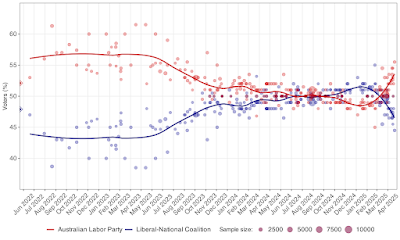
In the wake of Trump’s victory, this alienation led to an assessment within sections of Australian progressive forces that the ALP government was making the same errors Biden and Harris had made in the US. As such, a Dutton victory was inevitable. However, since the election was called, the ALP has built and strengthened a lead in the two-party preferred polls


Source: Wikipedia
While this has come as a shock to some commentators, it reflects a continuation of the problem the coalition faced going into the 2022 election in orienting to far-right discourse, made worse by their promise to bring Trump-style politics to Australia. 

This demonstrates a fundamental misunderstanding of how Australian and US politics differ. 

A key factor is the impact of compulsory voting. In the US, the largest voting block in the November elections, where people who didn’t vote, leaving aside the millions of US citizens who the Republicans have actively sought to prevent from registering to vote. In Australia, abstentionism and informal voting is not nearly that high, at around 15%. This means that in general, although not always, to win, a party needs to build a two-party preferred vote of more than 50% of the electorate. Historically, the coalition parties have done this by having a broad electoral base and then appealing to undecided voters in the centre.   

As I pointed out in 2022, the Liberal Party, following the US Republicans, has sought to energise the party’s right wing. For decades, while that has caused discomfort and alienation within the Liberal party’s voting bloc, within what has been described as the wets or social liberal-fiscally conservative, it rarely caused a split. However, there was a glimpse of a split with Howard losing the “doctors’ wives’” vote in 2007. However, with the emergence of the Teal independents before the 2022 elections, it has opened up a division in the Liberal Party’s historic voting base, with a permission pathway to preferencing the ALP over the Liberals. The Liberals lost six seats to Teal independents. To win government, they not only need to pick up seats from the ALP, but need to rewin those Teal seats. The promise to intensify cultural wars is unlikely to appeal to this constituency, which could also put additional Liberal seats at risk. 

Moreover, Dutton and Liberal strategists have interpreted the results of the Voice referendum as demonstrating an opportunity to use cultural wars to expand the coalition’s electoral support. However, while the outcome clearly demonstrated the ongoing deep vein of racism in the Australian politics, the referendum outcome was a consequence of additional factors in the campaign, such as confusion around what the Voice would mean, the relationship between Voice, Sovereignty, and Treaty, and the simple decision pathway “if you don’t know, vote no”. These are factors that don’t apply in a general election. 

In addition, the promise of gaining electoral support by modelling the coalition’s policies on Trump has proved a significant miscalculation. This miscalculation is not just that Australian society and electoral system are fundamentally different from the US, which will always mean a direct transplant of framing and rhetoric is unlikely to gain the same traction. It also fundamentally misread how Trump’s policies, once unleashed, would play out and be received in the US, globally, and most importantly within Australia. In all of these places they have been deeply upopular, most notably Tariffs that pose a threat to economies, promoting and endorsing Trump, means endorsing those attacks, in Canada, where Trump’s rhetoric also includes discussion of annexation, it has created a clear division of those who will stand up for national interests and those who will grovel at Trump’s feet. While the Albanese government has not been as resolute as the Canadian Liberal Party in opposing Trump, in both countries contrast on the question of Trump has been a key in turning election fortunes. 

Given the ALP’s likely victory, in a context where that victory will be primarily based on a rejection of the coalition and its regressive vision, rather than a sharp reorientation of the Albanese government’s policy position, poses a question of how can progressive forces within Australia, move the ALP towards more progressive positions? Whether on housing, social security, climate action, or a position of pressuring, rather than enabling, Israel’s ongoing genocide in Gaza?

In the wake of the emergence of social media, the answer to that question has often been to post hot-takes about the failures and inadequacies of the ALP, and while they generate likes and reshares in our bubbles, it won’t move the ALP. What has worked, and will always work is the clear articulation of demands that set out how things should be different and how that can be achieved, then seeking to organise and mobilise around those demands-based purely around support for the demands, not on an agreed assessment of the world and its ills, or even assessment of the ALP. This approach is starting to articulate in the US with the increasingly regular nationwide anti-Trump rallies. Building ongoing, escalating actions around clearly defined demands will not only strengthen and build the confidence of the movement, but also it will shake the government's and its supporters' confidence, irrespective of how much they claim the actions are irrelevant, opening up divisions and making a shift in government policy possible. How sharp this shift will be depends entirely on the level of ongoing pressure that the movement can generate and build.

If the unthinkable happens and the coalition wins on May 3, this strategic approach will be even more vital.  

------------------------------------------------------------------------------- 

This article is posted under copyleft, verbatim copying and distribution of the entire article is permitted in any medium without royalty provided this notice is preserved. If you reprint this article please email me at revitalisinglabour@gmail.com to let me know.

Read more...

Friday, January 29, 2021

On Trump’s Twitter ban


Lisbeth Latham

On January 8, Twitter announced that Trump would be permanently banned from the platform, this was followed by an announcement by Amazon that it would no longer be hosting right-wing social media platform Parler on its servers, and that Apple and Google were removing Parler from their app stores. These announcements have greeted with predictable howls of outrage from the right about freedom of speech and prompted discussions to limit the ability of Twitter and other social media companies to ban users. However, the move was also met with concern and opposition by sections of the left concerned by these bans and the potential that the same policy could be used to silence the left. Whilst the right’s statements are inspired by demagoguery, both their statements and those by left opponents fundamentally misunderstand the question of free speech as an unfettered right that trumps all other concerns. Moreover, many left’s criticisms fundamentally misunderstand the problems of corporate control under capitalism and how we should challenge this power.

Trump’s banning from Facebook and Twitter was not just a response to his comments and tweets around the insurrectionary storming of the Capitol building on January 6. It followed years of Trump using Twitter as a platform for incitement and misinformation in violation of Twitter’s terms and conditions. Moreover, there has been an ongoing debate about the proliferation of racist and misogynist material and harassment on social media platforms and their failure to properly apply their own Terms and Service about appropriate behaviour.

The emergence of the internet, social media, and digital media have been seen as making a massive contribution to the democratisation of the dissemination of information, as they offer relatively cheap mechanisms to potentially reach millions of people. At the same time, the reality is that the democratic character and opportunity to equal access to these mediums is relatively illusionary. Whilst anyone can establish a Twitter account, the ability to use Twitter, or any other social media, as a mechanism for communicating with others is not equal and it is not unmediated. From their inception, social media companies have been attempting to develop ways in which to monetise their platforms. This has primarily been achieved by the introduction of algorithms which limit organic reach encourages users to explore spending money to increase reach or attract followers. The reality is that like other mediums, social media do not provide equal platforms across society – they disproportionately favour the powerful – who are able to exploit their power and wealth to generate substantially greater reach than the average person.

Freedom of speech is one of the great achievements of the bourgeois-democratic revolutions beginning in the seventeenth century – the idea that the state should not be able to punish or persecute individuals and groups for saying things that the state objected to. Having said this, it is also a concept which is now widely abused, with people increasing suggesting any critique of speech as being a violation of this “right” – seeing freedom of speech as a right to speak without consequence or responsibility, and right that more important than all other rights including the rights of others to their own freedom speech and autonomy.

The denial of a platform is not a violation of freedom of speech, as there is no right to any given platform – if there were then the reality would be that for the majority of the world’s population it would be a right that is violated on a daily basis. Moreover to argue that to deny the right of any publication or organization to be able to withdraw a platform, on the basis that it is a violation of free speech is to reject the concepts of editorial independence, moral responsibility, and autonomy of individuals in general. Moreover, it robs the powerless of important political weapons of demanding the withdrawal and denial of platforms.

It would mean that a publishing house could not withdraw a publishing contract because of an assessment that a particular author was an anathema to their values (or more accurately a risk to their profits) such as publishing company Simon & Schuster cancelling Milo Yiannopoulos’s publishing deal. It would mean that the other Simon & Schuster contracted authors who threatened to leave the publisher were really part of denying freedom of speech – even though they were threatening their own loss of a platform. It would mean a right to the far-right to appearances on TV and Radio, something that has been a central target of left and anti-fascist mobilising for decades.

More chillingly, this argument feeds into the campaign by conservative government’s globally to criminalise boycott and divestment campaigns aimed at promoting that companies and organize withdraw commercial and financial relationships with problematic corporate actors such as the global Boycott, Divestment, and Sanctions campaign targeting businesses operating illegally in the Palestinian Occupied Territories; the campaign to block financing and insurance for Bravos’ massive Carmichael coal mine project in Queensland, and numerous corporate campaigns for justice that have been key tactics of a range of movements for decades.

The reality is that companies and other organisations act in their own interests. This means that there can be a confluence of interests between capital and the far-right, even “liberal-capitalism” will see its interests more in line with the aggressive right than the left, particularly when push comes to shove.

As a consequence, the left is less likely to have the same level of access to platforms, and we will face the danger of being denied platforms. There are a range of responses that we have historically taken – the first is recognising that capital will protect their interests and seeking to build our own networks of platforms. Historically this has been clearest with the establishment of left papers, magazines, and publishing houses. While the advance of digital technology has opened up new opportunities for communication, the underlying cost of starting up some aspects of platforms have also increased. It is potentially outside the means of individuals, but most likely not outside that of collectives of the left, most notably unions. In the event where the ability for the left to be hosted on the internet were to be challenged, it would be possible to explore and establish this capacity, and ideally, we would be doing this prior to such a challenge. Beyond this, as with anything, we need to be making the case in defence of the right of the left and progressive voices to speak and be heard, placing pressure and mobilising resistance to any attempt to silence us. However, this can’t be based on an agnostic view of, or even worse a defence, of the right to promote hatred and violence opposing actions by private companies to limit this type of speech.

The development of corporate power poses a massive threat to democracy globally. However, this power cannot be challenged by the left throwing itself into a defence of the far-right’s right to platform on social media or the internet or any other communication medium, or backing right-wing governmental attempts to limit democratic space to contest their policies and their protection of anti-social corporations and organisations.

-------------------------------------------------------------------------------
This article is posted under copyleft, verbatim copying and distribution of the entire article is permitted in any medium without royalty provided this notice is preserved. If you reprint this article please email me at revitalisinglabour@gmail.com to let me know.

Read more...

Friday, January 15, 2021

United States: On the threat of the far-right

Lisbeth Latham


On January 6 - thousands of pro-Trump militants, including members of the Proud Boys, and other white-supremacist armed groups, held protests in DC which culminated in the storming of the Capitol Building aiming to disrupting the certification of the presidential results by Congress. Similar actions occurred across the US outside of state buildings and governors’ residences. In the wake of the storming of the Capitol, there has been a wide range of reactions, this has included Trump’s sympathisers in the media seeking to shift responsibility for the attack and at the same time downplaying the importance of that attacks on the capitol. At the same time sections of the left have sought also downplay the significance of the events focusing on finding humour in the limitations of the action, the form it took, - as a mechanism both ridiculing the protests and the failures of the US state in handling them. It is important that what was attempted on the sixth is properly appreciated and that it be taken seriously by the left. Both as a stand-alone event, but also as a consequence of what it symbolises regarding the development and confidence of the fascist forces and the accommodation that they have made with the centre-right in a significant number of countries.

From the start of the confrontation at the Capitol building, sections of the right-wing media sought to downplay and shift responsibility for the actions at the capitol. Miranda Devine on Twitter attempted to argue that the protest was a consequence of the “left” supporting and normalising the “violence” of black lives matter protests - Devine, writing in the New York Post pivoted to argue that the real tragedy of January 6 was going to be felt by Republicans and Trump. Whilst as the seriousness of what was occurring became harder and harder for the right to downplay, sections of the far-right, such as Sebastion Gorka, a former Deputy Assistant to the President in the Trump Administration, shifted to an argument that in reality, it was really a false flag exercise driven by the left, most particularly Antifa. This is a gaslighting strategy, relying on the ready distribution of disinformation in the media and on social media. This is a lie that has been picked up widely on Twitter at the same time as significant numbers of registered Republicans support the events at the Capitol building.

The reality is that a significant number of participants came both intending and prepared to disrupt not just the city but the Capitol Building. That this was encouraged by Trump and other Republican leaders in the lead up to, on the day after the protest. It is also clear that these mobilisations have not stopped, and are likely to escalate in the lead up to Biden’s inauguration on January 20 and its wake.

The events of January 6, must be viewed from the broader context of the efforts by Trump and his supporters to identify ways to overturn the results of the November 3 elections and to reinstall Trump for a second term in the presidency. The right has been entirely open in this attempt to subvert the elections. This included discussions of trying to stop the certification of the elections in Congress, which had the potential to trigger a vote within Congress by state delegations, with each state getting one vote. If this was to have occurred there was a possibility that the Republicans would have potentially have had the numbers to give the presidency to Trump.

Blocking the certification of the elections has been a key focus of a number of the failed court challenges launched by Trump and his proxies. It has also been a point of public discussion as to whether VP Mike Pence had the power to do so. Also, there has been open discussion within the administration regarding Trump’s ability to invoke the “Insurrection Act” as a mechanism to mobilise the military to overturn the election results. All of these examples are attempts by Trump and his supporters seeking mechanisms to give a legal veneer to attempts to subvert the democratic process. While there was a clear intent to disrupt and intimidate the confirmation of voting, it is not clear how coherent the plan was or whether there was what could be called a plan rather than a shared intent.

It is highly unlikely that what was attempted could have been more than a disruption. Importantly it is unlikely they would have been able to maintain the disruption for much longer than was realistically possible. Even if successful, the overturning of the elections would not just have faced a judicial challenge, but may not have been accepted as legitimate by either significant sections of the state, most importantly the armed forces, or the broader community. While they were clearly trying to create a veneer of constitutionality, if it was not accepted the attempt would either have collapsed under its own weight or turned into a bloody struggle within both the state and broader society. Such a conflict would have had significant negative consequences for working communities. It would have also required the left to take a clear position against the far-right, seeking to mobilise the working class initially in defence of the state, aiming to build the confidence for independent mobilisation in defence of the working class’s interests.

The storming of the Capitol Building was only possible as a result of sections of the state deliberately undermining the capacity to respond to the known threat to Congress.

For weeks it was known that there would be a large scale mobilisation of Trump’s supporters, Most likely heavily armed, with the aim at best of disrupting and terrorising the city, if not disrupting the confirmation process itself. Much has been made of the fact that the security response to this protest was substantially smaller and less hostile than for previous protests by progressive groups, most particularly the Black Lives Matter rallies in 2020.

It is important to recognise that there are several factors playing into this. The downplaying the significance of the event, and likely size. The non-calling calling up of national guard units to support police presence at the Capitol building - this is being blamed on both the Capitol Hill Police and the Department of Defence (DoD). Who both failed to take the threat seriously and responded slowly to the unravelling events despite efforts by the Democratic Party leadership in Congress and by the Governor of Maryland to mobilise the National Guard.

However, in addition to this deliberate undermining of the capacity of the Police to protect the Capitol, there is substantial evidence of police enabling the protests in entering the building. Joshua Chaffin, Courtney Weaver, and James Politi writing in the Financial Times described the police response as “a strangely flaccid police force”. In the wake of the protests, the Capitol Hill Police chief, and the sergeants at arms for both the Senate and the House all resigned, under threats from Democratic Party Congressional leadership that they would push to remove them. Given these events, and the reports of Secret Service agents being overly close and intertwined into Trump camp. Sections of the US state will likely require heavy de-Trumpification by the Biden administration. This should be supported, both to clear out Trump’s supporters within the state and to send a message to the Republicans that there is a consequence for their actions.

Some on the left have dismissed the seriousness of the events in Washington. This dismissal has primarily based on three issues:
  • That it was a relatively small ineffective action; 
  • That the insurrectionists are clownish and ridiculous.
  • That this was a chance for the US to get a taste of their own medicine; 
While the mobilisation and incursion into the Capitol Building were relatively small, poorly organised, and ultimately failed, those are facts that we should be thankful for. It is not something to make jokes about as that risks us being complacent about the threat posed. It is also important to understand that right-wing insurrectionary movements tend to have a very different appearance to left-wing ones. As the right is more likely to find support within significant sections of capital, and because it is often the expression of frustration and anger by the petty-bourgeoisie, it is likely to also start to develop influence within the state. This may be either by direct recruitment or as a proxy for those sections of capital supporting the movement. This means, as against left-wing movements which are reliant on the social power of mass movements. Right-wing movements don’t necessarily need to have the same level of mass base, at least initially, they can simply rely on capturing sufficient amounts of the state, most notably the armed forces and police to bring society and the rest of the state to heel. However, fascism, as a mechanism of social control and repression over the working class does eventually need to take on a mass character but in doing so it also tends to become entwined with the state.

The outfits, which people have derided, speak to the development of networks of shared identities which are being developed within sections of the US far-right which tap into a range of right-wing traditions within the US and speak to and have resonance within those traditions. Most particularly within the QAnon conspiracy, the militia movement, and various other neo-nazi, proto-fascist and far-right groups. However, despite whatever we may think of their fashion choices, it doesn’t take away from the reality that there is a significant number of heavily armed right-wing groups who are developing an insurrectionary outlook and which are being engaged with and successfully mobilised by Trump and his proxies - and that is seriously dangerous for working people, particularly communities of colour, within the US.

While there may be some sense of schadenfreude regarding the events of January 6, the people who would have paid the price were not going to primarily be the US ruling class. They would be able and willing to come to an accommodation with whatever was to be installed. The people who would have paid the price would be working people, communities of colour, queer communities, people with disabilities, and women. When people think that seeing the US unravel into a dictatorship as in some way funny they are not thinking about the real targets of any mass repression of progressive forces and marginalised communities.

While some people may see the process unfolding as a weakening of the US state and think it is a good thing. It is not primarily that. At present what we are seeing is an unravelling of US ruling class hegemony and the emergence of an extreme right-wing movement, primarily within the US petty bourgeoisie. This movement is parts, at least, developing an insurrectionary outlook. The key problem here is both weaknesses of the left which is not currently in a position to act as a counterweight. The problem is that the US capitalist class is likely to become increasingly unpredictable both domestically and internationally. While this may provide some opportunities it may escalate potential threats.

It is not the role of the left to help rebuild the hegemonic power of bourgeois liberal democracy, but we should care about a shattering of democratic norms and we should be opposed to any attempts by the right to subvert democracy. This is not just a danger in the US, but across the globe where far-right populist movements have grown in strength and confidence. Moreover increasing sections of the centre-right are embracing the language and symbolism of the populist far-right, while much of this is cynical the reality is that it serves to strengthen and legitimise the far-right. Adding to this danger is the reality that sections of the police and armed forces in several countries have been penetrated. This is not just the case in the US where off duty police and armed forces personnel participated in the storming of the Capitol building. In Germany where the government has moved to disband special forces units due to the influence of the far-right. Sections of the US government are making noises about the need to clear out the US armed forces of far-right influences, on January 12, the Joint Chiefs of Staff issued a memorandum to those serving in the US armed forces reminding of them to their “duty to defend the US Constitution”, but it is important that they be held to account in doing this and that this not just be limited to the armed forces but to police and sheriffs departments as well.

A central objective for progressive forces everywhere must be to build our ability and confidence to mobilise and counter mobilise to oppose the far-right threat. The left must continue the tradition of being the most consistent and ardent defenders of democracy. In the US context, this would include pushing firmly against the undemocratic features of the US constitution and electoral laws which the Republicans have sought to exploit both before and during the current electoral cycle. We must demand that the state consistently apply the law against legitimate violations that pose a threat to working people and marginalised communities. It also means being prepared to push back against overreach and attempts by the state to go further than is necessary to respond to the threat posed by the far-right, however, we must be clear that the far-right poses a serious and existential threat which must be responded to.

------------------------------------------------------------------------------- 

This article is posted under copyleft, verbatim copying and distribution of the entire article is permitted in any medium without royalty provided this notice is preserved. If you reprint this article please email me at revitalisinglabour@gmail.com to let me know.

Read more...

Thursday, August 3, 2017

Trump’s transgender military ban: how should the left respond?

Lisbeth Latham

Donald Trump announced a ban on transgender people serving in the US armed forces via Twitter on July 26. The ban reverses a series of orders made by the Barack Obama administration to explore the integration of transgender service personnel into the military — and for any costs associated with gender affirmation medical technology to be covered.

The ban has re-raised questions about what attitude left-wing forces should take to questions of discrimination in the armed forces of imperialist countries. Should such discrimination be opposed and on what basis should you do so?

Trump’s ban appears to have had two primary motivations — appeasing the president’s transphobic base and addressing concerns from conservative Republicans over the cost of providing gender affirming medical technology to trans military personnel.

Missouri Republican Vicky Hartzler has been pushing since June to pass an amendment to the defence budget that would bar the US military from funding gender affirmation surgery and hormone therapy. Despite having wide support in the Republican caucus, this effort has been frustrated by an alliance of Democrats and 24 “moderate” Republicans.

Trump’s ban is also seen as a mechanism via which resistance from conservative Republicans to appropriations for Trump's southern wall can be overcome. However, the total ban goes beyond what many of the conservative Republicans were seeking. It is apparently not supported by any significant layers among senior levels of the US military apparatus.

This lack of broader support is not generally driven by opposition to transphobia. Rather, there are pragmatic concerns that a total ban will raise the risk of attempts at civilian legal intervention.

If successful, this would mean the courts would potentially limit the control that senior military and civilian administration would have over the integration of trans military personnel.

Opposing discrimination So what attitude should the left take to the ban? It is easy to say that the US military is a reactionary institution and the participation of oppressed minorities in it is not a liberating experience — and thus take an indifferent or hostile attitude to the question.

But such approaches are fundamentally wrong. The character of the US military is irrelevant as to whether US military personnel should have protections from discrimination.

This ban will do very little to stop trans people from serving in the military. It is estimated there are already between 2500 and 15,000 trans personnel in all branches of the US armed forces. The ban will simply impact negatively on the lives of these people — and undermine their ability to affirm their gender without serious consequences.

Some of these individuals may be out and out reactionaries — a fact which is irrelevant to the question of whether they deserve to be discriminated against on the basis of their gender identity. However, a large numbers of trans people, like tens of thousands of members of other marginalised communities who are members of the US military, are in the military as a consequence of the “poverty draft” operating in the US.

Opposition to minorities serving in the US military is not just meaningless (because participation is primarily driven by economic needs), it is paternalistic. It positions the left as supporting reactionary forces that seek to exclude oppressed groups from social life.

If we say it is okay to discriminate against people in certain parts of social life, it strengthens discriminatory attitudes throughout social life.

If our concern is dismantling reactionary institutions such as the US military, then the best approach is to demand maximum democratic rights both within and outside such institutions. Within the context of the military, this should include the right of soldiers to elect officers and to collectively refuse orders.

It is important to note that a significant factor in the breakdown of the US military as a functioning force during the Vietnam War was — on top of the heroic resistance of the Vietnamese people and global anti-war movement — the resistance within the US armed forces by soldiers. The great mass of soldiers decided, by and large, that staying alive was more important than the imperialist objectives of the US government and its officer corp.

Opposition to Trump’s ban should not just be limited to opposition to discrimination and violence against trans individuals within the US armed forces. It should include supporting the right to have access, with costs covered, to gender affirming medical technology.

Our arguments should not focus on how much these technologies cost — even though at an estimated US$8 million a year it is a drop in the ocean of the US government’s $611 billion defence budget — but because access to medical treatment is a right that should not be limited by costs or attitudes of those in power.

Broader impacts Accepting the right of the US government to exclude transgender affirmation surgery costs for military personnel would recreate space where other services can be cut off because of discrimination. It also puts at risk funding for trans prisoners to access publicly funded gender affirmation technology.

It strengthens the arguments in favour of the supposed “right” of private businesses and insurance companies to refuse coverage for procedures and medical technology that they are opposed to, such as access to contraceptive pills, gender affirmation surgery and hormones.

A fight against attacks on medical funding for trans military personal can, if argued effectively, lend itself to arguing for publicly funded universal health care — which is desperately needed in the US.

The ending of discrimination within the armed forces is not liberatory, but is an essential part of combating discrimination in broader society.

On the other hand, supporting the continued existence of discriminatory practices in the hope it might discourage people from joining up does nothing to disrupt the military.

However, it does help make the lives of minorities within the military hellish — an impact that will last throughout their lives — and helps enable and justify discriminatory behaviour outside the military.

Opposing pinkwashing At the same time, opponents of imperialism should not fall into the trap of glorifying either trans service personnel or lend ourselves to the pinkwashing of reactionary institutions.

There has been prominent sharing of images of Kristin Beck, a trans woman and former US Navy Seal, on social media. These memes promote the idea that trans service personnel are “defending the rights of US citizens”. The reality is that the deployment of the US military is not aimed at defending the rights of US citizens or progressive values of any form. The US military aims to extend US corporate interests and maintain US imperial hegemony.

There should be no ban on the involvement of trans personnel within the US military and US military personnel should be able to express their gender in whichever way they choose. This should be the case, despite the fact that the ability to do so will not change the US imperialist war machine — or lessen our opposition to its crimes.

[Lisbeth Latham is a trans woman. They are a long-term opponent of US imperialist adventures and a member of the Socialist Alliance in Australia.]

Originally published in Green Left Weekly #1148

Read more...

About This Blog

Revitalising Labour attempts to reflect on efforts to rebuild the labour movement internationally, emphasising the role that left-wing political currents can play in this process. It welcomes contributions on union struggles, internal renewal processes within the labour movement and the struggle against capitalism and imperialism.

  © Blogger templates The Professional Template by Ourblogtemplates.com 2008

Back to TOP  

Creative Commons Licence
This work is licensed under a Creative Commons Attribution-NonCommercial-ShareAlike 3.0 Australia License.