Showing posts with label Elections. Show all posts

Monday, April 28, 2025

With an ALP victory likely: How can progressive forces fight for change?

Lisbeth Latham

In the wake of Trump’s victory, there was a strong sense that a similar victory for the Liberal/National coalition was in the offing. Over the past months, this fear has dissipated, not primarily due to the strong performance of the Albanese government, but due to the absolute failure of the Dutton-led opposition to posit a vision for a new government other than a cheap knock-off of Trumpism. While this outcome of an outright ALP majority government, or a minority government reliant on support of the Greens, Teals, and other independents, there are lessons that the left needs to learn to build pressure on any future ALP government, to deliver for working people.

The 2022 election of the Albanese government gave hope for change in Australia, particularly after the long years of Coalition government were made worse by the strain of the early years of the COVID-19 pandemic. Many of these hopes were likely misguided. Especially given that it is a social democratic government, but the ALP, along with the French Socialist Party, was one of the first social democratic parties to push and implement neo-liberalism. As such, it is unlikely that the Albanese government was going take the initiative to implement the broad social reforms, that had not been part of its platform, which forces to its left were calling for. Reforms such as raising social security payments or caps on rents. It also meant that it would be limited in its willingness to respond effectively, of its own accord, to the cost-of-living pressures that emerged, as capital took advantage of supply chain issues caused by restrictions of the early pandemic period, and other dislocations in the global economy, to justify massive price-gauging.


Despite this, the government has had a reform agenda, and while this agenda has been uneven, and internally contradictory, it has progressed on some of it. The government has been able to point to greater wage growth, albeit mostly at below inflation levels for much of its term, some of which is the consequence of amendments included in the Fair Work (Better Jobs Better Pay) Amendment Act (2022) and the Closing the Loophole Acts. The coalition has repeatedly promised to repeal these changes, particularly in relation to changes in the definition of casual employment, the right to disconnect, and the same job, same pay provisions that requires that labour hire workers to be paid at the same pay rates as the directly employed workers working on a project. At the tail end of the campaign, the coalition has walked back some of these threats, along with a range of other commitments.   

In other areas, such as the government’s failure to seriously raise opposition to Israel’s genocidal attacks on Palestinians, like the vast majority of Western imperialist governments. Along with its continued support for fossil fuels and erosion of environmental protections, it has alienated many in its own base and those to its left

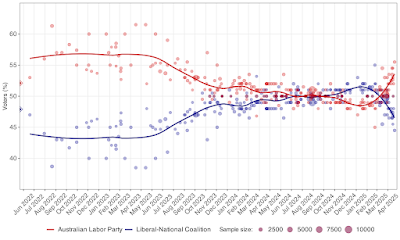
In the wake of Trump’s victory, this alienation led to an assessment within sections of Australian progressive forces that the ALP government was making the same errors Biden and Harris had made in the US. As such, a Dutton victory was inevitable. However, since the election was called, the ALP has built and strengthened a lead in the two-party preferred polls


Source: Wikipedia
While this has come as a shock to some commentators, it reflects a continuation of the problem the coalition faced going into the 2022 election in orienting to far-right discourse, made worse by their promise to bring Trump-style politics to Australia. 

This demonstrates a fundamental misunderstanding of how Australian and US politics differ. 

A key factor is the impact of compulsory voting. In the US, the largest voting block in the November elections, where people who didn’t vote, leaving aside the millions of US citizens who the Republicans have actively sought to prevent from registering to vote. In Australia, abstentionism and informal voting is not nearly that high, at around 15%. This means that in general, although not always, to win, a party needs to build a two-party preferred vote of more than 50% of the electorate. Historically, the coalition parties have done this by having a broad electoral base and then appealing to undecided voters in the centre.   

As I pointed out in 2022, the Liberal Party, following the US Republicans, has sought to energise the party’s right wing. For decades, while that has caused discomfort and alienation within the Liberal party’s voting bloc, within what has been described as the wets or social liberal-fiscally conservative, it rarely caused a split. However, there was a glimpse of a split with Howard losing the “doctors’ wives’” vote in 2007. However, with the emergence of the Teal independents before the 2022 elections, it has opened up a division in the Liberal Party’s historic voting base, with a permission pathway to preferencing the ALP over the Liberals. The Liberals lost six seats to Teal independents. To win government, they not only need to pick up seats from the ALP, but need to rewin those Teal seats. The promise to intensify cultural wars is unlikely to appeal to this constituency, which could also put additional Liberal seats at risk. 

Moreover, Dutton and Liberal strategists have interpreted the results of the Voice referendum as demonstrating an opportunity to use cultural wars to expand the coalition’s electoral support. However, while the outcome clearly demonstrated the ongoing deep vein of racism in the Australian politics, the referendum outcome was a consequence of additional factors in the campaign, such as confusion around what the Voice would mean, the relationship between Voice, Sovereignty, and Treaty, and the simple decision pathway “if you don’t know, vote no”. These are factors that don’t apply in a general election. 

In addition, the promise of gaining electoral support by modelling the coalition’s policies on Trump has proved a significant miscalculation. This miscalculation is not just that Australian society and electoral system are fundamentally different from the US, which will always mean a direct transplant of framing and rhetoric is unlikely to gain the same traction. It also fundamentally misread how Trump’s policies, once unleashed, would play out and be received in the US, globally, and most importantly within Australia. In all of these places they have been deeply upopular, most notably Tariffs that pose a threat to economies, promoting and endorsing Trump, means endorsing those attacks, in Canada, where Trump’s rhetoric also includes discussion of annexation, it has created a clear division of those who will stand up for national interests and those who will grovel at Trump’s feet. While the Albanese government has not been as resolute as the Canadian Liberal Party in opposing Trump, in both countries contrast on the question of Trump has been a key in turning election fortunes. 

Given the ALP’s likely victory, in a context where that victory will be primarily based on a rejection of the coalition and its regressive vision, rather than a sharp reorientation of the Albanese government’s policy position, poses a question of how can progressive forces within Australia, move the ALP towards more progressive positions? Whether on housing, social security, climate action, or a position of pressuring, rather than enabling, Israel’s ongoing genocide in Gaza?

In the wake of the emergence of social media, the answer to that question has often been to post hot-takes about the failures and inadequacies of the ALP, and while they generate likes and reshares in our bubbles, it won’t move the ALP. What has worked, and will always work is the clear articulation of demands that set out how things should be different and how that can be achieved, then seeking to organise and mobilise around those demands-based purely around support for the demands, not on an agreed assessment of the world and its ills, or even assessment of the ALP. This approach is starting to articulate in the US with the increasingly regular nationwide anti-Trump rallies. Building ongoing, escalating actions around clearly defined demands will not only strengthen and build the confidence of the movement, but also it will shake the government's and its supporters' confidence, irrespective of how much they claim the actions are irrelevant, opening up divisions and making a shift in government policy possible. How sharp this shift will be depends entirely on the level of ongoing pressure that the movement can generate and build.

If the unthinkable happens and the coalition wins on May 3, this strategic approach will be even more vital.  

------------------------------------------------------------------------------- 

This article is posted under copyleft, verbatim copying and distribution of the entire article is permitted in any medium without royalty provided this notice is preserved. If you reprint this article please email me at revitalisinglabour@gmail.com to let me know.

Read more...

Wednesday, July 10, 2024

France: Following the threat of National Rally - Towards a New Popular Front government

Source: Braveheart

Lisbeth Latham

In the second round of the French National Assembly elections on July 7, in the face of fears that the far-right National Rally and its allies would win government outright, the New Popular Front won the largest share of seats. A key factor in this outcome was the decision by the majority of parties to limit the number of three or four-way contests that included RN, to give voters a clear choice between the RN and the alternative parties. However, the success of the NPF in the elections opens up new questions and challenges for the NPF and its component units regarding the formation of the next French government and how to relate to both this government and the presidency of Macron’s remaining three years in office.

Infographic: Left Wins But Right Gains After French Elections | Statista
You will find more infographics at Statista
 
RN candidates, who had reached the second round in 444 constituencies, received 37.03% of votes cast in the second round totaling 10, 110, 013 votes. Despite this, they won 143 seats (up 54 from their total in the 2022 elections) far short of the 289 seats required for a victory. While RN’s performance is being described as a stunning defeat, it represents a significant and continued advance for the party with nearly two-fifths of the electorate backing the far-right, and it was only defeated partly by efforts for France’s parties of the left and centre to make tactical voting against RN candidates easier.

A factor in limiting RN gains was the decision by both NFP and the pro-Macron coalition Ensemble to withdraw their candidates from three-way contests if they were the third candidate. Consequently, 216 candidates withdrew from the second round, 134 backed by the NFP and 82 from Ensemble.

Consequently, both NFP’s and Ensemble’s votes in the second round are distorted and do not accurately reflect their level of support. The NFP received 25.81% of the vote and won 180 seats (up 49 on 2022). Ensemble received 24.53% of the vote and won 163 seats. The final major block is the remnants of the traditional centre-right, The Republicans, whose vote collapsed to 5.41% in the second round, winning 66 seats, down 9 seats from 2022.

No block is an easy position to form a majority government. For a majority government to be formed, at least two electoral blocks, or significant parts of them, would need to unite. While there will be pressure from French capital for this to occur, most notably Ensemble, The Republicans, and potentially some or all of the centre-left parties, most notably the Socialist Party, within the NFP. This is a threat that John Mullen points out “The right-wing majority, aided by a strong media campaign, would prefer a coalition government, including parts of the left and right: including everyone, in fact, except the [France Insoumise] FI and RN.” Although it is unclear that a working majority would be able to be constructed by these groups. Alternatively, Romain Geoffroy, Adrien Sénécat and Maxime Vaudano argue other options would be a minority government appointed by Macron or a "technical government" of experts, which is common in countries such as Italy, and reliant on Macron’s ability, under cl 49.3 of the French Constitution, to push through laws without having a vote in parliament as long as there is not a no-confidence vote within the National Assembly. Unlike in some countries where no clear majority government, the French Constitution prevents there being a further election until those scheduled for 2025. In the wake of the election results Macron has asked the current prime minister, Gabriel Attal, to remain in place for the time being.

Faced with the likelihood of a minority government being formed the parties of the NFP, including the PS, are demanding that Macron “must immediately turn to the New Popular Front to enable it to form a government”. This government would have FI leader Clémence Guetté as prime minister. In the statement, the NFP argues:

“The results of the first and second rounds of the legislative elections confirm the failure of Macron's party. The French people put the New Popular Front and its program in the lead and thus prevented the victory of the extreme right, which was nevertheless presented as a given three weeks ago.

“This is the result of a tremendous popular mobilization that we want to salute and of the responsibility of all the voters who voted to express their rejection of the extreme right. It led to a record turnout. Even without an absolute majority, it gives us an immense responsibility.

“The New Popular Front is without a doubt the leading force in the new National Assembly. Following the republican custom in times of cohabitation [where the government is a different party to that of the President], it is up to the President of the Republic to turn now to the New Popular Front to enable it to form a government. If the President of the Republic persisted in ignoring the result of Sunday's election, this would be a betrayal of the spirit of our constitution and a democratic coup that we would oppose with all our strength.”

The need for workers and popular forces in France to mobilise both in support of the formation of not only an NFP government, but in support of the implementation of the NFP’s radical program, is clear. As the New Anti-Capitalist Party-The Anti-Capitalist put in their statement on July 9 “For all this, our social camp must remain united to fight, debate, organise and build a left of combat and rupture, bringing social progress, with a view to a revolutionary transformation of society, freed from exploitation and oppression”. This call for action in support and defence of the NFP is echoed in statements of France’s militant union confederations, which are part of the NFP, most notably the General Confederation of Labour and the Trade Union Solidarity.

Should Macron refuse to appoint an NFP government, any current mass mobilisations will have an important impact in resisting and pressuring any new government.

------------------------------------------------------------------------------- 

This article is posted under copyleft, verbatim copying and distribution of the entire article is permitted in any medium without royalty provided this notice is preserved. If you reprint this article please email me at revitalisinglabour@gmail.com to let me know.

Read more...

Thursday, July 4, 2024

France: Responses to the spectre of a National Rally government


Lisbeth Latham

As expected the far-right National Rally (NR) and its allies emerged as the largest party in the first round of the French elections - with the potential to form government in the wake of the second round of elections on July 7. Demonstrating the extent to which the elections are seen as an existential crisis in French life, with a turnout of 66.71%, the highest turnout since the 1997 elections. In response, the coalitions of both the left, centre, and centre-right have moved to try to limit the performance of NR by taking a strategic approach to the second round to limit NR’s final seat tally. While such an approach is important, it poses significant risks for the left parties.

Candidates of RN and its allies the Union of the Far-Right (UXD) received 33.21% of the vote, the highest vote in the history of RN or its predecessor the National Front. This vote was down on the peak of RN’s support in opinion polls leading up to the elections. Based on this vote, candidates of the RN and UXN were elected in 38 constituencies and qualified for the second round in 444 constituencies. Which would allow them to potentially win a majority of seats and form government.

The New Popular Front (NFP) emerged as the second-largest party receiving 28.22% and winning 32 constituencies outright, with 415 candidates advancing to the second round. While this was consistent with NFP’s performance in opinion polls, it reflected a significant advance over the constituent parties’ performance in the 2022 elections - where New Ecological and Social People’s Union totaled 26% of the vote.

In response to this performance the parties of the left have been clear that the key threat is RN, and have sought to limit the number of RN candidates that will be elected in the second round. "Our guideline is simple and clear: not a single more vote for the National Rally," said France Unbowed (FI) leader Jean-Luc Mélenchon.

If no candidate reaches 50% in the first round, the top two contenders automatically qualify for the second round, as well as all those with 12.5% of registered voters. In the run-off, whoever wins the most votes take the constituency. RN candidates have qualified for run-off elections in 298 constituencies in which three or more parties have qualified.

Based on this Raphaël Glucksmann, who headed the Socialist party’s candidates in the European elections last month, called for all the candidates who finished third in the first-round to withdraw in order to forge a united barrier against the far right.

“Are we ready to hand over our country – the country of Victor Hugo, of Voltaire, of Rabelais – to the Le Pen family?
“That’s the only question that matters. It’s become a referendum and that’s why we’re asking all the third-place candidates to withdraw immediately, and why we’re asking people to vote, unambiguously and unhesitatingly, for democratic republicans whether they be on the left or the right, in order to stop the National Rally. We have seven days to avoid a catastrophe the likes of which France has never known in its history.”

Supporters of President Emmanuel Macron, who received 21.28% of the vote, have generally endorsed withdrawing candidates where they are the third candidate in a run-off. However, they have not been consistent in doing so. With leaders opposing withdrawing where the first or second candidate is from Melenchon’s FI, on the basis that, as Bruno Le Maire, France’s Finance Minister said “For me, France Unbowed is a danger for the nation, just as the National Rally is a danger for the Republic”. Despite this 224 candidates have withdrawn for the second round, reducing the number of four-way races from five to 2, and the number of three-way races from 306 to 89. The number of two candidate races has increased from 190 to 409. RN will be pitted against the NFP in 149 of these, while 134 elections will see RN contenders run against candidates from Macron's supporters.

The withdrawal of the third candidates substantially reduces the chances of RN being able to form a government. This could create a situation where the Macronists are reliant on votes of either RN or the parties of NFP. This creates a significant risk of the left, particularly with the threat of the far-right, being pressured to support either directly or indirectly a government of “republican unity”, an eventuality that can only further strengthen RN’s claims of being the party against the failings of the political mainstream elite.

In this context, the key will not just be what happens in the elections on July 7, but what happens in the streets after. As the National Confederal Committee of the General Confederation of Labour (CGT) said in a July 1 statement, “Nothing is written. The CGT will do everything to prevent the worst and win social and environmental progress. Through mobilization in the streets and at the ballot box, the world of work can and must win!”

------------------------------------------------------------------------------- 

This article is posted under copyleft, verbatim copying and distribution of the entire article is permitted in any medium without royalty provided this notice is preserved. If you reprint this article please email me at revitalisinglabour@gmail.com to let me know.

Read more...

Saturday, June 17, 2017

Record abstention in French elections as Macron secures majority

Lisbeth Latham

  The first round France’s National Assembly elections have been marked by record abstention of 51.29% of the electorate.

The abstentionism primarily impacted on the far-right and left parties. Meanwhile, recently elected President Emmanuel Macron’s The Republic on the March (LREM) and its allies look to secure a strong parliamentary majority in the second round of elections on June 18.

This would strengthen LREM and allies capacity to carry out Macron’s agenda of regressive assaults on students, workers, the unemployed and retirees. LREM’s victory in the first round creates a significant challenge for the French left to build resistance to Macron.


LREM’s allies include the centrist Democratic Movement (MoDem), along with dissident members of the right-wing The Republicans (LR) and the Socialist Party (PS). Combined, these forces received 32.32% of the vote. They are expected to ultimately win between 390-440 out of the 577 seats in the National Assembly.
The second highest result was achieved by the LR and allied right-wing parties, which received 21.57% of the vote. These traditional right-wing parties are expected to win between 70 and 90 seats in the second round.
The far-right Front National placed third with 13.20%, with the FN are expected to increase the number of seats it holds beyond its current two. There is an outside chance it could win enough seats to form a formal parliamentary group (15 seats).
Left results
On the left, Jean-Luc Melenchon’s France Unbowed (FI) received 11.02% of the vote, and 65 of its candidates have qualified for the second round.
The vote for the traditional social democratic party, the PS, and its allies fell dramatically from 2012, although it was up from its record low in the presidential elections. They won 9.51% of the vote and are expected to win 20-30 seats. This is down dramatically from the 331 seats they hold in the outgoing parliament, with a large number of former government ministers already eliminated in the second round.
The French Communist Party (PCF), for its part, had been heavily dependent on the Left Front electoral alliance with Melenchon’s Left Party to win its seven seats in 2012. With no alliance between the PCF and FI, it suffered a sharp decline in its electoral fortunes — receiving just 2.72% of the vote. Just 12 PCF candidates qualified for the second round.
LREM’s likely strong majority, along with Macron’s victory in the presidential election, is being presented as a rejection as the mainstream parties of the centre-left and the right, as well as an endorsement of Macron’s “modernising” agenda.
Macron is already flagging a new round of attacks on workers and their unions. These include expanding the areas that a company level agreement can undercut a sectoral agreement — along with his campaign pledge to cut France’s public sector by 140,000 jobs.
No mandate
However, while appearing a strong result, the reality is LREM domination of the vote is primarily a consequence of the decline in the mobilisation of voters of the left and far right.
Candidates backed by Macron received 1.3 million fewer votes than Macron did in the first round of the presidential election. Moreover, LREM vote constitutes a small section of the French electorate.
The New Anti-capitalist Party (NPA) pointed out in a statement: “With over 51% abstention, the results of the first round of parliamentary election is that of a sick and increasingly undemocratic Republic. 
“That the Republic on the March should have an absolute majority in the Assembly with the support of 16% of registered voters ... this result shows that this government has no legitimacy to rule by decree, much less to destroy our social gains, the Labour Code, or social Security”.
It is unclear what drove the sharp decline electoral support for the FI and the PCF from the first round of the presidential election. Some of the decline potentially reflects a letdown from Macron’s victory, along with difficulty in transforming Melenchon’s individual electoral appeal to the FI.
Another factor may well have been the failure of the FI and PCF to build a united left electoral campaign for the legislative elections. This division was a consequence of long running tensions between Melenchon and the Left Party on the one hand and the PCF on the other.
These tensions led the majority the PCF’s national conference in November to reject a proposal that the PCF support Melenchon’s presidential campaign. The PCF subsequently endorsed Melenchon only after a narrow membership vote in favour.
Struggle for united left 
There was widespread support for a united legislative campaign, but there was no agreement over the basis for such an alliance.
The PCF sought an alliance based on non-aggression and the ability the parties to present their own programs under their own banner. The FI, on the other hand, made the basis of unity having all candidates accepting its program, under its banner and with all public funding based on votes going to the FI.
The impact of this division was felt in a range of ways. It led to a number of the PCF candidates standing solely as FI candidates. It also led to a level of alienation of the bases of the different groups over the blame game for divisions.
The only PCF candidates who did not compete against an FI candidate in their constituency were those PCF members of parliament who endorsed Melenchon’s campaign. These were among some of the better performing PCF candidates (some receiving more than 30% of the vote in their constituencies).
However, this may also have been a consequence of them standing in seats where the PCF has continued to maintain strong links with the working class.
It is unclear exactly how much of an impact the standing of multiple left candidates in individual constituencies had on the left vote. But it is clear that the divided situation resulted in less left candidates qualifying for the second round of the elections. This weakens the ability of the left to blunt the size of the LREM’s parliamentary majority.
The FI and PCF leaderships have both made clear the pressing need for the left to unite to support the remaining left candidates. There are 80 left candidates who made it through to the second round (including PS candidates who have consistently opposed anti-worker changes to the Labour Code). There are 42 seen as being in a strong position to win a seat.
However, this number could rise if the left is able to mobilise a greater section of its base in the second round. PCF national secretary Pierre Laurent was reported in l'Humanite on June 13 as saying: “The mobilisation of leftist voters is necessary because it is thanks to the huge abstention that the Republic on the Move could get an absolute majority.”
The street
As important as the June 18 second round vote will be in establishing a parliamentary opposition to Macron, the reality will be that the main struggle against attacks on social gains in France will occur in the street.
The Front Social, established in April and including more than 100 unions and other activist groups, has called national mobilisations against Macron for June 19. Unions in Paris have also called protests for June 27, the day that newly elected MPs will take their seats, as part of their campaign against the attacks on France’s labour laws.
These mobilisations will be important steps in the building of a movement against Macron.
[This article originally appeared in Green Left Weekly #1141]

Read more...

Sunday, June 11, 2017

France: France Insoumise, the PCF and the challenge of building a left fight-back against Macron

Lisbeth Latham
The strong performance of Jean-Luc Mélenchon in the first round of the French presidential election (19.58%), the highest vote by candidate to the left of social democracy since 1969, gave rise to hope for the potential for the French left to rebuild its presence in the French parliament and establish itself as a barrier to Macron establishing a parliamentary majority. A factor that could contribute to fully realising this opportunity would be the extent to which a united-left electoral campaign could be built– particularly between the parties which made up the Front de Gauche (Left Front - FG).

Jean-Luc Mélenchon addresses a France Insoumise rally
However, rather than unity the dynamics of division that have been in play for more than two years have largely deepened and could potentially result in the left returning fewer members to parliament than in 2012.

Mélenchon’s presidential campaign was primarily driven by France Insoumise (Indomitable France – FI), the mass organisation which Mélenchon launched on February 10, 2016 with the support of Parti de Gauche (Left Party – PG), the party he launched following his resignation from the PS in 2009. When FI was launched, Mélenchon also announced the dissolution of the Front de Gauche – the electoral front which had been launched between the PG, the Parti Communiste Français (French Communist Party – PCF) and a number of smaller left parties. FI has primarily organised via the web, with supporters being organised into committees of between 5-12 people, By May 1, FI had more than 450, 000 supporters, in March, when the organisation had over 260, 000 supporters, there were 2, 800 committees across.

Pierre Laurent
In addition to the support from FI, Mélenchon’s presidential campaign was supported by the PCF and Ensemble (a regroupment of smaller left groups within the FG). However, while the launch of FI and Mélenchon’s presidential campaign was supported by some of PCF’s leadership, particularly Pierre Laurent, PCF National Secretary, and Marie-George Buffet, current MP and former PCF National Secretary, many PCF members were hostile to both the creation of FI and to Melenchon’s presidential campaign. Fifty-five percent of the PCF’s National Conference on November 5, rejected a proposal to support Melenchon’s presidential bid. Three weeks later, 54% of the party’s 50, 000 paid membership voted to support Mélenchon’s candidacy. This support was vital, as in order to be formally nominated for president, he required the endorsement from 500 elected officials – which the PCF’s formal support gave him. There was also significant resistance within Ensemble where 30% of members voting against supporting Mélenchon’s candidature.

Mélenchon’s success in the presidential elections while being a culmination of a growth of in hope around his campaign – also raised the hope that if the vote could be translated through to the legislative elections there would be a possibility that the left of the PS could not only significantly boost its presence in parliament, but have a big enough contingent to be able to block Emmanuel Macron’s La Republique En Marche! (the Republic on the Move – LREM) holding a majority in the parliament. This need was reinforced after Macron announced his government with former right-wing Les Repulicains MP Édouard Philippe as his prime minister. Macron announced plans for a new round of attacks on workers to follow on from last year’s El Khomri labour laws which significantly undermined worker and union rights.

Despite this hope and need for a united left electoral response, it has not materialised. While in the wake of the Macron’s victory in the second round both the PCF and Ensemble! issued statements calling for a united left electoral ticket. FI insisted the basis for unity was for candidates run under FI’s banner, be based on acceptance of FI’s program, and that all public funding generated based on votes for FI candidates would go to FI. Positions which the PCF was unwilling to accept, based on their desire run under a common banner but also allow individual parties to be profiled and the PCF’s unwillingness to campaign for the withdrawal from nuclear power generation. On May 9, Manuel Bompard an FI spokesperson announced that negotiations had broken down, he blamed the PCF’s Laurent for this. As a consequence, the FI would be running its own candidates in every constituency including constituencies where the PCF, Ensemble!, or Europe Ecology les Vertes (Europe Ecology - The Greens) have sitting MPs (unless the sitting MP had endorsed Mélenchon’s presidential campaign).


The failure to form a united ticket reflects long-running tensions within the FG which culminated in the 2015 regional elections where the FG was heavily divided and received tiny votes. From the outset there were tensions within the Front about both the character of the front, was it an alliance between organisations or should individual activists be able to join and have a say, and around democracy, with the PCF, particularly in areas where it was the largest organisation, imposing its candidates, there had also been tensions as to who could say they were front candidate – which was a problem in municipal and regional elections where tickets are run and at times member organisations were represented on different tickets – with the sharpest question being could a ticket involving official PS candidates be labelled a FG ticket? With the PCF (which was more likely to be in such an alliance pushing for the ability for it to wave the FG flag in these circumstances).

These tensions culminated in a meeting of the European United Left/ Nordic Green Left (EUG/NGL) in 2014 where PG sort to block Pierre Laurent’s election to the presidency of the EUL/NGL over the question of the PCF’s running joint tickets with the PS, although Laurent was subsequently elected. In the 2015 regional elections (which were marked by a sharp increase in support for the Front National) the FG ran only a seven of tickets involving all of the FG– with the rest being a variety of separate tickets with the PCF and thePG running on different tickets. The joint tickets performed badly, with the only ticket in Languedoc-Roussillon-Midi-Pyrénées receiving sufficient votes to contest the second round – all the remaining tickets averaging 2.49%. In the wake of this failure, the Front essentially stopped operating as a joint organisation and Mélenchon announcing the PG would be leaving the Front.

The rupture between the PCF and FI has created considerable concern that it will dramatically undermine the ability to of the left to maximise its parliamentary representation and build an effective block to work with social movements to oppose Macron’s regressive agenda for France. On May 10, Ensemble! issued a statement saying that it was not the time to settle scores or for mutual accusations, but instead to build a framework for bringing together the forces which had supported Mélenchon’s candidacy, based on a proposal of a common charter for candidates for the legislative elections that Ensemble! had made to the PCF and FI – Ensemble! had also called for regional and departmental meetings of the organisations to try and overcome the “national bottleneck”. While these proposals if adopted might create clarity for the basis of joint candidates, it doesn’t overcome the sticking point of who would be the candidate in each constituency – particularly when the PCF is faced with a fight for its electoral survival, and there is a view that Mélenchon’s approach to the PCF is partly motivated by desire to further marginalise the PCF.

It is unclear what the impact of the electoral division will have on the elections. The shared polling for the FI/PCF has been in decline since early May from a high of 18% to a low of 14.5% with projected returned candidates down from a projected high of 25-30 to a low of 12-22 (the FG components currently hold 10 seats). The splitting of the vote is likely to result in less candidates making it through to the second round (unlike the presidential elections where only the top two candidates go through to the second round, in the legislative elections if no candidate gets more than 50% of the vote then all candidates receiving more than 12% of the vote qualify for the second round) other than lowering confidence of the left electorate, having two or more left candidates (both the Nouveau Parti Anticapitlisate and Lutte Ouvrier will also be standing candidates) in a constituency may not undermine the capacity for the left to win seats. The bigger threats are the potential rebound in the PS vote from the historic low of 6.38% which Hamon received in April – while the left division could contribute to this – the PS performs is likely to be better at the local level particularly from the PS’s left who opposed the regressive record of the Hollande and the governments of Aryault and Valls. An additional factor is that Hamon’s vote also collapsed as Mélenchon’s campaign built momentum and it looked more likely he could overtake Francois Fillon and possibly Le Pen – this dynamic is much less likely to occur in the legislative elections, at least at the national level. By far the biggest threat to the return of left candidates, however, will be the threat of abstentionism as people see a victory for Macron’s LREM and the forces to its right as inevitable.

The reality is that no matter the result for the parties of the left – they will not be able to block Macron’s agenda by their actions in parliament alone – even if LREM does not achieve an electoral majority outright, it will be in a position to try and stick together sufficient support from the PS and Les Repulicains to pass legislation. The only force which will be able to stop that process will be the resistance in the streets. To this end, there has been a positive boost to the resistance with the formation of the Social Front. Initiated by union activists who had been involved in the campaign against the El Khomri laws and who had been frustrated by the decision by union leaderships to end mobilisations against those laws on September 15, 2016. The FS called for mobilisations against both Le Pen and Macron on April 22, May 1, and May 8 – it has now expanded its support to from 70 militant organisations. The FS has also called for a national meeting on June 10, along with local organising meetings after that date, and a mass mobilisation for June 19. The significance of the emergence of the FS is that in the last decade resistance to government attacks, particularly on workers, has primarily occurred via the intersydicale which brings together the leaderships of France’s union confederations – however if some of these confederations refuse to participate such as the Confédération Française Démocratique du Travail (French Democratic Confederation of Labour) and the Confédération Française des Travailleurs Chrétiens (French Confederation of Christian Workers) in the campaign against the El Khomri laws in 2016, then there is a very limited framework for engaging rank-and-file members of these confederations who want to fight government attacks. The formation of the FS may provide a framework to reach out to broader layers of workers and build resistance despite the direction of the more conservative confederation leaderships.


While there are serious challenges for progressive forces in France – made more difficult by the organisational divisions within the left, both the legislative elections and the formation of the FS pose a positive opportunity to build resistance to the attacks which Macron is preparing on French society. ------------------------------------------------------------------------------- 

Read more...

Friday, May 12, 2017

France: Le Pen loses, but struggle against Macron brings new challenges

Lisbeth Latham

Emmanuel Macron won the second round of the French presidential elections on May 7, receiving 58.21% of the vote compared to the 30.01% share for far-right National Front (FN) candidate Marine Le Pen.

Despite the apparently decisive victory, the vote signals continued political uncertainty in France fuelled by widespread disillusionment with France’s democracy. It raises questions as to whether Macron’s supporters, organised in a new centrist movement called En Marche!, will be able to form a working government out of legislative elections scheduled for mid-June.
Despite Macron winning the first round, there were doubts over whether sufficient numbers of voters who had supported other candidates would shift their vote to Macron in the second round. The desire to deal the FN a defeat was strong, but many were put off by the hard neoliberal platform of Macron, the personification of an establishment technocrat.
AbstentionMacron’s total vote ultimately more than doubled his first round vote, but in the context of the lowest turnout in a presidential vote since the 1969 presidential elections, which occurred in the aftermath of repression of the mass mobilisations of May-June 1968.
More than 25% of voters abstained from the contest between the far-right and centrist candidate. There were also 11.47% blank ballots cast.
The abstention and blank ballots reflect the extent to which voters were alienated not just from the racist pro-capitalist politics of Le Pen, but also Macron’s promise to continue and deepen the neoliberal attacks on French society carried out by successive governments.
Some of Macron’s policies include budget cuts totalling €60 billion; lowering corporate tax from 33.3% to 25%; creating a 5000-strong EU border force; adding 10,000 extra police; and expanding jails to house a further 15,000 prisoners.
National FrontLe Pen was always seen as unlikely to win the second round — the only real chance for her to win was huge abstentionism. Her objective in the second round was always to further build the position of the FN for the legislative elections as well as the 2022 presidential elections.
Le Pen’s final vote of 10.5 million (a 38.62% increase over the first round) was significant. But it was widely greeted with relief that the vote was not as high as some feared, with polls up until May 3 suggesting that the FN vote could be more than 41%.
Le Pen's weaker performance was partly a consequence of the release of further allegations from the European parliament in which she is implicated in a fake jobs scandal. Le Pen’s performance in the second round debate was also widely panned.
The rise of the FN and Le Pen poses a serious threat, but their forward march is not inevitable. They face significant challenges.
One of these is that, despite Le Pen’s efforts to detoxify the FN’s image, its overt racism continues to alienate significant sections of the French working class — particularly Muslim and migrant communities. This reality was reflected in Le Pen’s cynical move immediately after the first round on April 23 to stand down as FN president so she could be “the candidate for all of France”.
However, her efforts were undermined by her replacement Jean-Francois Jalkh, a long-term party member who had joined as a 17-year-old in 1974. He had to resign just days later for previous statements minimising the Holocaust.
The FN also faces significant internal division over the way forward. Le Pen wants to continue moving the party into the mainstream of French right-wing politics and challenge the centre-right Republicans as the main party of the right.
The most unreconstructed reactionary wing of the party continues to resist this push. It is seeking to use Le Pen’s poorer than expected showing to attack this project.
Marine's father and party founder, Jean-Marie Le Pen, who Marine had expelled from the party in 2015, publicly attacked his daughter on the eve of the second round. He said she was unfit to be president.
Left debatesHow to respond to such a second-round contest was a source of debate within the French left. A particular focus was the extent to which the danger posed by Le Pen made it incumbent on the left to support Macron’s candidacy.
Of particular interest in this regard was the stance taken by Jean-Luc Melenchon’s France Insoumise (France Unbowed, FI). Melenchon’s campaign posed a radical, left-wing pole in the first round of campaigning, mobilising tens of thousands and securing just under 20% of the vote.
The FI called for not one single vote for Le Pen. However, it put the other options to a membership vote: calling for a vote for Macron; abstaining or casting a blank ballot. More than 36% of FI members backed the organisation calling for blank ballots to be cast.
The French Communist Party (PCF), which campaigned for Melenchon in the first round, called for a vote for Macron, as did and the French Confederation of Democratic Workers (CFDT), France's second-largest union confederation.
PCF national secretary Pierre Laurent called for “beating Marine Le Pen on May 8 and to build legislative victories to defeat both Emmanuel Macron and the extreme right”.
The General Confederation of Labour (CGT), France’s largest union confederation, called for a “vote to block the extreme right”, but refused to publicly call for a vote for Macron.
The CGT said Le Pen posed “a danger to democracy, social cohesion and the world of work”, but that “the governments, which since 2002 have followed one another without ever meeting the legitimate aspirations for greater social justice, failing to create opportunities for a better future, bear a heavy responsibility [for the growth of the FN].”
The New Anti-capitalist Party (NPA) went further, arguing against a call for a vote for Macron. It said: “Macron is not a bulwark against the FN; to impose a lasting retreat [on the FN] there is no alternative but to take the streets against the far right and against all those who, like Macron, impose or try to impose anti-social measures.”
New challengesWith Macron’s victory, the focus for the left will shift to a struggle on the streets against Macron’s looming assault and on efforts to build a legislative opposition. The CGT called for mobilisations against Macron for May 8, which drew thousands of protestors.
In its call for mobilisations, the CGT said the FN vote was too high and “reflected the level of social despair unleashed by liberal policies a consequence of the refusal of successive governments to fight for social justice.
“Fighting the FN requires a break with liberal policies. It is the perspective of the CGT to work, through social mobilisations, to impose alternative choices, act for social justice and win a world of peace.”
The legislative elections could pose an opportunity for those to the left of the now severely weakened Socialist Party (PS) to achieve a greater parliamentary voice than the 10 MPs that the Left Front (an alliance including the PCF and Melenchon’s Left Party) achieved in the 2012 elections.
The traditional party of French social democracy, the PS candidate won just over 6% in the first round of the presidential elections, leaving a large space on the left.
The position of the left heading to the poll is relatively weak - the combined vote for the left in the presidential elections, including the PS, was just under 10 million. However, parties to the left of the PS won about 7.7 million.
If this was maintained in the legislative elections, it would likely result in a significant expansion in the number of seats won.
However, the bulk of Melenchon’s increased vote in the presidential contest came from PS voters shifting to Melenchon as support for the PS’s Benoit Hamon collapsed. This is unlikely to be replicated.
An added complication is that, at present, there is no agreement between the parties that supported Melenchon’s presidential candidacy on a united campaign in the legislative elections. There is a chance that the FI and the PCF will run candidates against each other, including in constituencies currently held by the PCF.
If this occurred, it could risk a reduction in the number of seats held by the left. In the face of this danger, Ensemble (a far-left regroupment within the Left Front) has called for building a united force of the “defiant left” that breaks with neoliberalism to contest the legislative elections.
“The next legislative elections will be decisive in mobilising the hope raised by Jean-Luc Melenchon’s success in the first round of the French Presidential election,” it said in a statement.
“We need to elect genuine left representatives who will fight Macron’s policies and build an alternative. We have everything to play for.
“Macron must be prevented from obtaining a majority of deputies, drawn from the traditional parties of the right and the French Socialist Party, which will continue and worsen the policies of Francois Hollande’s last five years in power.
“For this reason, it is essential that the progressive forces who supported Jean-Luc Melenchon’s candidacy stand in constituencies across the country and build on the success of the first round. It is necessary to unite left and environmental activists in choosing candidates and break from the social liberals.
“This will give sufficient force to opposing the policies of Macron and challenge both the extreme right and other conservative forces.”
[This article originally appeared in Green Left Weekly #1137You can read a series of translated statements from the French left on the presidential elections at Links International Journal of Socialist Renewal ] 

Read more...

Tuesday, March 20, 2012

France: NPA Confirm Presidential Candidate

Lisbeth Latham

The Neaveau Parti Anticatiliste (NPA) announced March 13 that they had completed the final administrative step in nominating Philippe Poutou for the April 22 Presidential election. Poutou is a Confédération générale du travail (CGT) militant at Ford’s Bordeaux plant.

Under France’s undemocratic electoral system presidential candidates require the endorsement of 500 of a list of 45, 000 elected officials, the majority of which are municipal mayors. Presidential nomination is a simple process for larger parties as they can rely on the endorsement from their own members. For smaller parties the process requires that they convince officials from the larger parties to endorse their candidate, which means it is possible for the larger parties to actively exclude smaller parties from the elections and rob people of the opportunity to vote for their preferred candidate.

This is precisely what has occurred to the NPA and other parties to the left of the Parti Socialiste (PS), with the PS leadership sending a letter to its elected officials directing them to not endorse the presidential candidates of other parties. Despite this obstacle, after more than eight months work of talking to elected officials across France, NPA activists were able to obtain endorsement from 520 officials.

The official nomination will help to secure a greater public profile for Poutou’s candidacy. It remains to this increased exposure enable Poutou to lift his current support of 0.5-1% in opinion polls.


Read more...

About This Blog

Revitalising Labour attempts to reflect on efforts to rebuild the labour movement internationally, emphasising the role that left-wing political currents can play in this process. It welcomes contributions on union struggles, internal renewal processes within the labour movement and the struggle against capitalism and imperialism.

  © Blogger templates The Professional Template by Ourblogtemplates.com 2008

Back to TOP  

Creative Commons Licence
This work is licensed under a Creative Commons Attribution-NonCommercial-ShareAlike 3.0 Australia License.