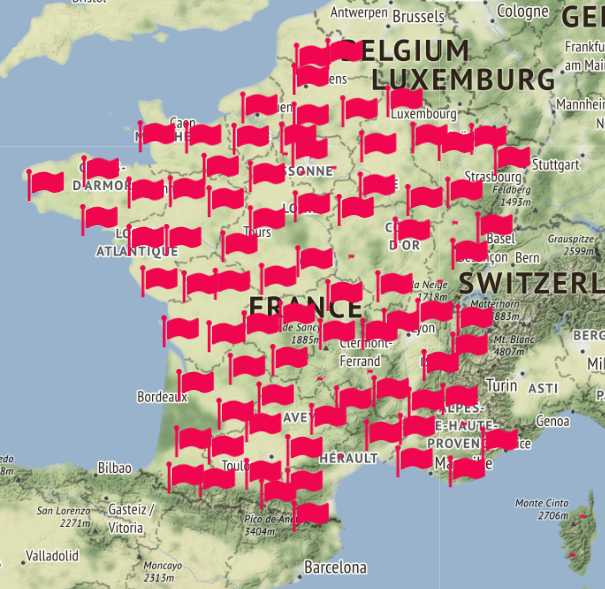
In the second round of the French National Assembly elections on July 7, in the face of fears that the far-right National Rally and its allies would win government outright, the New Popular Front won the largest share of seats. A key factor in this outcome was the decision by the majority of parties to limit the number of three or four-way contests that included RN, to give voters a clear choice between the RN and the alternative parties. However, the success of the NPF in the elections opens up new questions and challenges for the NPF and its component units regarding the formation of the next French government and how to relate to both this government and the presidency of Macron’s remaining three years in office.
RN candidates, who had reached the second round in 444 constituencies, received 37.03% of votes cast in the second round totaling 10, 110, 013 votes. Despite this, they won 143 seats (up 54 from their total in the 2022 elections) far short of the 289 seats required for a victory. While RN’s performance is being described as a stunning defeat, it represents a significant and continued advance for the party with nearly two-fifths of the electorate backing the far-right, and it was only defeated partly by efforts for France’s parties of the left and centre to make tactical voting against RN candidates easier.
A factor in limiting RN gains was the decision by both NFP and the pro-Macron coalition Ensemble to withdraw their candidates from three-way contests if they were the third candidate. Consequently, 216 candidates withdrew from the second round, 134 backed by the NFP and 82 from Ensemble.
Consequently, both NFP’s and Ensemble’s votes in the second round are distorted and do not accurately reflect their level of support. The NFP received 25.81% of the vote and won 180 seats (up 49 on 2022). Ensemble received 24.53% of the vote and won 163 seats. The final major block is the remnants of the traditional centre-right, The Republicans, whose vote collapsed to 5.41% in the second round, winning 66 seats, down 9 seats from 2022.
No block is an easy position to form a majority government. For a majority government to be formed, at least two electoral blocks, or significant parts of them, would need to unite. While there will be pressure from French capital for this to occur, most notably Ensemble, The Republicans, and potentially some or all of the centre-left parties, most notably the Socialist Party, within the NFP. This is a threat that John Mullen points out “The right-wing majority, aided by a strong media campaign, would prefer a coalition government, including parts of the left and right: including everyone, in fact, except the [France Insoumise] FI and RN.” Although it is unclear that a working majority would be able to be constructed by these groups. Alternatively, Romain Geoffroy, Adrien Sénécat and Maxime Vaudano argue other options would be a minority government appointed by Macron or a "technical government" of experts, which is common in countries such as Italy, and reliant on Macron’s ability, under cl 49.3 of the French Constitution, to push through laws without having a vote in parliament as long as there is not a no-confidence vote within the National Assembly. Unlike in some countries where no clear majority government, the French Constitution prevents there being a further election until those scheduled for 2025. In the wake of the election results Macron has asked the current prime minister, Gabriel Attal, to remain in place for the time being.
Faced with the likelihood of a minority government being formed the parties of the NFP, including the PS, are demanding that Macron “must immediately turn to the New Popular Front to enable it to form a government”. This government would have FI leader Clémence Guetté as prime minister. In the statement, the NFP argues:
“The results of the first and second rounds of the legislative elections confirm the failure of Macron's party. The French people put the New Popular Front and its program in the lead and thus prevented the victory of the extreme right, which was nevertheless presented as a given three weeks ago.
“This is the result of a tremendous popular mobilization that we want to salute and of the responsibility of all the voters who voted to express their rejection of the extreme right. It led to a record turnout. Even without an absolute majority, it gives us an immense responsibility.
“The New Popular Front is without a doubt the leading force in the new National Assembly. Following the republican custom in times of cohabitation [where the government is a different party to that of the President], it is up to the President of the Republic to turn now to the New Popular Front to enable it to form a government. If the President of the Republic persisted in ignoring the result of Sunday's election, this would be a betrayal of the spirit of our constitution and a democratic coup that we would oppose with all our strength.”
The need for workers and popular forces in France to mobilise both in support of the formation of not only an NFP government, but in support of the implementation of the NFP’s radical program, is clear. As the New Anti-Capitalist Party-The Anti-Capitalist put in their statement on July 9 “For all this, our social camp must remain united to fight, debate, organise and build a left of combat and rupture, bringing social progress, with a view to a revolutionary transformation of society, freed from exploitation and oppression”. This call for action in support and defence of the NFP is echoed in statements of France’s militant union confederations, which are part of the NFP, most notably the General Confederation of Labour and the Trade Union Solidarity.
Should Macron refuse to appoint an NFP government, any current mass mobilisations will have an important impact in resisting and pressuring any new government.
This article is posted under copyleft, verbatim copying and distribution of the entire article is permitted in any medium without royalty provided this notice is preserved. If you reprint this article please email me at revitalisinglabour@gmail.com to let me know.
Joint worker and student protest against the First Employment Contract in Rennes April 4 2006
Lisbeth Latham
Dwindling rates of industrial action - particularly in advanced capitalist countries- are often cited as evidence of the labour movement’s global decline. Yet the value of industrial action, and particularly mass strikes, are often grossly oversimplified. ‘If we strike, we will win’ may galvanise workers temporarily, but it belies the complex nature of social movements, where a willingness to struggle is only part of the formula necessary for victory. The complexity of this reality can be seen in the experiences of the contemporary French labour movement. In comparison to movements in other advanced capitalist countries, the French movement is often seen as incredibly militant and powerful. Yet, since the global financial crisis in 2008, it has suffered a series of defeats and has found it increasingly difficult to mobilise to the same extent as before. This is not to say that the French movement is any less heroic than it was in the past, but that the balance of class forces and the confidence of the French popular classes has declined. This has exposed limitations in the mass strike as an industrial tactic when it is not paired with a broader perspective of victory; winning requires not only mass involvement but also a determination to maintain struggle at times in the face of defeat.
The Mass Strike
One of the most influential works on strikes is The Mass Strike, the Political Party
and the Trade Unions written by Rosa Luxemburg in 1906[1]. She sought to explore the experiences of Russia's failed 1905 revolution and draw lessons for the broader European social democratic movement. Prior to the pamphlet’s publication, social democracy had been highly critical of mass strikes, seeing them as an anarchist fantasy, as Luxemburg put it
“the theory of the general strike as a means of inaugurating the social revolution, in contradistinction to the daily political struggle of the working-class – and exhausts itself in the following simple dilemma: either the proletariat as a whole are not yet in possession of the powerful organisation and financial resources required, in which case they cannot carry through the general strike; or they are already sufficiently well organised, in which case they do not need the general strike”[2]
Contrary to this view Luxemburg argued:
“the mass strike in Russia has been realised not as means of evading the political struggle of the working-class, and especially of parliamentarism, not as a means of jumping suddenly into the social revolution by means of a theatrical coup, but as a means, firstly, of creating for the proletariat the conditions of the daily political struggle and especially of parliamentarism. The revolutionary struggle in Russia, in which mass strikes are the most important weapon, is, by the working people, and above all by the proletariat, conducted for those political rights and conditions whose necessity and importance in the struggle for the emancipation of the working-class”[3].
The subsequent role of mass strike movements in creating legitimation crises for the capitalist class, blunting their offensive, and creating the impetus for revolutions has vindicated Luxemburg’s position[4]. At the same time mass strikes, like other tactics, have their limitations and even large mass strikes, as demonstrated by Russia in 1905, do not guarantee the successful achievement of a movement’s objectives.
The recent movements in France in defence of pensions and against labour market reforms are important experiences in demonstrating both the strengths and weaknesses of the mass strike as a political tactic.
Leading into the global financial crisis the French working class had achieved a series of victories against government attacks. Most notably:
the strike wave against attacks on the public sector attacks in 1995
the movement leading up to the defeat of the referendum on endorsing the Lisbon treaty in 2005; and
the mass movement lead by students against the contrat première embauche (First Employment Contact - CPE) legislation in 2006[5]
At the same time the French organised left was in a process of breakdown and realignment. The Parti Communiste Francais (PCF) , once the hegemonic force on the French left saw its vote in presidential elections fall from 15.35% % in 1981 to 3.37% in 2002. As its old red-belt strongholds became locations of strength for the Front Nationale. deindustrialisation under successive Parti Socialiste (PS) -with the PCF as a minority partner- shattered France’s traditional heavy industrial areas[7]. The impact on the working class in these areas was devastating. Consequently, the PCF’s parliamentary representation became increasingly dependent on a non-aggression pact with the PS, who did not run candidates against sitting PCF MPs. This dependent relationship between the PCF and the PS was to become a key point of conflict in discussions regarding joint far-left candidates, with the Ligue Communiste Revolutionnaire (LCR) and subsequently the Nouveau Parti Anticapitaliste setting down a priori independence from the PS as a key basis for any discussions about united left electoral tickets[8].
It was not just the PCF who was negatively impacted; the PS suffered the indignity of running third in the 2002 presidential elections behind Jacques Chirac and Front Nationale’s (National Front - FN) Jean-Marie Le Pen[9]. Whilst some blamed this embarrassment on the shock results of the Trotskyist LCR (4.25%) and Lutte Ouvrière (5.72%) candidates, it still posed the question of why people weren’t voting for the PS. It also failed to explain why workers were voting for small far-left parties instead, or even abstaining from voting at all. This put the left in the position of having to respond to a presidential run-off between the right and the far-right - an unenviable position which was repeated in 2017 with the runoff between Macron and Marine Le Pen.
2009 Post GFC Movement
Triggered by the mass defaulting of subprime mortgages in the US economy and exacerbated by the failure of the mortgage backed securities which underwrote the loans, the GFC of 2007-2008 spread like an infection through the global financial sector. Yet as governments scrambled to bailout high finance, they also sought to shift the cost onto working people.[10]
In France this response was met with mass resistance. The intersyndicale (an informal alliance of union confederations at a national level) called for mass mobilisations against the policies of Sarkozy and the Fillon government. Their demands included:
Increases in the minimum wage and payments to the unemployed and pensioners;
Increased social spending on public housing;
Action to reduce job losses including bans on redundancies at profitable companies;
Reversal of the tax cuts given to the rich at the start of the crisis;
Reversal of job losses and restructuring of the public sector[11]
The intersyndicale achieved a series of mass mobilisations throughout 2009, the largest of which was the general strike of March 19 which drew over 3 million people[12]. Despite these mobilisations the coalition was unable to force any real concessions from the government and, as they progressed, the mobilisations lost impetus.
This development was not a surprise to all the union leaderships. One of France’s most militant union confederations, the openly anti-capitalist Solidaires, consistently argued for a need to go beyond individual days of mobilisation. Solidaires predicted that, however successful, individual days of mobilisation alone would not be enough to steer the government from its well-worn course of protecting capital at the expense of working people. Instead, Solidaires argued for the need to build towards a renewable general strike[13]. As evidence of the effectiveness of this approach they pointed to the successful strikes by workers in the French colonies of Martinique and Guadeloupe from January to March of that year. Although Solidaires leadership did concede under pressure from other unions that capacity for such action did not exist, they argued that the work still needed to be done. Affirming the movement’s need and capacity to mobilise on both a mass and ongoing basis would be more productive than simply acknowledging and accepting its inadequacies, they felt[14].
As 2009 continued the movement declined. By 13 June the once three million-strong movement had plummeted to a mere 150, 000 and was essentially over, having achieved very little in the way of concessions. At the same time, the state was preparing a new wave of attacks on working people, this time in the form of an assault on France’s pension system.
Joint mobilisation against the attack on France's Pension System 2010
2010 Pension Struggle
In early 2010, the Fillon government announced that it was seeking to change France’s pension system. The proposed changes included raising the retirement age and increasing workers’ contributions to the social security scheme - effectively requiring workers to work more hours over a greater duration of their lifetimes.
In the wake of this announcement, the Intersyndicale resumed meeting in earnest. Their concerns were well-founded. Though Fillon’s attack on the pension system threatened to disadvantage all workers, its impacts would be felt most acutely by women, significantly reducing the number of women expected to qualify for a full pension and exacerbating the problem of French women retiring into poverty.
From the outset, the unions were divided in their view of the objectives of the movement. The class-struggle unions (combat syndicales), whose membership includes Solidaires (Solidarity), Force Ouvrière (Workers Force - FO), and large sections of both the Federation Syndicale Unitaire (FSU) and Confédération Générale du Travail (CGT) wanted the proposals to be totally withdrawn. The more conservative unions, most notably the Confédération française démocratique du travail (French Confederation of Democratic Workers - CFDT) and Confédération Française des Travailleurs Chrétiens (French Confederation of Christian Workers - CFTC) were more conciliatory, seeking greater consultation with the government regarding the changes. Yet despite these differences, there was eventually a basis for a common united movement involving France’s eight main union confederations and federations - although the early movement involved just five[15].
Initially, the 2010 movement was far smaller than the previous years with the March protests reaching only 800, 000 nationally. These disappointing numbers inevitably gave rise to commentary that the defeat of 2009 had undermined the mobilising capacity of the movement. However, as the year progressed the movement began to grow and the pace of mobilisations increased. By 24 June mobilisations had reached 1.92 million. Numbers continued to grow as the legislation worked its way through France’s legislative processes in September and October. Ultimately, there were seven mobilisations, all exceeding two million people and peaking at 3.5 million. However, the total number of people involved in the movement is likely to have been far greater[16].
Solidaires Adverstisment calling for a genderal strike on September 9, 2010
Significantly, in a number of industries the days of mobilisation were linked by strike action. Initially these renewable strikes began in France’s oil refineries - triggered by a struggle around Total’s plans to close its Dunkirk refinery[17]. Yet the movement also spread to other sectors. This spread was facilitated, in part, by a decision within the intersyndicale to allow industrial action in workplaces, and at the municipal level, to be initiated by general assemblies of workers at those levels. This meant that, in those sectors and regions where the more militant unions had greater influence, they were able to link protracted strikes to the mobilisations, which were then called and supported by all unions between the punctuating mass mobilisations. Under France’s Labour Code and constitution, if one union in a workplace issues a strike notice then any worker can participate regardless of their union affiliation. While there were a number of spaces where renewable strikes were in effect, the most important of these was in the oil refineries whose closure massively disrupted fuel supplies across France[18].
Despite the size and escalating character of the movement the government pushed ahead with passing the legislation. In the wake of the passing of the legislation in November, there was one more joint mass mobilisation on November 23. The interior ministry estimated the protests size at 52, 000 and the unions did not announce a size estimate. This small mobilisation indicated that the movement had effectively collapsed. The more conservative unions withdrew from the campaign on the promise that the legislation, whose impact was not immediate but delayed, could be defeated via the election of a PS government in 2012.Those workers who remained on strike - most notably the oil refinery workers - became increasingly isolated as the movement collapsed. In Marseille, a city controlled by the PS, municipal workers were forced back to work using legislation introduced by the de Vilipin government the year before[19]. This legislation, which guaranteed minimum essential services during strikes, was anti-worker by design and undermined a number localised strikes that were holding out against the collapse of the broader movement
Mobilisation in Marseille March 18, 2006
Movement against the First Employment Contract
In 2006, the de Villipin government had sought to introduce the CPE, a change in France’s employment laws which would have weakened the rights of workers under the age of 26, including allowing employers to dismiss young workers aged between 18-26 without notice or reason during their first two years of employment[20]. By targeting just younger workers, the de Villepin government hoped that by focusing on one section of the workforce they could divide and limit any potential opposition movement.
Initially this was the case, as there was limited united resistance by the union confederations[21]. However, despite the lack of leadership from workers’ unions, high school and university students, primarily organised via the Union Nationale des Étudiants de France (National Union of Students of France), Fédération indépendante et démocratique lycéenne (Independent and Democratic High School Federation), and the Union Nationale Lycéenne (National Union of Secondary Students) began their own mass mobilisations - shutting down schools and universities and driving mass mobilisations of students. These student mobilisations gave impetus for militants within the union confederations to push to support the student protests[22]. Between the rising peaks of mass mobilisations, student pursued a broader goal of disrupting the economy via their own collective actions and concentrated on building alliances with workers to support and exacerbate the disruption. By March 2006, 68 of France’s 89 universities were either occupied or on strike with many high schools across France barricaded shut by striking students[24]. More spectacular were the student occupations of rail lines or the successful blocking of Airbus airliners being transported from manufacturing plants[25].
As inspiring as the movement was, it was not significantly bigger or more disruptive than the 2010 movement. What really differentiated the 2006 movement against the CPE from the 2010 movement to defend pensions was that when the CPE was passed, the movement continued. In passing the legislation in 2006, the de Villepin government gambled that passing of the legislation would dissipate the movement and remove the threat to French state and capital[26]. When the movement continued despite the legislation passing the threat effectively expanded with no hope that it would decline in the short-term. In response to the movement’s determination, the government retreated and the legislation, despite passing, became a dead letter[27].
The lesson to be drawn from comparing the events of 2006 and 2010 is not that mass movements are no longer capable of winning, or that strikes are no longer crucial to achieving victory in industrial and political struggles. It is instead that these struggles are ultimately battles of will and endurance. What changed between 2006 and 2010 was not the capacity of the movement to mobilise- indeed the 2010 movement was arguably larger in size than the 2006 mobilisations. No, what differed between them was the determination of the ruling class to persist with their attacks on working people and, even more crucially, the ability in 2006 of the more radical sections of the movement, most notably the student unions, to cohere and mobilise after the passing of the legislation. It is not sufficient for our movements to be massive or powerful. In order to be victorious,the will and determination of workers must be strong enough to outlast that of capital and its governments. Escalating and disruptive action is thus most effective when deployed as a means of undermining capital’s confidence and endurance. The continuation of the mass movement of 2006 and consequent disruption of the economy cast the gamble made by the right to push forward with legislation as a grievous error, creating the fear that the movement would not stop. By contrast in 2010, the government’s bet proved correct, the movement did collapse and the state and capital could both be confident not only to maintain that round of attacks but contemplate and implant further attacks on working people.
This article is posted under copyleft, verbatim copying and distribution of the entire article is permitted in any medium without royalty provided this notice is preserved. If you reprint this article please email me at revitalisinglabour@gmail.com to let me know.
On March 4, workers and students within France’s cultural sector began occupying the Theatre Odeon in Paris as part of protests aimed at increasing government support for the sector in the face of the economic impact of the COVID pandemic. Since March 4 the occupations have spread and there are now over theatres across France that have been occupied. The movement is an important development within the French labour movement’s response to the current crisis and follows the central role played by workers at the Paris Opera played during the 2019-2020 movement to defend pensions.
Striking Ballerinas perform Swan Lake December 2019
Like in most countries the COVID pandemic has caused considerable disruption to the French economy. In response to the crisis, the French government has sought to support the wages of workers (albeit those workers who have had their hours reduced only have up to 60% of their incomes protected) and the capacity of companies to survive even if they were no longer able to operate - this has included making available government-backed financing. All aid to business is tied to a restriction on these companies not paying either bonuses or dividends for a period they receive the support.
At the same time as businesses have been supported, France’s cultural sector has been repeatedly ignored and abandoned by the Macron government. While workers have had access to wage subsidies museums and theatres were not initially provided with the same support as other businesses, and despite widespread planning regarding how to safely reopen in the context COVID, have been largely ignored in government planning for reopening following the end of France’s second national lockdown in December, with the exception of bookshops and small private galleries, which have been treated by the government as shops rather than cultural spaces in planning.
This abandonment of France’s cultural sector. Which has been so central to French identity for the past century. Has caused considerable anger in France not just because of the immediate and potential long term impact on the affected spaces, but also the potential weakening for French culture in face of globalising cultural imperialism emanating particularly from the US. With fears that France’s efforts to protect the French language and cultural products, which itself is part of the French imperialist project in francophone countries that remain from France and Belgium’s former colonial empires, and its cultural and economic hegemony over these neo-colonies. While this tension between the maintenance of French identity and its own cultural imperialism means that the process is not unproblematic the destruction of the French cultural sector would be a significant loss to the diversity of cultural production globally and a disaster for the workers within the French cultural sector.
The tensions within this space have been reflected in a number of protests, most notably an impromptu performance by cellist Gautier Capuçon in a supermarket to highlight the difference in restrictions operating in theatres and other spaces as compared to commercial spaces. While these differences can be justified on the basis of what constitutes an “essential service” it also demonstrates significant anger at the abandonment of the cultural sector and its workers.
On March 4 protests were held across France. In Paris, the protests culminated in the occupation of the Odeon Theatre by workers and students, particularly the General Confederation of Labour’s (CGT) cultural worker federations the Syndicat Français des Artistes Interprètes (French Performers Union - CGT-SFA), Fédération nationale des syndicats du spectacle de l'audiovisuel et de l'action culturelle (National Federation of Audiovisual and Cultural Action Unions - CGT-Spectacle) and Syndicat National des Professionnels du Théâtre et des Activités Culturelles (National Union of Theater and Cultural Activities Professionals - SYNPTAC-CGT).
On March 4 protests occurred in France calling for the reopening of Cultural Spaces. In Paris, students entered the Odeon Theatre. Since March 4, the occupation movement has spread, by March 14 occupations had spread to 30 cultural buildings across France.
In response, Roselyne Bachelat, Minister of Culture, announced that the government announced that it would be making €20 million available to support the cultural sector. However, this package is totally inadequate to meet the challenges facing the sector and is dwarfed by the support provided to companies in other sectors by the government. At the same time, Bachelat has sought to delegitimise the movement, arguing that the occupations posed a physical threat to the buildings - many of which are historic sites.
The CGT-SFA has rejected these claims issuing a statement on March 17 stating:
“Madame Bachelot, we are not rambunctious children whom you can publicly lecture for what you seem to consider to be a whim on our part. We demand a minimum of respect, even though for many months we, performers, workers in the performing arts, have been considered non-essential to the life of the country. Our struggle, far from giving our jobs a bad image, on the contrary, gives us back our dignity.
If the actions we are taking disturb you Madame Minister, know that this is precisely the goal we are looking for, and as long as we have not obtained satisfaction with the demands that we are making, we will continue”.
Moreover, the occupations have been supported by the managements of the occupied buildings, an example being David Bobée, director of the Théâtre du Nord in Lille, who reported by Radio France Internationale on March 15, as expressing his “complete and total support to this new mobilisation” which he described and an appeal to “revive the performing arts as quickly as possible”.
The CGT-SFA, SYNPTAC-CGT, CGT-Spectacle and SUD Culture, the cultural worker federation of the Solidaires union confederation, in prosecuting their campaign to reopen cultural buildings not simply by advocating on behalf of cultural workers, but by linking this struggle with the broader efforts in France to opposed attacks by President Macron and the Castex government on the rights of all French workers.
This article is posted under copyleft, verbatim copying and distribution of the entire article is permitted in any medium without royalty provided this notice is preserved. If you reprint this article please email me at revitalisinglabour@gmail.com to let me know.
On February 29, French prime minister Edouard Philippe announced that the government would use clause 49.3 of the French Constitution, which allows the government to pass legislation without a parliamentary vote, to enable the government to expedite the passing the government’s controversial pension reforms. The exercise of Guillotine was primarily aimed at blunting efforts by left parties to hold up the passage of the legislation through parliament. However, the government also hopes that the passage of the legislation will undermine the current movement to defend the pensions.
Pensions Legislation
Despite the government announcing it would push through the legislation, it remains unclear exactly what form the legislation will take, with France24 reporting that the pension age will remain at 62, however, the “Pivot Age” when workers can access their full pension will be extended to 64 – which reflects concessions to the opponents of the counter-reforms.
This is the first time since 2015, that a government has activated clause 49.3 to push through legislation. The clause allows the government to pass legislation without a parliamentary vote, with parliamentary opponents of legislation only able to block it if they can pass a motion of “no confidence” in the government. During the passing of the El Khomri attacks on France’s Labour Law, when Macron was the finance minister in the Parti Socialiste (PS) government. On that occasion, clause 49.3 was enacted because opposition within the PS put at risk the government’s majority and the government correctly assessed that they would be less at risk of a no-confidence vote.
Parliamentary Response
The Philippe government’s use of clause 49.3 is not a response to a concern of an inability to pass legislation, despite some defections, the ruling Le REM (République en Marche - Republic on the March) government has a comfortable parliamentary majority. Instead, the government is seeking to truncate debate over more than 40, 000 amendments which have been moved by the opposition, primarily the parties of the left. After 119 hours of debate, there are still more than 29 000 amendments that are yet to be discussed. Philippe in parliamentary debate described the step of cutting debate as “not to put an end to debate but to end this period of non-debate”. Motions of no confidence have been flagged by both MPs of the Parti Communiste Francais and France Insoumise (France Untamed - FI) and by the far-right Rassemblement National (National Rally). FI leader, Jean-Luc Mélenchon denounced the use of clause 49.3 as an “extraordinarily violent” methods of the government.
The movement continues
Since the start of the mobilisations and strikes against the pensions reforms on December 5, France’s union movement has been highly divided. With left-wing trade unions and student organisations calling ongoing mobilisations, strikes, and blockades aimed at the total withdrawal the counter-reforms, also linked to local and sectorial struggles – including the longest transport strike in France in the last 50 years. On the other hand, the more conservative unions, particularly the Confédération française démocratique du travail (French Democratic Confederation of Labour - CFDT), have sought to focus on lobbying the government for amendments to mitigate against
the worst aspects of the counter-reforms. With the leadership CFDT actively making statements against the mobilisations of more left unions, including tweets from the CFDT denouncing strikes as a method of struggle for unions. This conservatism and limited participation in the mobilisations have led to significant tensions between the CFDT and the memberships of more militant unions, tensions which have come to protests by militants from Solidaires and Confédération Générale du Travail (General Confederation of Labour - CGT) at the CFDT national headquarters, including the cutting off of electricity to CFDT building by CGT power workers. Protests which have been denounced by the CFDT leadership as an attempt at intimidation.
"There are alternative ways to pursue claims. A strike is not the necessary means of unionization. In Nantes, faced with the refusal to wear shorts in summer, the bus drivers had come in skirts for example".
In response, the leaderships of the CGT, Force Ouvriere (Workers Force), Fédération Syndicale Unitaire (Unitary Trade Union Federation), and Solidaires have denounced the activation of clause 49.3 and called for new mobilisations from March 5-8 as well as calling for amplifying the mobilisations which had already called for March 31. The struggle against the pension reforms will also be a feature of the International Women’s Day mobilisations and Women’s Strike on March 8 and 9.
In contrast, the CFDT and Confédération française des travailleurs chrétiens (French Confederation of Christian Workers) have announced that they are hopeful the government will still include amendments which they have lobbied for in the final legislation. The government will be hoping that the pushing through of the legislation will help demobilise the movement against the counter-reforms, which is what has happened with previous movements over the last decade. However, a major difference between the current movement and those previous ones, is that the conservative unions have played almost no role in the current mobilisations, and so they will not be able to have the same demobilisation effect on the movement as they did in the past.
In addition to the coming mobilisations, the municipal elections, scheduled for March 15 and March 22, are expected to be a significant test of public opinions towards the government. Indeed, it is thought that the pushing through of the legislation prior to elections was aimed at reducing the extent to which the elections would be used to protest against Le REM candidates.
Whilst the government appears confident that it has successfully passed its counter-reforms, it remains to be seen if this will signal the end of the movement or its intensification.
-------------------------------------------------------------------------------
Lisbeth Latham is a contributing editor with the Irish Broad Left.
This article is posted under copyleft, verbatim copying and distribution of the entire article is permitted in any medium without royalty provided this notice is preserved. If you reprint this article please email me at revitalisinglabour@gmail.com to let me know.
Read more...
Since December 5, France has been gripped by ongoing strikes and mobilisations by a coalition of trade unions, high school and university student unions, as well as the gilet jaunes (yellow vests) to defeat the attack by the Macron and the Philippe government on France’s pension system. Whilst the alliance has been able to sustain a period of heightened mobilisations that have put the government under pressure, it remains unclear that the movement is powerful to defeat the attack, and there are serious barriers if the movement is to expand and grow.
Pension Counter Reforms
During the 2017 election campaign, Macron promised that he would look to “reform” France’s pension system. The current attacks both build on the changes to the pension system pushed through by the Sarkozy and Fillon government in 2010, and the failed attacks on the Special Retirement Plans for workers in a number of public services and recently privatised companies, launched in 1995 and 2007. These attacks have been justified on the need to make the pension system sustainable in the face of France’s ageing population (France’s pension system relies on pensions being paid out on the payments of current workers, with excess payments going into an investment fund).
The changes affecting the majority of French workers would increase the age which workers could access their pensions to 64 (in 2027) up from 62 years of age currently (Pivot Age), increase the period of time that workers have to have been working in order to qualify for a full pension from 42 to 43 years, and increase the age at which workers can retire on a full-pension without which working the minimum qualifying years work (Equalising Age).
The Special Retirement Plans refer to 42 different pension schemes received by workers in 15 organisations including rail workers with SNCF (French National Railway Company) and RATP (Autonomous Operator of Parisian Transportation), members of the Paris Opera, lawyers, members of the army, sailors, and the National Police. Workers in these primarily public organisations had had pension schemes (some of them dating back to Louis XIV) that had been in place prior to the introduction of the national pension scheme in October 1945. The Special Retirement Plans, tend to allow earlier retirement – many of these jobs are extremely physically strenuous, provide for workers to receive a higher defined benefit than the standard pensions, and have better indexation (the standard pension is indexed at inflation, whilst the majority of the Special Retirement Plan pensions provide for workers to have their pensions to be indexed with wage increases in their former industry). This attack on these has been justified on the basis of providing transparency and equality to the French pension system and would also secure the financial basis of the pensions in these plans (all of which are in sectors in which there have had significant contraction in employment and so there are substantial more retirees dependent on the pensions than workers contributing to the schemes), with the aim of splitting opposition to the pension reform.
Union Responses
Opposition to the proposed changes have been premised on four major arguments:
First that the changes will disproportionately affect women, who due to the socialised norms around responsibility for child-rearing means that women are more likely to have substantial career breaks and already many French women are unable to qualify for a full-pension prior to reaching pivot age, unions argue that increasing both the qualifying period and the full-pension age will cast greater numbers of women poverty in retirement - currently, women who have children are given credit towards their pension qualification, 1 year per child in the public sector, two-years per child in the private section, the proposed changes would remove this. Women currently receive 29% of the pensions of men, however, the CGT (Confédération générale du travail - General Confederation of Labour) expects this gap to rise to 42% if the current protections for women are removed as proposed.
Secondly, that increases in the pension ages mean that workers will increasingly be unable to retire prior to the onset of the illnesses of old age, and so fewer and fewer workers will be able to have a healthy period of retirement prior to the onset of these illnesses.
Your pharmacist recommends retirement before arthritis
Thirdly, the changes will unfairly impact workers who work in more physically demanding
industries. These workers currently are able to retire earlier, the extension of the pension age will put heavy pressure on the bodies of these workers to be able to work to the new pension age. Whilst the government has pulled back on the removal for some categories of workers, notably police and firefighters, sewage workers, who on average die seven years earlier than other workers and 17 years earlier than managers, will lose their current early retirement.
Finally, that workers who lose their jobs later in their working lives, who already find it difficult to obtain work, will have to face a longer period of either unemployment or underemployment prior to reaching the pension age.
Convergence of struggles
The present movement draws together separate struggles that have been occurring in France during the Macron presidency. The left has, and the more militant unions have sought to draw together and converge the existing struggles within French society into the pension struggle. This has included pre-existing workers' struggles but has also included movements of students that have campaigned against both fees and the introduction of increased university entrance requirements which has seen thousands of young people fail to gain entrance to university and the introduction of increased student fees for international students and the mobilisation of thousands of university and high school students which has seen schools and universities blockaded and the call for exams to be totally cancelled to allow the full involvement of students in the movement. This process of convergence is not new, and his been an objective of a range of militant organisations since prior to the Macron presidency, and particularly in relation to the emergence of the Front Social and the Nuit Debout during struggle against the El Khomri attacks on the Labour Law and the gilet jaunes as a new force mobilisation which, since November 2018, has drawn into motion sections of the French popular classes that unions and other progressive forces have not been able to mobilise for an extended period of time.
State and Government Responses
In response to the mass movement the state, just as it has to other mobilisation since the November 2015 introduction of the (withdrawn in November 2017) state of emergency following the terror attacks in Paris, has responded with escalating repressive violence. There has been widespread footage of CRS (Republican Security Companies) and Gendarme riot police beating protestors, as well the deployment of a range of “non-lethal” weapons, including explosive tear gas grenades (France is the only European country to deploy explosive canisters in law enforcement) and flash balls, that has seen a steady rise in the number of people who have been maimed at protests.
In addition, the government has sought to manoeuvre in the hope of dividing and blunting the movement. The tactic has been the announcement of the “temporary” withdrawal of the first phases of the increase in the Pivot Age, that had been scheduled to begin in 2022. A withdrawal that is based on finding an alternative way of saving €12 billion “in order to secure the system by 2027” - the government has proposed a conference on January 30 to identify alternative mechanisms to make savings in the pension system. The “concessions” have primarily been aimed at the conservative unions, particularly the CFDT (Confédération française démocratique du travail - French Democratic Confederation of Labour - the largest French confederation when measured by the number of members and second-largest in employee representative bodies) and UNSA (L'Union nationale des syndicats autonomes - National Union of Autonomous Trade Unions, which is the second most popular union within both the SNSF and RAPT), who have responded positively to the concessions, with CFDT general secretary Berger calling the withdrawal of the 2022 Pivot Age phase-in date a victory for the CFDT and called on CFDT members to desist from participating in strikes and mobilisations against the pension reform. However, the more militant unions have rejected the overtures of the government, arguing that legislation is not amendable and that it should be withdrawn. The CGT, in a January 11 statement said, “that debate on the Pivot Age is simply aimed at winning the support of certain unions”. Léon Crémieux, a militant in SUD Rail, the trade union Solidaires union within the SNSF and RAPT, and leader of the NPA (Nouveau parti anticapitaliste - New Anticapitalist Party), argues that the conference is a trap which “ is going to close quickly since this conference will only be able to put the “pivotal age at 64” back in the frame, forcing retirement two years later, or lengthening the number of years worked necessary to retire (43 years today)”. SUD Rail, in a statement on January 24, said it would refuse to meet with the government and would continue to mobilise its members until the withdrawal of the bill.
The current movement has significant weaknesses
Despite significant public support, opinion polls suggest that support for the movement has reached peaks of 65%, however, the movement has failed to not only meet that level of support but the size and breadth of the major working-class mobilisations of the past three decades.
This has meant that the current movement is substantially bigger and longer-lasting than the peak of the counter government movements of the last decade, but the movement is substantially smaller than the big movements against government attacks against the working class of the last three decades, particularly the movements of 1995, 2003, and 2010. In 1995, the movement was primarily within the public sector, and was not directly supported by the more conservative unions particularly the CFDT, but were driven by the CGT and FO (Force ouvriere - Workers Force) - however, the more militant unions were able to draw much broader layers of the working class, including significant sections of the CFDT’s membership and support base, into motion. 2003 the movement against the first employment contract, which focused on the employment rights of young workers,, was primarily driven by mobilisations by students and education workers. The 2010 movement to defend the pension system, peaked at mobilisations of 3.5 million, and seven mobilisations of more than 2 million across eight weeks, in addition there indefinite strikes in a number of industries particularly oil refining which resulted in widespread fuel shortages. However despite the larger size of these earlier movements, they at best achieved partial victories, and in the case of 2010 movement, it failed totally and demobilised on the promise that a future Parti Socialiste (PS) government would repeal the changes - which the PS government never attempted to do, instead it introduced new attacks on the unions and France’s working class. Defeats which have contributed to the current inability of the movement to spread.
At the same time the ability of the movement to sustain itself and force the government to offer “concessions” has given hope that perhaps the movement can outlast the resilience of the government or potentially capital. Importantly, the movement has been expanding, the more than 200 mobilisations across France on January 24, drew an estimated 1.3 million people onto the street up from 800, 000 on January 16. At the centre of the struggle has been the strikes within the SNCF and RATP with 45 days of strike action which ended January 24. This strike was initiated by the militant union federation within both SNCF and RATP, and was primarily built on the back of the September strike within RATP against pension reform. Other key areas have been the depth of the struggle within France’s cultural institutions particularly the Paris Opera, which has been on strike and performing at the mass demonstrations in Paris, the Louvre, and the French National Library, the blockading of oil refineries which occurred between January 8 to 11. On January 24, the CGT stated it was seeking to initiate discussions with workers in those workplaces not yet on strike, to draw them into action. This is occurring through the holding of general assemblies of workers and at the workplace and municipal level. Whilst the inability to draw the more conservative unions, particularly the CFDT consistently into the movement is a real weakness and break on the movement’s potential to mobilise, it potentially could be a strength, as it reduces the influence of the CFDT on the movement and government cannot rely on the CFDT’s sudden withdrawal from the movement, which happened in 2010 after the pension changes were passed, to undermine and demobilise the movement. This has the potential to place considerable additional pressure on the government, as it is less likely, compared to 2010, that the movement will simply evaporate following the passing of any legislation. Added to this, with the splintering of the PS in the wake of the 2017 presidential elections, it is hard for more conservative forces to advocate an electoral solution to addressing the assault on pensions.
'
The current national intersyndicale which brings together the CGT, FO, CGC-CFE (Confédération française de l'encadrement - Confédération générale des cadres - CFE-CGC), the trade union Solidaires, FSU (Fédération syndicale unitaire - Unitary Union Federation), FIDL ( Fédération indépendante et démocratique lycéenne - Independent and Democratic High School Federation), MNL (Mouvement national lycéen - National High School Student Movement), UNL (L’Union nationale lycéenne - The National High School Union), and UNEF (Union Nationale des Étudiants de France - National Union of Students of France) has called for three further days of mobilisation on January 29, 30, and 31. These days of mobilisation will be an important test as to the direction of the movement’s inertia.
This article is posted under copyleft, verbatim copying and distribution of the entire article are permitted in any medium without royalty provided this notice is preserved. If you reprint this article please email me at revitalisinglabour@gmail.com to let me know.
Read more...
The mobilizations of September may seem scattered. They respond to
different issues. We believe that conditions must be created to converge
them to create a sufficient balance of power. To bend the government and
the bosses and propose alternatives for another future.
Several dates of
mobilizations and sectoral strikes will take place in September: in the urgency
all over France, September 13 at the RATP, September 16 to the public finances
... All are the fruit of the struggles against regressive policies of this
government: attacks all in the same vein, public service cuts, the removal of
civil servants, the deterioration of working conditions, etc. Yellow vests will
also resume. The "solutions" of Macron have not extinguished the
social anger that persists despite the repressions at work. Climate change
and pensions are part of the battle to build another alternative.
FOR CLIMATE AND
SOCIAL JUSTICE! STRIKE AND MANIFESTATIONS OF SEPTEMBER 20 AND 21!
Solidaires calls on
the 20th to strike and demonstrate, to be with students, high school students,
college students who are mobilizing for their future and ours. Participate
in events, rallies, events, public debates, at the initiative of young
people! On September 21st, new marches and disobedience actions will take
place all over the country and yellow vests will also be on the street! Let us hear our voices:
for other
transport and energy policies: to provide access to efficient public transport
all over the country
for local public
services (schools, hospitals, access to water) ...)
for an environmentally
friendly agriculture and the end of pesticides that pollute nature and endanger
populations.
OUR FUTURE, OUR PENSIONS! STRIKE
AND MANIFESTATION ON SEPTEMBER 24!
Solidaires brings
clear claims that go against a point system: it will impoverish retirees and
will gradually switch to expensive private insurance systems! We reject this system and claim:
A starting age to
60 years maximum, and less in case of hardship,
a replacement rate of
75% and at least the minimum wage,
that effective equality between
women and men finally be implemented!
The question of funding is the one the government wants to bury:
prosperous capitalism for the benefit of some (50 billion euros paid back to
shareholders of French companies in the first half-six-months), exemptions from
employer contributions, tax choices, fraud and tax evasion still favour the
same, and that is why
a radical change is
necessary, for the climate, for the public services, for social protection!
Let's fight to impose other choices, for another future
Originally published August 30 2018
For union organisations of employees, university students and high school students – the General Confederation of Labour (CGT), Workers Force (FO), Solidarity, National Union of Students of France (UNEF) and the National Union of Secondary Students (UNL) - met on 30 August 2018, a statement is necessary and is reinforced, that of an ideological policy aimed at the destruction of our social model, promoting in particular the explosion of inequalities and the breakdown of the collective rights.
This policy as well as the measures recently announced by the government, are part of a logic of individualisation which undermines solidarity and social justice, essential values of the social cohesion and undermining once again the weakest, the most precarious and the poorest.
These include:
threats to the rights of employees and job applicants to unemployment insurance;
the questioning of the right of young people to a future through the introduction of selective entry to higher education and the waste that is universal national service;
undermining of the public service, in particular CAP 22[1];
job destruction through deindustrialisation;
attacks on our health system;
The destruction of our pension system;
Freezing of social benefits;
The signatory organisations call on the Government to hear the multiple social expectations that have been expressed in public and the private sectors, by working people, young people, unemployed and retirees, and that it no longer be guided an obsession to decrease public spending. At a time when an explosion of dividends in France and in the world is once again being announced, it is time to pursue a policy of sharing wealth, to increase wages, pensions and the social minima.
Faced with this situation and regressive decisions in opposition to the legitimate demands of workers and youth, it is time to defend the foundations of our social model and win new rights.
That is why, the signatory organisations have decided to make October 9 a major day of day of mobilizations and strikes by unions, university and high school students.
Concerning the day of mobilization and strikes, the Trade Union Solidarity will authorise it during the meeting of its national leadership next week.
The signatory organisations invite the other trade unions and youth organisations to join them widely and be part of the mobilisation process.
Paris, 30 August 2018
1 Public Affairs Committee 2022 report aimed at deepening the neoliberal restructuring of the French public sector with the aim of "improving" public accounts by €30 billion.Read more...
On March 23, more than 500, 000 people joined 180 protests across France to oppose looming changes to both the French National Railway Corporation (SNCF) and to France's Public sector. These changes are seen as direct pushes to privatise the SNCF and to break the social mission of France's public sector. While these were the primary drivers of the mobilisations numbers were also bolstered by striking air traffic controllers calling for increased recruitment, teachers concerned that increases in teacher numbers announced for the new school year will be insufficient to enable teachers to deliver on the government's pledge to deliver additional teaching in areas of teaching priority, and university and high school students campaigning against changes to university entrance.
The largest mobilisations occurred in Paris where marches by 25, 000 rail workers linked with 40, 000 public sector workers, teachers, air traffic controllers, hospital workers and students.
The rail workers march achieved a significant mobilisation of the SNCF workforce. This was despite not all rail unions supporting the mobilisation, the CFDT did not support the mobilisations at all, although a number of its militants participated, and that there had not been a firm call by the CGT (the largest union within SNCF) for a strike with the union instead simply calling on workers to mobilise. The size of the protest had also been undermined by SNCF management cancelling services which would have brought workers from regional centres to Paris for the mobilisation - l'Humanite reported that some 6, 000 workers were unable to make the trip to Paris as a consequence and instead joined the public sector mobilisations in their cities and towns.
As a consequence of strikes, SNCF services were disrupted with some 50% of regional services, 60% of TGV high-speed trains, and 75% of intercity trains being cancelled. In addition, three-quarters of the high-speed trains between the centre of Paris and its suburbs were also cancelled. 40% of short-haul flights to and from Charles de Gaul and Orly airports were cancelled, while 30% of flights to and from France's other airports were also cancelled. Whilst the teachers' strikes were supported by 14.5% of teachers resulting in school closures across France.
The rail strikes are primarily driven by concerns over plans for the SNCF to be further broken up and privatised in line with European Union directives. Whilst union mobilisations often have a wide resonance in France - the government has been actively trying to paint rail workers as privileged and the mobilisations as aimed at protecting this privilege. This push does seem to have had some resonance with l'Monde reporting an opinion poll conducted in early March found that the rail strike was seen as unnecessary 58% of respondents.
The public sector mobilisations are driven by ongoing concerns over Macrons campaign pledges during the 2017 elections to cut the public sector by 120, 000 jobs and the government's recent decision to freeze the sectors normal wage indexation and to reintroduce a measure where public servants will not receive pay for the first day of any period of sick leave. In addition on March 7, the government began a nine-month period of consultation around "reforms" to the public service - which has generated concern over the possibility of increased reliance on contract workers rather ongoing employment and the introduction of performance pay. In addition, there is a fear that the reforms will lead to a greater corporatisation of France's public sector following the trajectory of the public sector in other countries such as Britain, the US, Australia. Despite these concerns, both the CFDT and UNSA refused to support the public sector strike with the CFDT leadership arguing it is too early to mobilise against the reforms. Despite these two unions not supporting the action, the mobilisations were only slighter smaller than the public sector strike in October 2017 which had been supported by all public sector unions.
On Thursday evening, a number of general assemblies were held across France by militants including by student activists. A number of these were attacked by armed gangs. The worst example of this was at the University of Montpellier 2 where the Dean of the Faculty of Law had invited and facilitated the gangs entrance into the Law Building where students were occupying - the widespread anger generated by this attack across the French progressive movement forced the Dean's suspension and his and another academic being charged by police. These attacks have given impetus to student organising and helping to build campus GAs - with subsequent GAs at Montpellier involving more than 2000 people.
The unions supporting the mobilisation have been clear that this is a start of a new round of mobilisation. Workers at Air France also struck on March 23, with 30% of flights cancelled as a result and their second strike on March 30 saw 25% of flights cancelled. Air France's unions have called a further four days of strike action for April 3, 7, 10, and 11.
Unions within the SNCF began three months of rolling strike action at 5 pm on April 2, workers will carry out 48-hour strikes every three days. The trade union Solidaires initially called on their members in the public service to take public action in support of the public service on that day in the form of "gathering, actions, leafleting, demonstration ... outside of train stations, hospitals, financial centres, Post offices, job centres". The CGT has also called for a national day of protest of protest for April 17. The New Anti-Capitalist Party, which last week hosted a meeting of France's left organisations to build united supported for the strikes and protests - is calling for April 17 to be transformed into a general strike. On March 28, Solidaires held an extraordinary National Council meeting to discuss "the best ways to build interprofessional convergences between the sectors mobilized ... It is up to the workers and each sector to decide what to do next". At this meeting, Solidaires resolved to issue an unlimited strike notice for the entire public sector beginning on April 3. In announcing their strike action Solidaires stated "we know that to win, we must anchor and strengthen each mobilization to make them the most massive and visible. It is also necessary to create bridges between the employees and the users. As well as it is the general assemblies of strikers who must decide the modalities of actions and the renewal of the strikes, we must associate the whole population with the defence and the improvement of the public services, our common goods". While Solidaires is a smaller union within France's public service, their notice aimed at constructing GAs will enable it to draw members and supporters of the other public sector unions and non-aligned workers into their discussions regarding ongoing action in defence of the public sector.
While there is a clear convergence of struggles within France, there remain considerable divisions with the movement - with the left unions still struggling to unify themselves and draw in the more conservative unions. As Solidaires said in their March 22 statement "union unity is essential to face a government that seeks to reduce collective rights, to oppose and divide the population thinking that it can hide that it is at the service of the rich".
Read more...
Feminist struggles have won rights and made progress towards equality between women and men. But this equality is far from effective. This is why the day of March 8th does not "celebrate" and is not the "day of the woman" but that of the fight for the rights of women! March 8 is an international day of convergence of all our struggles, those of women here and elsewhere.
Equality between women and men is unavoidable for us: it contributes to social progress. To allow inequality to continue, to exert violence against women and girls, is to bear the responsibility that retrograde ideas progress, patriarchy endures. And we will not stop repeating: the "cause of women" is neither secondary nor a communication operation. It is not limited to feminizing management positions by forgetting the majority of women glued to the sticky floor of part-time and precarious work. It requires not only political will at all times, but also significant human and financial resources to achieve it and sanctions against employers who do not respect professional equality. Our conclusion is irrevocable: the French government never put them in place. The employers put all their energy to fight any restrictive measure. And so in 2018, the urgency to achieve equality is still there.
Many women are mobilized. They denounce sexist and sexual violence at home, in public, and at work. They protest about persistent gender stereotypes in the media, at school, in public and private life. They condemn precariousness, poverty and unemployment. They refuse inequalities at work in terms of wages, access to employment, career, working time. And they recall the consequences of all these inequalities on the size of women's pensions. They denounce the consequences of the unequal distribution of domestic tasks on women's lives. They fight against the questioning of the right to abortion, to access contraception. They require the guarantee of public services for all, services to develop and balance across the territories, from early childhood to loss of autonomy. They fight lesbophobia and all the stereotypes relating to any other marginalised identity. They support migrant and refugee women. They do not admit to discrimination, such as against women with disabilities ...
This long list shows that there is a social system behind all these inequalities. This domination we reject and refuse. Until it stops. And for that we call to act throughout the territory, through strike actions, walkouts, rallies, demonstrations. Equality between women and men is a question of social justice and democracy. It is a lever to win the emancipation of all.
This is why we call on all our organizations to prepare the mobilizations of 8 March 2018 for the territories as a whole.
First Signatories: Collectif National pour les Droits des Femmes, Confédération Générale du Travail, Fédération Syndicale Unitaire, Union Syndicale Solidaires, Action Aid France Peuples Solidaires, Femmes Egalité, Union Nationale des Étudiants de France, Chiennes de garde, Encore féministes, Zeromacho, Réseau Féministe "Ruptures", Le Planning Familial, Mouvement National des Chômeurs et Précaires , ATTAC, Femmes Libres Radio Libertaire, Marche Mondiale des Femmes… Read more...
Revitalising Labour attempts to reflect on efforts to rebuild the labour movement internationally, emphasising the role that left-wing political currents can play in this process. It welcomes contributions on union struggles, internal renewal processes within the labour movement and the struggle against capitalism and imperialism.